June 17: Seoul Holds Roundtable on Foreign Domestic Workers
Ministry of Employment and Labor: Project Uncertain Due to Cost Issues
Seoul City: "Need to Link with Public Child Care Service"
Domestic Workers Describe "Positive Experience" Working in Korea
The full-scale project for foreign domestic workers, which began as a pilot program in Seoul in September last year, now faces an uncertain future. This is because the project plan has been delayed due to concerns that it does not align with the original aim of reducing caregiving costs.
On June 17, the Seoul Metropolitan Government held a "Foreign Domestic Worker Roundtable" near Gwangjin District. At the roundtable, Han Eunsook, Director of Foreign Workforce at the Ministry of Employment and Labor, said, "During the pilot project, the domestic workers have worked hard, and user households have reported high satisfaction, so there have been positive outcomes." However, she added, "When we look at the original purpose of introducing the foreign domestic worker pilot project, we see a need for supplementary measures regarding reducing the burden of caregiving costs. If this issue is not resolved, it will be difficult to proceed with the full-scale project."
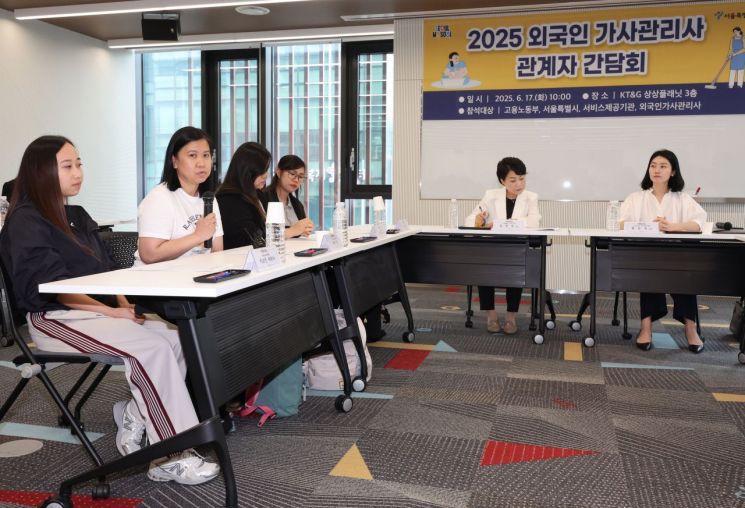
The foreign domestic worker pilot project is a program run by the Ministry of Employment and Labor that brings in foreign workers on E-9 (Employment Permit System) visas to work as domestic workers, assisting dual-income households with household chores and caregiving. The project began in September last year and was scheduled to transition into a full-scale project after ending in February this year, but no decision has been made, and the pilot period has simply been extended by one year.
When initially designing the project, the city argued for excluding the minimum wage requirement to ease the caregiving burden on user households. However, under the current system using E-9 visas, the minimum wage must be observed. Han explained, "Because the minimum wage applies to E-9 visa holders, it is difficult to achieve the original goal of reducing the caregiving cost burden, no matter how hard we try," adding, "We are considering how to address this issue."
As a solution, the city proposed integrating the government's public child care service. The public child care service dispatches caregivers to households with children under the age of 12 to ease the caregiving burden on dual-income families and others. The level of support, including costs, varies depending on household income. Kim Sunsoon, Director of the Seoul Metropolitan Government's Women and Family Policy Office, said, "If foreign domestic workers are included within the framework of the public child care service, I believe there will be no problem," adding, "With the new government now in office, I hope we can discuss and resolve such issues together."
Foreign Domestic Workers: "Satisfied with the Work"
This roundtable was held to gather feedback from the field after concerns were raised about foreign domestic workers working in poor labor conditions. Kim explained, "In connection with the Seoul Metropolitan Council's policy questions and debate session on June 12, we organized this event to hear directly from domestic workers about their difficulties," adding, "We will listen to the experiences of the domestic workers present today and immediately implement improvements if needed."
Previously, on June 12, a debate titled "Precarious Stay, Excluded Labor Rights: Voices of Filipino Caregivers" was held at the Seoul Metropolitan Council. Lim Miae, a joint researcher at the Seoul National University Asia Migration Center, presented findings from interviews with 21 Filipino caregivers, revealing issues such as being required to work as domestic workers, low wages, excessive workloads, and insufficient rest time.
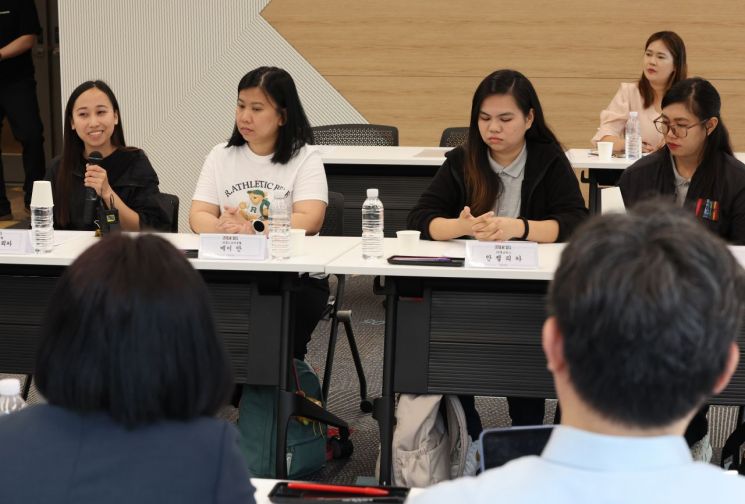
The four foreign domestic workers who attended the roundtable all expressed that their experience working as domestic workers in Korea has been positive. Mayan said, "Public transportation is convenient, the accommodation is safe and clean, and the families I work for are kind and respectful." Angelica said, "I started working in Korea last August and have not had a single bad experience. I work for two families, one in the morning and one in the afternoon. Each family has a different parenting style, but by accepting their way of raising children, I was able to adapt and develop a very comfortable relationship."
It was also positively noted that any issues between user households and domestic workers are communicated through the service provider rather than directly. Park Geolli said, "The agency always checks on how we are doing and whether we have any difficulties. If there is a problem, they always try to resolve it and communication is smooth."
However, difficulty communicating in Korean was identified as a problem. These workers mainly communicate in English with the parents and children of user households, but misunderstandings have occurred due to their lack of proficiency in Korean. Park Geolli said, "My colleagues also find communication challenging. Sometimes, because we do not fully understand, misunderstandings can occur or we may not grasp what is wanted."
User households have also reported high satisfaction. Jeon Changmin, CEO of the domestic worker service provider Hubris, said, "Existing domestic caregivers in Korea tend to be older, so it was difficult for them to play actively with the children. With the arrival of foreign domestic workers, there has been feedback that children are now more active and have a wider variety of play experiences."
© The Asia Business Daily(www.asiae.co.kr). All rights reserved.


















