The central and southern regions are expected to enter the monsoon season around June 20.
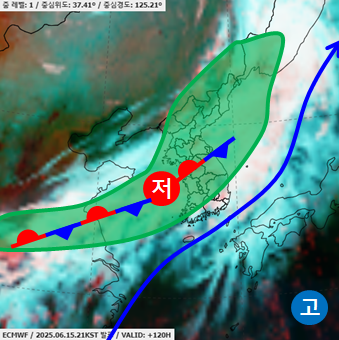
According to the Korea Meteorological Administration on June 17, as the North Pacific high-pressure system gradually expands its influence, hot and humid air from southern China is moving into Korea. Around June 20, the central and southern regions will come under the influence of a stationary front.
In the central region and North Jeolla, rain is expected to begin late in the afternoon or at night on June 19, due to the influence of a warm front formed ahead of a low-pressure system approaching from the west, accompanied by the stationary front. From June 20 to 21, heavy rainfall is forecast nationwide due to the influence of the stationary front.
However, the rain clouds formed along the stationary front are expected to be long from east to west but narrow from north to south. As a result, there may be significant variation in rainfall, with some areas experiencing heavy downpours while others receive only light drizzle.
If the monsoon begins on June 20, it will start five days earlier than average in the central region and three days earlier in the southern region, compared to the normal period from 1991 to 2020. The average monsoon onset dates for the central and southern regions are June 25 and June 23, respectively.
The Korea Meteorological Administration predicts that as a mesoscale low-pressure system develops along the stationary front, some areas could see enough rainfall to warrant a heavy rain warning. A heavy rain warning is issued when rainfall is expected to exceed 90mm in three hours or 180mm in twelve hours.
Mesoscale low-pressure systems strengthen the 'low-level jet' (a fast wind blowing in the lower atmosphere at an altitude of about 1.5 km), increasing the supply of water vapor and destabilizing the atmosphere, which can lead to heavy downpours and thunder and lightning. It is extremely difficult to predict the occurrence of mesoscale low-pressure systems.
In fact, last year, when mesoscale low-pressure systems frequently occurred along the stationary front during the monsoon season, there were large differences in rainfall between regions, making rainfall prediction less accurate. There were as many as 16 instances of extreme downpours with hourly rainfall exceeding 100mm.
The stationary front is expected to remain around Jeju and the southern coast from June 22 to 24, and then move northward again around June 25.
© The Asia Business Daily(www.asiae.co.kr). All rights reserved.

















