The Daegu Metropolitan Office of Education (Superintendent Kang Eunhee) announced on June 17 that it has established and will implement the "2025 Summer Heat Wave Countermeasures" to prevent heat-related illnesses and other heat wave damages among students and staff, and to ensure smooth educational activities. This decision follows the Korea Meteorological Administration's forecast that this summer's temperatures are likely to be higher than the average for previous years.
According to the Korea Meteorological Administration's analysis, the average summer temperature has risen by 0.8°C, from 23.7°C during the baseline period (1991?2020) to 24.5°C over the past decade (2015?2024). The onset of heat waves is also trending earlier, moving from July 11 in the 1990s to July 2 in recent years. Notably, last year recorded 30.1 days of heat waves, the second highest on record.
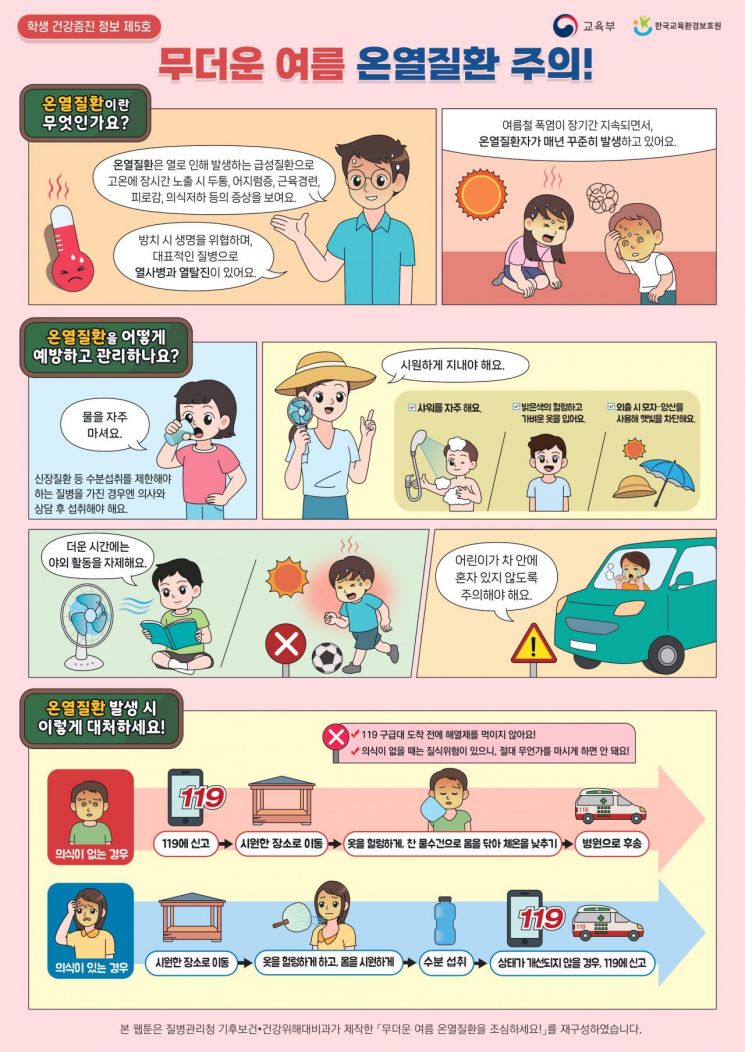
In response, the Daegu Metropolitan Office of Education has designated the period until September 30 as the heat wave response period. It will implement comprehensive measures centered on four key tasks: establishing and operating an emergency response team, strengthening student education on heat wave response, improving the educational environment, and flexibly adjusting and operating the academic calendar.
First, the Office will form a heat wave emergency response team led by the Director of Education and maintain a 24-hour emergency system. Each school will also organize an emergency response team of at least two members, including the vice principal, update emergency contact networks, and strengthen on-site response systems according to the disaster response safety management manual and the heat wave countermeasure implementation plan.
Second, to enhance students' ability to respond in emergencies, the Office will provide education on heat wave response guidelines through various means such as newsletters to families, health education, and school broadcasts. In addition, "heat wave" will be included in disaster safety education in accordance with the seven standard safety education guidelines for schools.
Third, to create a safe and comfortable educational environment, a total budget of 20.7 billion KRW will be invested to improve outdated heating and cooling facilities in 50 schools. The budget for school air conditioning will also be increased by 1.2 billion KRW from the previous year, totaling 31.1 billion KRW. Each school will conduct pre-inspections, cleaning, and disinfection of air conditioning facilities, and maintain a 5°C difference between indoor and outdoor temperatures to prevent air-conditioning-related illnesses among students and staff.
Fourth, in the event of a heat wave advisory, principals may decide to shorten classes or close schools. If a heat wave warning persists for more than one week, early summer vacation will also be actively considered, allowing for flexible adjustment of the academic calendar. Information related to academic calendar adjustments will be promptly communicated to parents and students via text messages and other means.
Additionally, to prevent food poisoning, thorough cleaning and disinfection of cafeteria facilities and equipment will be carried out. Real-time situation monitoring and reporting will be maintained through the disaster situation management system.
Kang Eunhee, Superintendent of Daegu Metropolitan Office of Education, stated, "This year, the average summer temperature is expected to be higher than usual, requiring even more thorough preparation. The Office of Education and all schools will work together to prioritize the safety and health of students and do our utmost to maintain a safe educational environment despite the heat wave."
© The Asia Business Daily(www.asiae.co.kr). All rights reserved.

















