On the 17th, the National Policy Planning Committee (NPPC) of the Lee Jaemyung administration held its steering committee meeting and officially began its activities, identifying "government organizational restructuring" as its top priority. This indicates an intention to decentralize the authority of government ministries such as the Ministry of Economy and Finance, the prosecution, and the Financial Services Commission.
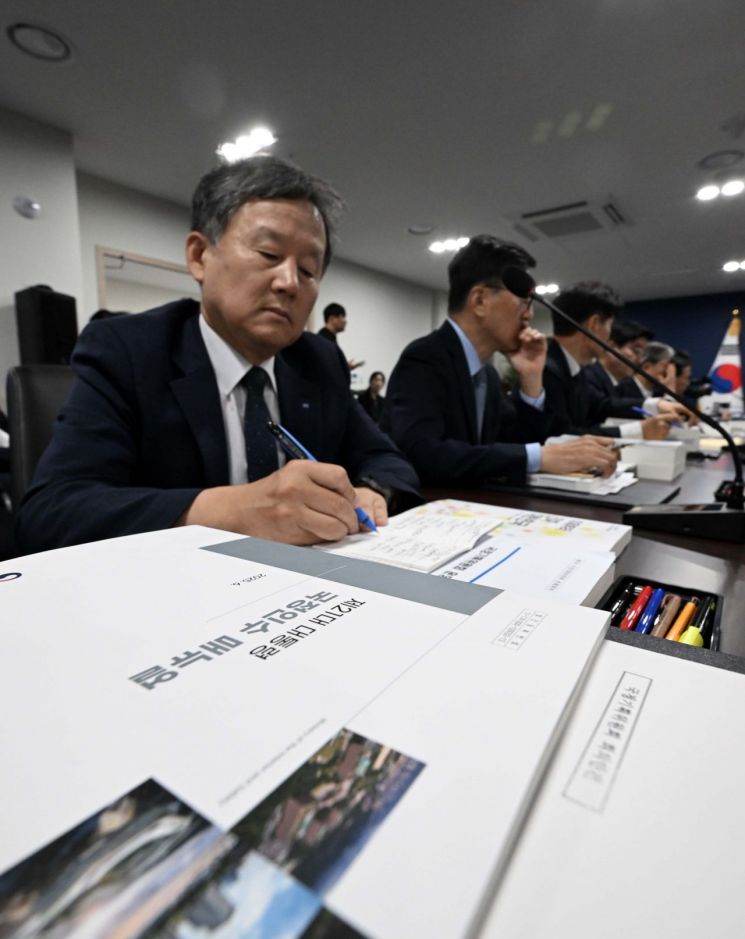 On the 16th, at the first plenary meeting of the National Policy Planning Committee held at the Changseong-dong Annex of the Government Seoul Office in Jongno-gu, Seoul, the '21st Presidential National Transition Manual' issued by the Ministry of the Interior and Safety was available. Photo by Yonhap News
Cho Seungrae, spokesperson for the NPPC, stated in a press briefing held at the Changseong-dong Annex of the Government Seoul Office the previous afternoon, "We will focus first and foremost on organizational restructuring in order to correct inefficient practices and strengthen the government's capabilities."
The direction of reforms for the Ministry of Economy and Finance and the Financial Services Commission is expected to be discussed in the NPPC's first economic subcommittee. Oh Gihyung, a Democratic Party lawmaker participating in the first economic subcommittee, has consistently advocated for splitting the budget formulation function of the Ministry of Economy and Finance into a "Ministry of Planning and Budget" and a "Ministry of Finance and Economy." Kim Eunhyeong, a professor at Hankuk University of Foreign Studies, is a leading proponent of dismantling the Financial Services Commission. The Democratic Party has been considering a plan to transfer the financial policy function of the Financial Services Commission to the Ministry of Economy and Finance, and then merge the remaining organization with the Financial Supervisory Service to create a "Financial Supervisory Commission."
For the political and administrative subcommittee handling prosecution reform, Im Eunjung, a senior prosecutor known for her strong stance on prosecution reform, and Ryu Samyoung, a former senior superintendent, have joined as expert members. They are expected to play a key role in institutionalizing prosecution reform, including the complete separation of investigation and indictment functions within the prosecution and the establishment of a new "Public Prosecution Office."
The NPPC plans to visit the Government Sejong Complex from the 18th to the 20th to receive departmental briefings from each ministry and formulate concrete implementation plans.
Although the NPPC intends to discuss organizational restructuring swiftly, there is a heightened sense of caution regarding security, given the strong internal resistance within individual organizations. The committee has also decided to minimize contact between subcommittee members, expert members, and the media as much as possible.
It has been confirmed that committee members who attended the NPPC's inauguration ceremony, appointment ceremony, and plenary meeting the previous day signed a confidentiality agreement pledging not to disclose matters discussed within the committee to outsiders. Many of these members displayed caution when approached by reporters on site, saying, "I cannot give you my business card," or "I cannot take your call."
In a briefing the previous afternoon, spokesperson Cho Seungrae stated, "There have been cases where individual opinions of committee members are reported as if they are finalized decisions, which causes confusion when matters that have not been decided are made public. The problem is that this confuses the public." He emphasized that all communication with the media would be centralized through the spokesperson.
© The Asia Business Daily(www.asiae.co.kr). All rights reserved.

















