Refusal to Call for "Diplomatic Resolution"
Cancels Remaining G7 Schedule and Returns Home
Iran Willing to Resume Talks If U.S. Abstains from Attacks
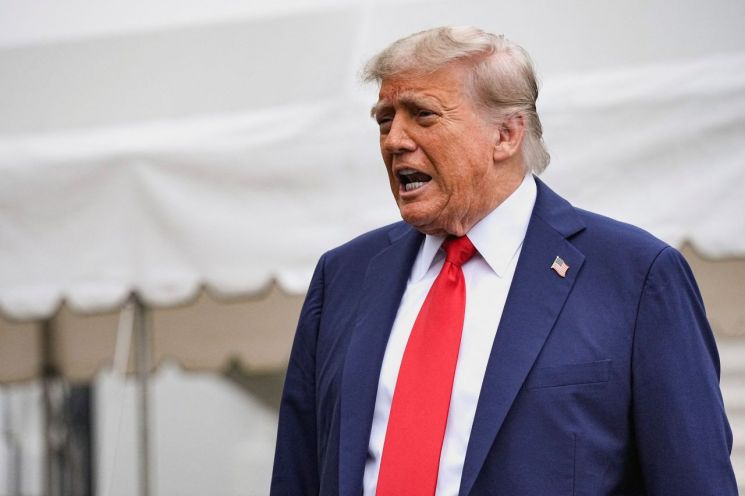 Donald Trump, President of the United States, is holding a Q&A session with reporters at the White House before departing for Canada on the 15th to attend the G7 Summit. Photo by Reuters Yonhap News
The war that began with Israel's preemptive strike on Iranian nuclear facilities in the early morning of June 13 (local time) is now escalating under the tacit approval of the Trump administration in the United States. President Donald Trump, who should be mediating the conflict, has instead positioned himself as a supporter of Israeli Prime Minister Benjamin Netanyahu, citing the cause of "Iranian denuclearization."
President Trump not only refused to adopt a joint statement from the Group of Seven (G7) calling for a "diplomatic resolution" to the Middle East crisis, but also returned to the United States early, citing the need to respond to the situation, creating discord with the international community. Under the close cooperation between the United States and Israel, Iran, now cornered, expressed its willingness to "return to the negotiating table" on the condition that the United States does not participate in Israel's attacks against Iran. It is estimated that the death toll in both countries exceeded 1,900 within the first three days of the conflict.
While attending the G7 Summit in Canada, President Trump wrote on the social media platform Truth Social on June 16, "Iran should have signed the agreement I told them to sign. What a shame, and what a waste of lives," adding, "I have repeatedly said that Iran must never have even a single nuclear weapon." He then wrote, "Everyone must leave Tehran immediately," without specifying the intended recipients. President Trump's remarks are interpreted as an attempt to observe or increase pressure on the conflict, rather than to mediate or resolve it.
President Trump has consistently maintained a stance that appears to encourage the war. At a joint press conference with Canadian Prime Minister Mark Carney, the host of the G7 Summit, he made overtly pro-Israel statements such as "Israel is doing well" and "We gave Iran a 60-day grace period." According to The New York Times (NYT), he subsequently rejected a joint G7 statement calling for "de-escalation" and a diplomatic resolution between the two countries. President Trump also engaged in unexpected actions, such as returning to the United States without completing the remainder of the G7 Summit schedule. As a result, important events, including a summit meeting with President Lee Jaemyung, were canceled.
The day before, President Trump had shown a passive attitude toward the Middle East conflict, stating that Iran and Israel "should resolve the issue by fighting if necessary." Even before departing the White House, he urged both sides to negotiate but also said, "Sometimes countries have to fight first," thus fueling the conflict rather than mediating it. Editorials in outlets such as the Financial Times (FT) have recently called for the United States to take a more active role in mediating the war.
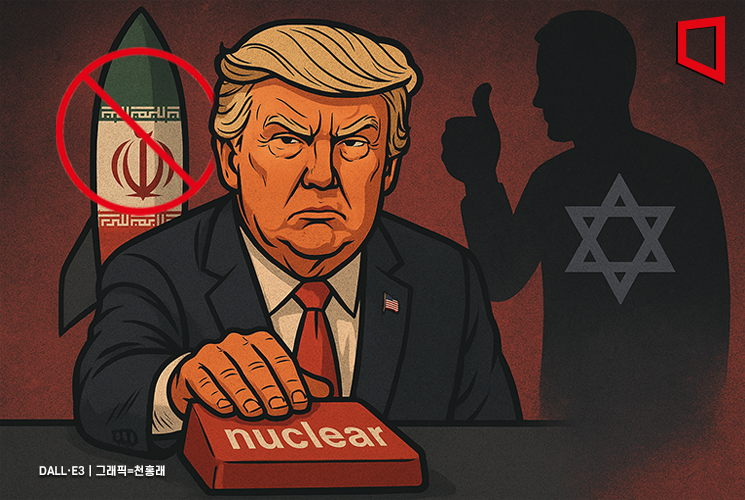
With the United States as its backer, Israel is intensifying its offensive against Iran. Prime Minister Netanyahu stated in a virtual press conference that "Iranians have realized that their regime is much weaker than they thought," adding, "Realizing this could lead to consequences." In an interview with ABC, he also expressed his intention to remove Iran's Supreme Leader Ayatollah Seyyed Ali Khamenei, emphasizing that "(this) would end the conflict."
In line with such statements, the Trump administration is strengthening military readiness for national defense and support for Israel. According to AFP, the United States is concentrating its military power by deploying additional aircraft carriers and aerial refueling tankers to the Middle East.
The U.S. pressure appears to have had some effect. According to The Wall Street Journal (WSJ), Iran urgently sent signals through a third country to Israel and the United States that it wants a halt to mutual attacks and a resumption of nuclear negotiations. WSJ reported that Iranian officials told Arab government officials that Iran would be open to returning to the negotiating table with the United States, provided that the U.S. does not participate in Israel's attacks against Iran. Concerns that the United States could support attacks on Iran's underground nuclear facilities with advanced weaponry in the future appear to be a factor pressuring Iran.
There are also concerns that if the United States does not respond to nuclear negotiations, the Israel-Iran military conflict could escalate further. According to WSJ, Iranian officials told Arab officials that if the prospect of resuming negotiations with the United States does not materialize, Iran may accelerate its nuclear program and move toward escalation. The United States and Iran had originally planned to hold a sixth round of nuclear talks in Oman on June 15, but the negotiations ultimately collapsed after Israel launched airstrikes on Iranian nuclear facilities beforehand.
Meanwhile, the human toll in both countries is rising exponentially due to the war. According to Iran's Ministry of Health, as of June 15, 224 people had been killed and 1,277 wounded since Israel's attacks began. The Iranian Ministry of Health stated that more than 90% of the casualties were civilians. In Israel, 14 people were killed and 390 injured after Iran's large-scale airstrikes penetrated the Iron Dome defense system.
© The Asia Business Daily(www.asiae.co.kr). All rights reserved.
![Clutching a Stolen Dior Bag, Saying "I Hate Being Poor but Real"... The Grotesque Con of a "Human Knockoff" [Slate]](https://cwcontent.asiae.co.kr/asiaresize/183/2026021902243444107_1771435474.jpg)

















