[Emergency Check on Housing Prices]
Proportion of Transactions at Higher Prices Rose in 24 Districts Last Month
The upward trend in housing prices, which began in the Gangnam area of Seoul, is now spreading to most regions of the city. Since the Seoul Metropolitan Government lifted the land transaction permit zone designation in February this year, transactions in the three Gangnam districts have increased, and the price surge has extended to the Geumgwan-gu area (Geumcheon, Gwanak, and Guro districts).
Housing prices have risen sharply as last-minute demand to purchase homes before the implementation of stricter lending regulations in the second half of this year has intensified. Analysts note that, in the absence of clear real estate policy direction from the new administration, the government’s prioritization of economic stimulus has contributed to establishing a sustained upward trend in housing prices.
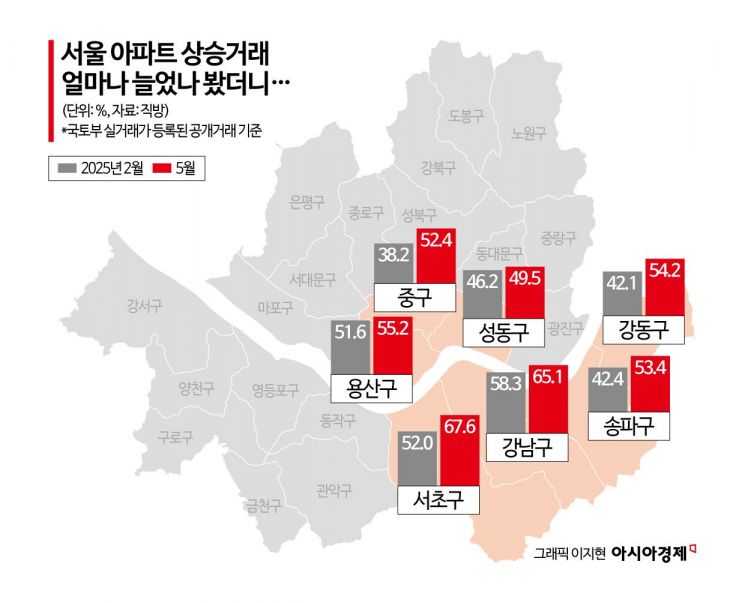
According to an analysis released on the 17th by Zigbang, a real estate information provider, based on transaction data from the Ministry of Land, Infrastructure and Transport, 24 out of 25 districts in Seoul?excluding Nowon District?saw more transactions at higher prices last month compared to previous deals. In 11 of the 25 districts, more than half of the transactions were at increased prices as of last month.
As recently as February, when the Seoul Metropolitan Government abruptly lifted the land transaction permit zone designation, only about 17 out of the 25 districts saw more transactions at higher prices. The company calculated these figures by analyzing, over the past year, sales transactions of identical unit sizes within the same complexes, where at least two transactions were reported, and categorizing them as rising, stable, or falling.
In the three Gangnam districts and Yongsan District, which are leading the rise in Seoul housing prices, the proportion of transactions at higher prices increased by 20 to 40 percentage points compared to transactions at lower prices. In Gangnam District, 65.1% of transactions last month were at higher prices, more than three times the proportion of transactions at lower prices (20.9%). In Seocho District, transactions at higher prices accounted for 67.6%, exceeding one-third of all transactions.
Even in areas not directly affected by the lifting or re-designation of the land transaction permit zone, price increases have become more pronounced. In Gwanak, Geumcheon, Dongdaemun, Seongbuk, Jongno, Jung, and Jungnang districts, the number of transactions at lower prices was higher or similar to those at higher prices as recently as February. However, last month, transactions at higher prices became more prevalent.
The market views the restriction of transactions in highly sought-after areas due to the land transaction permit zone as causing demand to spill over into adjacent districts. Additionally, there is a psychological effect prompting buyers to rush contracts in anticipation of a reduced loan limit when the third phase of the stress DSR (Debt Service Ratio) is implemented next month.
In response to these concerning trends in Seoul’s housing prices, the government held a real estate market monitoring task force meeting on June 12, chaired by First Vice Minister Lee Hyungil, who is serving as Acting Minister of Economy and Finance. The government stated that it will consider all available policy measures. However, President Lee Jaemyung has previously expressed a negative stance on implementing artificial demand-suppression policies during his presidential campaign.
© The Asia Business Daily(www.asiae.co.kr). All rights reserved.


















