Nationwide Index Rises by 3.9 Points on Hopes of Economic Recovery
Concerns Over Weakened Demand in the Seoul Metropolitan Area Due to July Phase 3 DSR Implementation
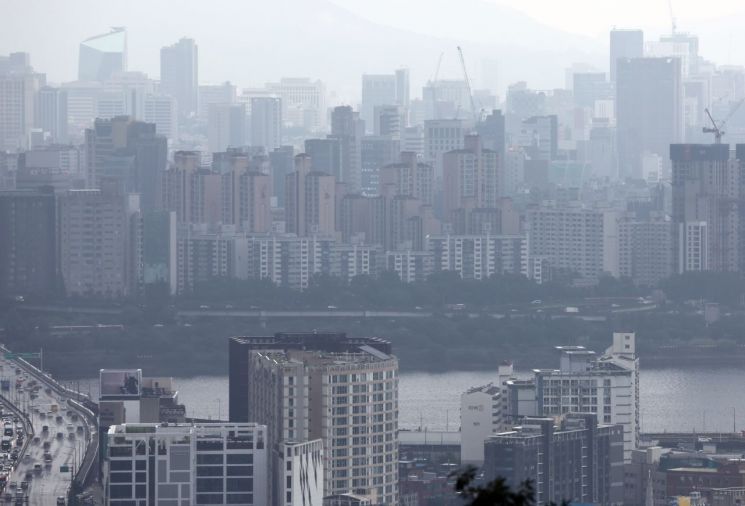
Driven by expectations for economic recovery, the nationwide housing business outlook index in June showed an upward trend. However, in the Seoul metropolitan area, the outlook declined, influenced by the upcoming implementation of the phase 3 stress Debt Service Ratio (DSR) regulations.
According to the Housing Industry Research Institute (HIRI) on June 17, the June Housing Business Outlook Index, based on a survey of housing business operators, was 93.5, up 3.9 points from the previous month. The index had dropped to 61.6 in January this year before rebounding and has now risen for five consecutive months. When the Housing Business Outlook Index exceeds the baseline of 100, it indicates that a greater proportion of companies expect the housing business environment to improve.
In contrast to the nationwide rise, the outlook index for the Seoul metropolitan area fell by 6.1 points to 98.3. HIRI explained, "Concerns over weakened housing demand have grown due to the confirmed introduction of phase 3 stress DSR regulations for the metropolitan area in July. In addition, except for some key areas such as Gwacheon and Bundang, a clear recovery trend has not yet appeared." HIRI further stated, "In outlying areas such as Pyeongtaek, Yangju, and Icheon, unsold units after completion have only been partially resolved, so overall, business sentiment in the metropolitan area appears somewhat subdued."
Within the metropolitan area, Seoul fell by 10.4 points (from 116.6 to 106.2), Gyeonggi by 7.2 points (from 100.0 to 92.8), and Incheon by 0.8 points (from 96.6 to 95.8). In Seoul, the index is still expected to remain above the baseline of 100, as mortgage rates have entered the 3% range and demand for so-called "smart single-unit" properties has become concentrated in Seoul, positively influencing business sentiment.

However, even within Seoul, a sharp rise in transaction prices was first observed in preferred areas such as Gangnam, Seocho, Songpa, and Yongsan, then spread to areas like Mapo and Seongdong, which benefited from the land transaction permit system, and more recently, demand has gradually expanded to regions such as Nowon and Seongbuk. HIRI noted, "Demand is still concentrated in certain areas and is only gradually spreading, so it is difficult to say that prices are rising evenly across all of Seoul. The pace and trend of the increase also differ by region, which is why this month's index saw a slight decline. However, with the resolution of political uncertainties following the inauguration of the new government and growing expectations for economic recovery, there is a high possibility of improvement going forward."
Outside the metropolitan area, the outlook index rose by 6.1 points to 92.5. For major cities, the index is expected to rise by 3.7 points, and for provincial regions by 7.8 points. Among major cities, Daejeon is projected to rise by 31.9 points, Ulsan by 13.4 points, while Gwangju is expected to fall by 14.1 points and Busan by 13.0 points. Among provincial regions, North Gyeongsang is expected to rise by 30.8 points, South Jeolla by 22.2 points, and Gangwon by 13.3 points, while North Chungcheong is expected to fall by 12.5 points, and South Gyeongsang and North Jeolla by 2.8 points each.
Although the housing business outlook index for non-metropolitan areas increased, the gap between the metropolitan and non-metropolitan regions is widening. HIRI stated, "Recently, demand from end-users without homes or with only one home has become concentrated in the Gangnam area of Seoul and central metropolitan regions, further deepening the polarization between the metropolitan and non-metropolitan areas, and local housing markets are increasingly neglected. Most of the so-called 'toxic unsold units'?unsold after completion?are located in non-metropolitan areas, so the backlog of unsold homes in the provinces remains a serious issue."
Meanwhile, this month's national financing index rose by 1.0 point from the previous month to 80.3, and the materials supply index is also expected to rise by 1.7 points to 97.9.
© The Asia Business Daily(www.asiae.co.kr). All rights reserved.
![Clutching a Stolen Dior Bag, Saying "I Hate Being Poor but Real"... The Grotesque Con of a "Human Knockoff" [Slate]](https://cwcontent.asiae.co.kr/asiaresize/183/2026021902243444107_1771435474.jpg)

















