A smart window technology that allows users to control the amount of light and heat transmitted through windows has been developed. This technology is expected to help reduce heating and cooling energy consumption in urban buildings and address the issue of light pollution in cities.
KAIST announced on the 17th that the research team led by Professor Hongchul Moon from the Department of Chemical and Biomolecular Engineering has developed a "smart window technology (Reversible Electrodeposition and Electrochromic Mirror, hereafter RECM)" that can adjust the amount of light and heat entering through windows according to user preference, effectively offsetting external light pollution.
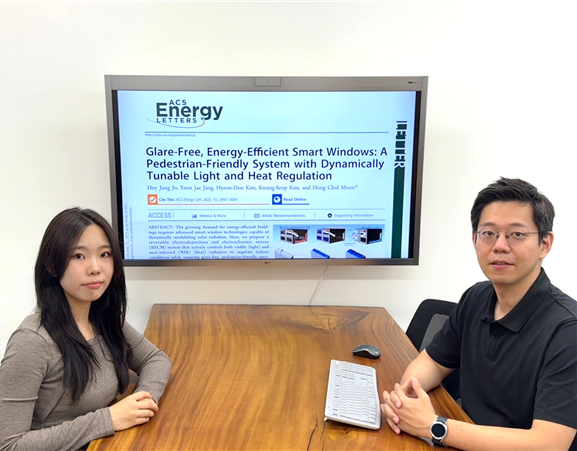
RECM is a smart window system based on a single-structure electrochromic device, which can actively control the transmittance of visible light and near-infrared radiation (heat). An electrochromic device is a device whose optical properties change in response to electrical signals.
In particular, the research team implemented a "pedestrian-friendly smart window" suitable for building exteriors by suppressing glare caused by external reflected light?a problem identified in conventional metal-deposition smart windows?through the application of electrochromic materials.
The RECM system operates in three modes depending on voltage control.
Mode I (transparent mode) allows both light and heat to pass through like regular glass, making it advantageous for letting sunlight indoors during winter.
Mode II (electrochromic mode) forms chemical species such as Prussian Blue (PB, an electrochromic material that switches between colorless and blue depending on electrical stimulation via a redox reaction) and DHV+ (a radical-state chromophore generated by electrical stimulation), turning the window a deep blue. In this state, light is absorbed and only a portion of heat is transmitted, enabling both privacy protection and appropriate indoor temperature control.
Mode III (electrochromic and deposition mode) involves the reduction and deposition of silver (Ag+) ions on the electrode surface, reflecting both light and heat. At the same time, the electrochromic material absorbs the reflected light, effectively blocking glare for pedestrians outside.
The research team conducted experiments using a miniature model house to verify the actual indoor temperature reduction effect of the RECM technology.
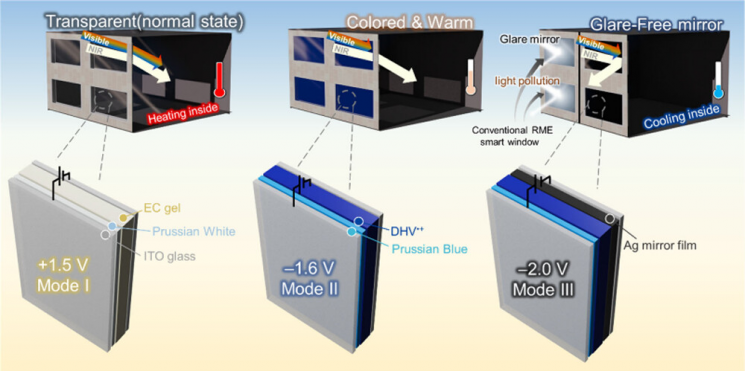
According to the research team, when a regular glass window was used in the experiment, the indoor temperature rose to 58.7°C within 45 minutes. However, when RECM Mode III was applied, the temperature reached only 31.5°C in the same period, demonstrating a temperature difference of approximately 27.2°C.
Above all, RECM technology is regarded as a representative "active smart technology" because it allows functional switching according to external conditions using only electrical signals, enabling immediate response to changes in season, time, or usage purpose.
Professor Hongchul Moon stated, "This study is significant in that it presents a smart window platform that goes beyond conventional smart window technologies limited to visible light control, enabling both active indoor thermal management and pedestrian visual safety. We expect that RECM technology will be applied in various fields such as urban buildings, vehicles, and trains in the future."
This research was supported by the Nano and Material Technology Development Program (Nano Connect) of the National Research Foundation of Korea and the Basic Project of the Korea Institute of Machinery and Materials. The research paper was published on the 13th in the international energy journal 'ACS Energy Letters.'
© The Asia Business Daily(www.asiae.co.kr). All rights reserved.


















