Torben M. Andersen, Chairman of the Greenland Economic Committee
Local Briefing on the 'Greenland Economic Report'
"We Must Question Whether Economic Extraction Is Actually Feasible"
"The development of just one or two small-scale mines cannot lead to Greenland's economic self-sufficiency. Infrastructure such as roads, ports, and airports is practically necessary, and building these requires a tremendous amount of time and cost."
The Export-Import Bank of the United States is currently considering providing loans for rare earth mining projects in Greenland. Torben M. Andersen, Chairman of the Greenland Economic Committee (Professor at Aarhus University), stated at a press conference for the release of the 'Greenland Economic Report' held at the International Press Center (IPC) in Copenhagen, Denmark, on the 16th (local time), "Even if mines are developed and mining operations begin in Greenland right away, there is a lack of infrastructure and labor to transport the resources." He emphasized that mine development would not significantly contribute to economic self-sufficiency.
 Torben M. Andersen, Chairman of the Greenland Economic Committee (Professor at Aarhus University), is presenting the 'Greenland Economic Report' at the International Press Center in Copenhagen, Denmark, on the 16th (local time). Photo by Hyunju Lee
Chairman Andersen is an expert in Nordic welfare model economics, public economics, and pension economics. He has served as a policy advisor not only in Denmark and Greenland but also to the European Union (EU) Commission, the World Bank, and the Organisation for Economic Co-operation and Development (OECD). Currently, he serves not only as Chairman of the Greenland Economic Committee Board but also as Chairman of the Danish Pension Fund Board and as a member of the Faroe Islands Systemic Risk Committee and the Danish Economic Council Board.
In the report, Chairman Andersen stated, "According to maps provided by the Geological Survey of Greenland, almost every imaginable type of mineral is distributed somewhere in Greenland." He added, "While this is theoretically promising, the next step is to determine whether economic extraction is actually feasible." He continued, "In some regions, port access is difficult year-round due to climate issues," and stressed, "Ultimately, all of this must be considered in light of the very high costs involved."
Chairman Andersen also expressed a negative outlook on the prospect of Greenland achieving economic self-sufficiency through the mining industry. He said, "Contrary to some claims, mining has not been blocked; it has been open for decades." He explained, "However, in recent years, there has been almost no actual mining activity. The reason is the lack of business viability." He added, "A gold mine in southern Greenland is also scheduled to open, but its scale is very small," and noted, "It will take considerable time before large-scale mining becomes possible."
Research on methods for Greenland's economic self-sufficiency has recently become active, coinciding with the issue of Greenlandic independence. Of the government's revenue of approximately 14 billion Danish kroner (about 2.95 trillion won), 8 billion kroner (1.68 trillion won) is covered by taxes and other sources. 4.1 billion kroner (864 billion won) is provided as a block grant from the Danish government, meaning that Danish financial support still accounts for a significant portion of Greenland's economy.
According to the report, Greenland has traditionally maintained its economic strength through the fishing industry. In recent years, GDP has increased due to expanded fishing, but because the economy relies solely on fisheries, the outlook for future growth remains negative. Chairman Andersen said, "Too many people are engaged in fishing relative to the available fish species," and emphasized, "From the perspectives of efficiency and resource management, it is necessary to reduce the number of people working in fisheries and transition them to other jobs."
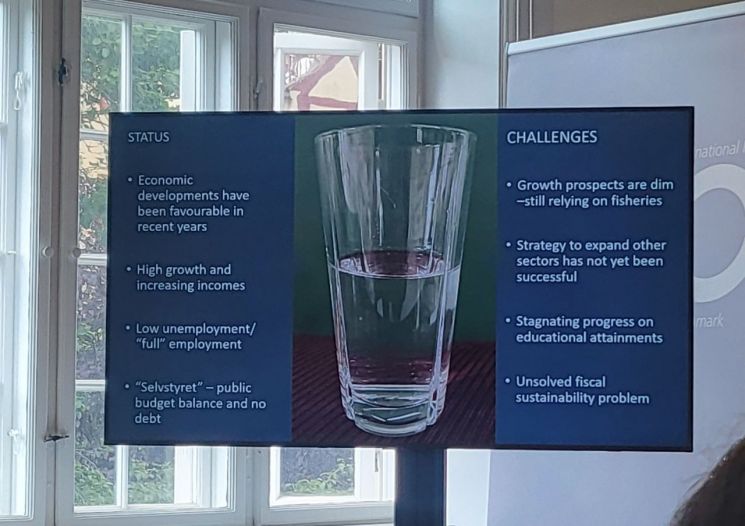 Andersen, Chairman of the Greenland Economic Committee, compared Greenland's current economic situation to a glass half-filled with water. Photo by Lee Hyunju
A negative outlook was also presented regarding the workforce. Chairman Andersen pointed out, "A unique feature of Greenland's workforce is that a considerable number of people are uneducated," and added, "These individuals show a significantly low employment rate." He explained, "The problem of labor shortages stems from the fact that many people are unqualified, that is, they have not received proper education," and addressed Greenland's geographic and demographic characteristics. In some small schools, especially those outside urban areas, it is difficult to hire qualified teachers.
Chairman Andersen warned, "In the future, the number of young people in Greenland will decrease while the elderly population will increase. If we add the issue of education levels to this, the problem becomes even more serious." He stated, "The proportion of people who have received education beyond compulsory schooling has steadily increased, but recently appears to have stagnated," and explained, "Currently, about 50% of the population does not receive education beyond the compulsory level."
Chairman Andersen identified the tourism industry as a potential comparative advantage for Greenland. He said, "A new airport is scheduled to open next year, and accessibility has certainly improved," adding, "This is a completely new situation, and there will be further growth in the region going forward." However, he also noted, "It will take some time to build infrastructure such as hotel accommodation capacity and a variety of activities."
© The Asia Business Daily(www.asiae.co.kr). All rights reserved.
![Clutching a Stolen Dior Bag, Saying "I Hate Being Poor but Real"... The Grotesque Con of a "Human Knockoff" [Slate]](https://cwcontent.asiae.co.kr/asiaresize/183/2026021902243444107_1771435474.jpg)












