Dr. Seungkeun Yu's Team at KERI Develops Core-Shell Structured Composite Particle Synthesis Technology Using Dry Process
Published in the Prestigious Journal "Advanced Materials"
Anticipated Industrial Applications in Battery Materials and More
Dr. Seungkeun Yu's team at the Insulating Materials Research Center of the Korea Electrotechnology Research Institute (KERI) has developed a groundbreaking "composite particle synthesis technology" that enables the attachment of inorganic nanoparticles to the surface of polymer microparticles through simple mechanical collisions.
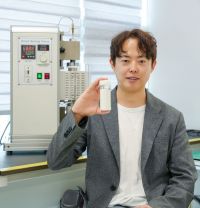 Dr. Seungkeun Yu, KERI.
The "composite particle synthesis technology," which combines functional inorganic nanoparticles with polymer microparticles, is widely used across various industrial fields, including battery electrode materials, catalyst systems, pharmaceuticals and biotechnology, semiconductor packaging, and insulating materials for power equipment.
In this process, the combination of materials has typically relied on wet chemical processes, which have posed numerous issues: the complexity and added costs of multi-step procedures, environmental problems arising from solvent use, and limitations in surface functionalization technologies needed to induce chemical bonding between different materials.
Inspired by the craters formed on the moon due to asteroid impacts, Dr. Seungkeun Yu adopted a method that physically and mechanically collides particles. Specifically, the surface of the polymer microparticle serves as the core, with inorganic nanoparticles individually attached to form a shell-like structure enveloping the core.
Although the principle appears simple, actual implementation was extremely challenging. For nanoparticles to stably adhere to the surface of polymer microparticles, various factors had to be considered in combination, including the size ratio between particles, collision velocity and rotational energy, as well as surface energy and roughness. By precisely controlling these conditions, KERI established optimal synthesis parameters by experimenting with dozens of inorganic nanoparticles and polymer microparticles of different sizes and properties, and succeeded in elucidating the physical adhesion mechanism for the first time in the world.
Moreover, the research team developed techniques to quantitatively analyze the degree of nanoparticle attachment, surface coverage, and interfacial bonding stability, as well as to evaluate thermal, mechanical, and chemical durability. As a result, they were able to produce multifunctional, highly reliable composite particles that withstand various environments and simultaneously exhibit magnetic, photocatalytic, and adsorption properties.
The excellence of this research has been recognized with its selection for the "Inside Front Cover" of "Advanced Materials," one of the world's top journals in materials science. The journal's Impact Factor is 27.4, placing it in the top 1.9% of its field.
Dr. Seungkeun Yu stated, "In this environmentally friendly dry process, which does not use any solvents, we can easily combine the required materials like toy blocks, making it advantageous for mass production and commercialization. The range of materials that can be attached is extremely broad, and the process is simple and highly reproducible, so the barrier to industrial adoption is very low."
KERI aims to further optimize the material synthesis process through ongoing research. The institute also plans to identify companies interested in the technology and pursue commercialization through technology transfer.
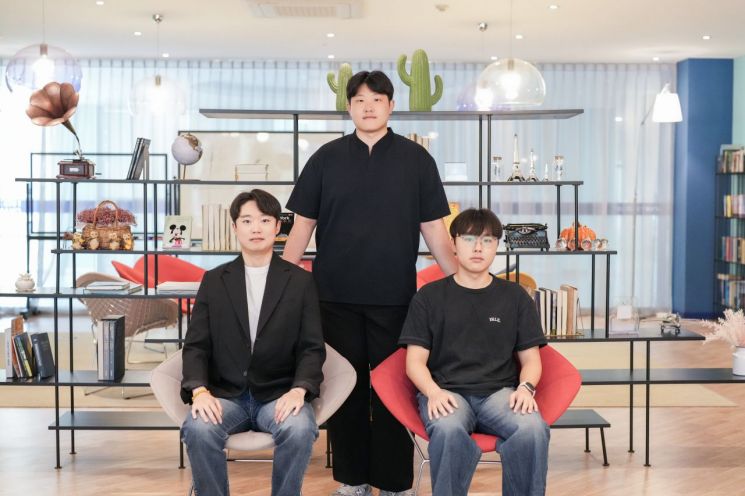 Research team (from left) Jungwook Hwang, Researcher (First author), Jinhoon Lee, PhD, Geonho Lee, Researcher (First author). Provided by UNIST
KERI is a government-funded research institute under the National Research Council of Science and Technology, Ministry of Science and ICT. This research was carried out as part of KERI's core projects, in collaboration with Professor Dongwook Lee's team at UNIST, Dr. Seungnyeol Jeon's team at KIST, and Professor Shu Yang's team at the University of Pennsylvania.
© The Asia Business Daily(www.asiae.co.kr). All rights reserved.

















