Nine Nuclear-Armed States Estimated to Hold 12,241 Warheads
Stockholm International Peace Research Institute Releases Yearbook
"Decline in Number of Nuclear Warheads Could Reverse Within Years"
An analysis has found that as nuclear-armed countries around the world race to strengthen their nuclear capabilities, the risks associated with nuclear weapons are increasing. While Russia and the United States together possess 90% of the world's total nuclear warheads, China has been observed accelerating its nuclear armament by adding 100 warheads each year since 2023. North Korea, which currently holds 50 nuclear warheads, is also reportedly preparing to increase its arsenal to 90 warheads.
"Nuclear-Armed States Continued Nuclear Modernization Last Year"
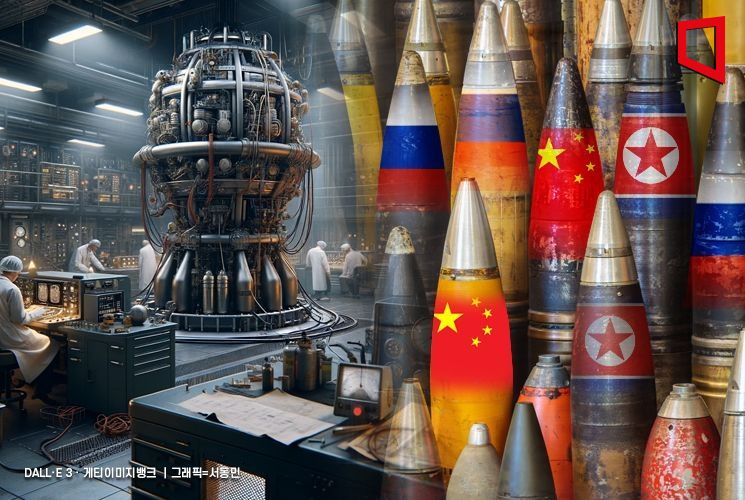
The Stockholm International Peace Research Institute (SIPRI) estimated in its 2025 Yearbook, published on June 16 (local time), that as of January this year, the global stockpile of nuclear warheads stood at 12,241.
Of these, 2,627 are retired warheads, leaving a total of 9,614 warheads that are actually available for use. Of these, 3,912 warheads are deployed on missiles or bombers, while 5,702 are stored in stockpiles. Retired warheads are distinct from dismantled warheads; they have been withdrawn from operational deployment but have not yet been fully dismantled.
SIPRI stated, "Almost all of the nine nuclear-armed states continued intensive nuclear modernization programs in 2024, upgrading existing weapons and adding new versions." The institute warned, "As the pace of reductions slows and the deployment of new nuclear weapons accelerates, the long-standing trend of declining global nuclear warhead numbers since the end of the Cold War is likely to reverse within the next few years."
"China's ICBM Numbers Could Match U.S. by Late 2020s"
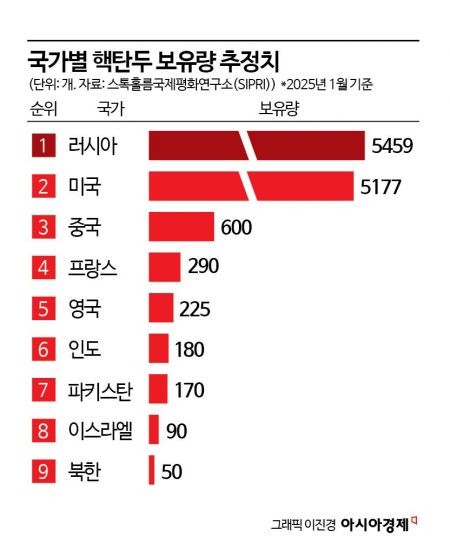
By country, the United States and Russia possess 5,177 and 5,459 nuclear warheads respectively, accounting for about 90% of the total. They are followed by China (600), France (290), the United Kingdom (225), India (180), Pakistan (170), and Israel (90). SIPRI also estimated that North Korea possesses 50 nuclear warheads.
China, in particular, has been assessed as the fastest-growing nuclear power, producing more than 100 additional warheads each year since 2023. SIPRI noted, "Depending on how China structures its military forces, it is possible that by the end of the 2020s, China will possess at least as many intercontinental ballistic missiles (ICBMs) as Russia or the United States."
North Korea is also considered likely to increase its arsenal to as many as 90 warheads. SIPRI explained, "North Korea continues to prioritize its military nuclear program as a central element of its national security strategy," and added, "It is estimated to have assembled about 50 nuclear warheads and possesses enough fissile material to produce up to 40 more, while accelerating its production of fissile material." The institute further noted, "This has fueled debate in South Korea about the possibility of acquiring nuclear weapons in response to North Korea's threat, heightening concerns about nuclear proliferation."
In the United States, there are calls to redeploy nuclear weapons currently in storage and to secure new delivery systems in response to China's growing nuclear capabilities. Signs of nuclear modernization have also been observed in Russia. The United Kingdom, France, India, and Pakistan are also expected to seek long-term increases in their nuclear arsenals. SIPRI pointed out that Israel appears to be modernizing its nuclear forces as well, having conducted what is believed to be a propulsion system test related to nuclear-capable ballistic missiles in 2024 and upgrading the plutonium production reactor at Dimona.
Dan Smith, Director of SIPRI, warned, "There are signs of a new nuclear arms race that is much more dangerous and uncertain than those of the past," adding that the emergence of technologies such as artificial intelligence (AI), which can accelerate decision-making in crisis situations, is increasing the risk of accidental nuclear war due to misunderstandings or communication failures.
He stated, "Assessing who is ahead in the arms race will become much more ambiguous and unclear than in the past," and added, "In this context, the existing formula for arms control based on numbers will no longer be sufficient."
© The Asia Business Daily(www.asiae.co.kr). All rights reserved.
![Clutching a Stolen Dior Bag, Saying "I Hate Being Poor but Real"... The Grotesque Con of a "Human Knockoff" [Slate]](https://cwcontent.asiae.co.kr/asiaresize/183/2026021902243444107_1771435474.jpg)












