Operation Rate at 79.2%... Number of Trips at 66.8%
Songjeong 19 and Ilgok 38 Running at 'Half the Usual Level'
City Deploys Six Temporary Buses to Routes 01 and 37
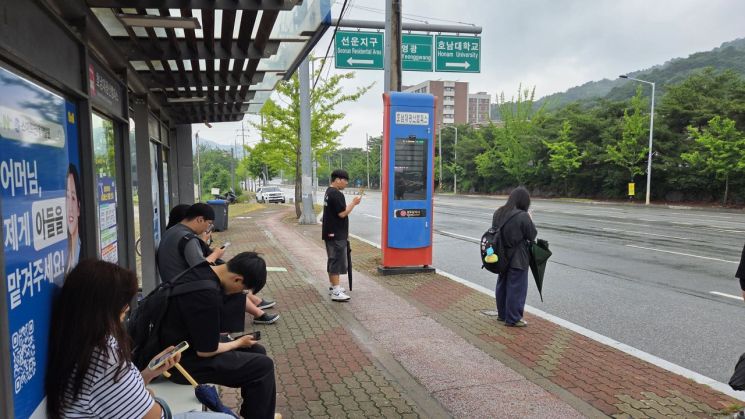 On the morning of the 16th, the 9th day of the Gwangju city bus union strike, citizens are waiting for buses such as Bongseon 37 at the bus stop in front of the main gate of Honam University in Gwangsan-gu, Gwangju. Photo by Min Chanki
On the 16th, the ninth day of the Gwangju city bus union strike, some city bus routes were operating at less than half their usual capacity, causing increasing inconvenience for citizens.
The Gwangju city government is making every effort to alleviate these inconveniences for citizens, including deploying six temporary shuttle buses to routes where the operation rate has dropped sharply.
According to the city of Gwangju on the 16th, 792 out of 1,000 city buses were in operation that day, resulting in an operation rate of 79.2%. The number of trips made was 5,620, which is 66.8% of the usual 8,402 trips.
Due to the impact of the city bus union members' strike, some routes are operating at less than half their normal capacity. For example, on Songjeong 19 and Ilgok 38, 6 out of 16 buses are running; on Unnim 50, 6 out of 12; on Munheung 53, 3 out of 5; and on Songjeong 98, 10 out of 22. Routes with relatively high passenger demand are experiencing more disruptions as more drivers on those lines are participating in the strike.
In response, the city deployed six temporary shuttle buses to "Suhwan 01" and "Bongseon 37" on this day. For Suhwan 01, more buses than usual were deployed, but since there are many passengers and the overall number of trips has decreased, two temporary shuttle buses were added. For Bongseon 37, four additional buses were added because there were no alternative routes serving the Seonun district area.
The city has secured a total of 60 chartered buses to be deployed across 20 routes. The plan is to flexibly deploy these chartered buses to routes where the operation rate drops sharply. In addition, the city has increased subway operations by 12 trips and is concentrating taxi dispatch at bus stops with high passenger traffic.
Previously, the Gwangju city bus union demanded an 8.2% increase in base pay and an extension of the retirement age to 65, but after failing to reach an agreement with management, launched a general strike on the 5th.
The union temporarily suspended the strike and kept negotiation channels open for three days during the Memorial Day holiday, but as labor and management remained at an impasse, the strike resumed on the 9th.
Post-strike mediation between labor and management took place on the 13th. Management proposed a 2.5% wage increase, and the local labor relations commission suggested a 3% compromise, but the union insisted on a 5% increase, resulting in a breakdown in negotiations. Currently, there is no official schedule for further negotiations between labor and management.
Meanwhile, at an emergency session of the city council's regular meeting held that morning, Park Pilsun, a Gwangju city council member (Gwangsan-gu 3, Democratic Party), urged, "The Gwangju city government should not hide behind a neutral administration, but instead step into the center of the conflict and play the role of mediator."
In response, Mayor Kang Gijung stated, "Initially, management proposed a wage freeze, but later offered a 2.5% increase, and the local labor relations commission suggested 3%. Among all bus companies nationwide that considered strikes this year, none have had their base pay increased. The union must decide whether to accept the 3% proposal or not, and whether to continue causing inconvenience to citizens or not."
© The Asia Business Daily(www.asiae.co.kr). All rights reserved.
![Clutching a Stolen Dior Bag, Saying "I Hate Being Poor but Real"... The Grotesque Con of a "Human Knockoff" [Slate]](https://cwcontent.asiae.co.kr/asiaresize/183/2026021902243444107_1771435474.jpg)
















