Protests Against Overtourism Sweep Across Southern Europe
"Give Us Back Our Lives, Not Just Tourism"
Housing Crisis Deepens
As major tourist cities around the world struggle with an influx of excessive visitors, residents in some European destinations have voiced their frustrations over overtourism. In particular, these residents have staged performance protests, such as shooting water guns at tourists and dragging suitcases to create noise, intensifying tensions between locals and visitors. On June 15 (local time), The New York Times (NYT) reported that anti-tourism sentiment in Barcelona had surged once again, following a water gun protest last summer.
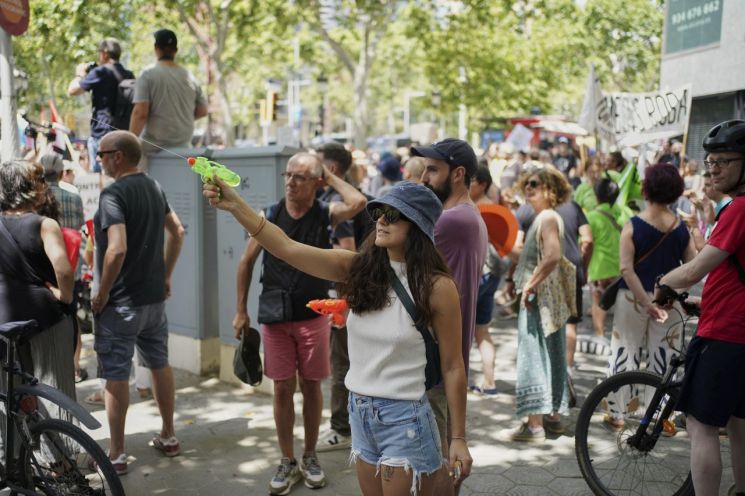 On the 15th (local time), a woman raising a water gun during an 'Overtourism' protest held in Barcelona, Spain. Photo by AP and Yonhap News Agency
Approximately 1,000 protesters marched along the city center’s upscale shopping district, known as the “Golden Mile,” holding signs that read “Tourists go home” and “Tourism is stealing from us,” and chanting slogans. Some protesters shot water guns at tourists passing by luxury brand stores. Scuffles broke out with staff in front of nearby hostels, and smoke bombs were set off in some areas. The protest was eventually stopped by police near the Sagrada Familia.
According to the NYT, this protest was sparked by a “Southern European Anti-Tourism Network” workshop held in Barcelona in April. Protesters are highlighting not just emotional grievances, but structural issues as well. They argue that the city’s economy, which is heavily reliant on tourism, has led to rising rents, housing shortages, and environmental degradation. Juan Mas, a Barcelona resident and restaurant worker who participated in the protest, said, “Most tourists are seen as people who rent homes we can’t afford and come here to drink,” adding, “The problem isn’t tourism itself, but rather the tourism model centered on real estate and the hotel industry.”
The Number of Tourists Rises as Residents’ Quality of Life Declines
In Spain, the tourism industry accounts for about 12% of GDP, making it a major economic sector. The problem, however, is that as the number of tourists increases, the quality of life experienced by residents declines. In particular, Barcelona, a city with a population of only 1.6 million, recorded 26 million tourist visits last year. Protesters warned that unless the number of tourists is reduced, residents will continue to be driven out of their communities.
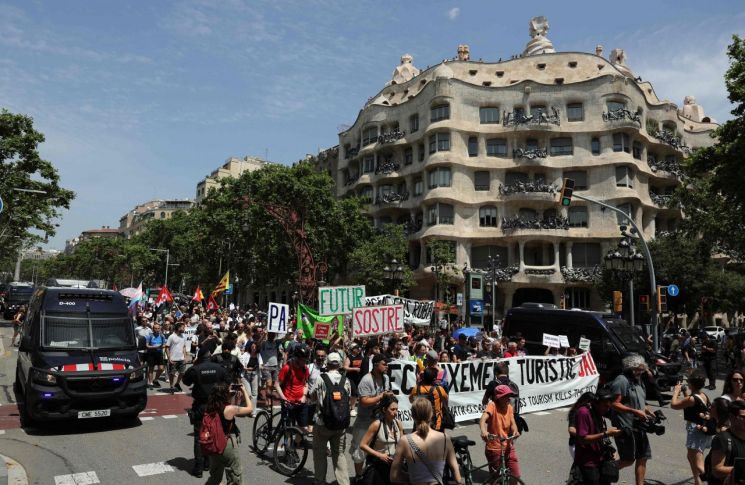 On the 15th (local time), a protest against overtourism is taking place on the island of Mallorca, Spain. Photo by AFP and Yonhap News
This phenomenon is not limited to Barcelona; it has also occurred in other major tourist destinations such as Mallorca, Ibiza, Menorca, Malaga, and Granada. In Mallorca, protesters stopped double-decker tour buses and set off flares as part of more aggressive demonstrations. Pere Joan Pemenia, spokesperson for the local group “Less Tourism, More Life,” said, “This tourism model only deepens the housing crisis rather than bringing economic prosperity.”
Elsewhere in Europe, protesters in Genoa, Italy, staged a “noisy march” by dragging suitcases to create disruptive sounds, while in Lisbon, citizens carried dolls modeled after city statues and occupied sites designated for new five-star hotels. In Venice, a daily entrance fee of 5 to 10 euros has been introduced as a measure to control overtourism, and small-scale protests have taken place against the conversion of public housing and newly built hotels into tourist accommodations.
Meanwhile, the number of foreign visitors across Europe has increased by about 5% year-on-year so far this year. In response, Santorini in Greece and Bruges in Belgium have strengthened their tourist taxes, and Barcelona plans to completely ban short-term apartment rentals such as Airbnb by 2028. Some areas, including Ibiza, are restricting cruise ship arrivals, and Mallorca recently announced plans to remove 1,600 beach chairs from its shores.
As tourist hotspots around the world grapple with the challenges of overtourism, authorities are seeking solutions for sustainable tourism. According to Forbes, countries around the world are adopting three main strategies to address overtourism: dispersing tourists, promoting coexistence between residents and visitors, and encouraging changes in traveler behavior.
© The Asia Business Daily(www.asiae.co.kr). All rights reserved.


















