KOSPI Opens Higher but Turns Lower
Honeymoon Rally Raises Hopes for 3,000,
But Middle East Crisis Halts Momentum
Market Expected to Consolidate for the Time Being
The relentless upward momentum of the KOSPI, which had been fueled by Middle East-driven geopolitical risks, has come to a halt. The 2,900-point level, which was recovered last week, was broken due to Israel's airstrike on Iran. The market believes that, given the accumulated fatigue from the recent steep rally, these new geopolitical risks from the Middle East will serve as a trigger for a correction. A period of market consolidation is expected for the time being.
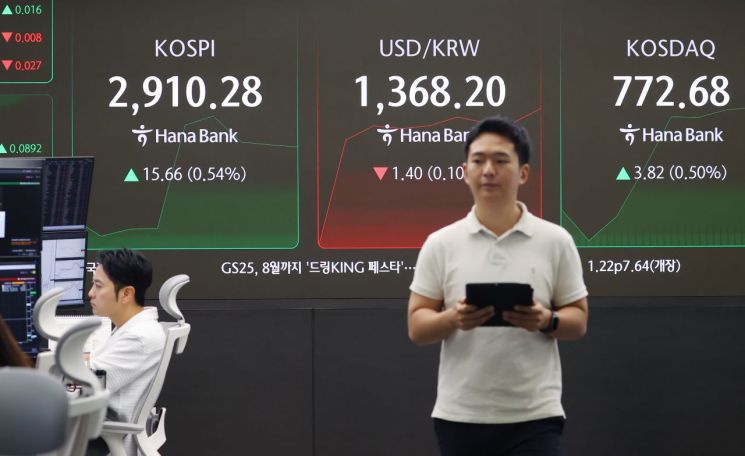
As of 9:30 a.m. on June 16, the KOSPI was trading at 2,889.94, down 4.68 points (0.16%) from the previous session. The KOSDAQ was at 765.22, down 3.64 points (0.47%). On this day, the KOSPI started higher and briefly reclaimed the 2,900-point level, but failed to maintain its gains and turned downward. The KOSDAQ also started lower, then reversed to gains, before falling back again.
This is interpreted as an impact of weakened investor sentiment due to escalating tensions between Israel and Iran over the weekend. On June 13 (local time), the U.S. stock market also closed sharply lower across the board. The Dow Jones Industrial Average fell by 1.79%, the S&P 500 Index by 1.13%, and the Nasdaq Index by 1.30%, with all three indices posting declines of more than 1%.
Cho Junkgi, a researcher at SK Securities, stated, "Last week, despite technical burdens, the KOSPI rose to as high as 2,920 points on a closing basis during the week, supported by momentum from the new administration and foreign investor buying. However, after the emergence of Middle East-driven geopolitical risks on June 13, the index was corrected and closed just below the 2,900-point level. Ultimately, there was a high level of short-term price pressure, and as the market atmosphere became increasingly sensitive to negative factors rather than positive ones, the geopolitical risk emerged as a trigger for a correction. However, unless the situation worsens further, it is more likely to remain a short-term correction rather than a reversal of the recent positive trend."
This means that although the conflict between Israel and Iran does not appear likely to be resolved quickly, it is not expected to break the upward trend of the stock market. Han Jiyoung, a researcher at Kiwoom Securities, also commented, "While the military conflict between Israel and Iran is unlikely to be resolved quickly, the likelihood of it escalating into a major negative event that would undermine the current upward trend of the stock market is limited. It is worth noting that, except for full-scale crisis cases such as the oil shock of the 1970s, the Gulf War in the 1990s, and the Russia-Ukraine war in 2022, geopolitical shocks have generally resulted in short-term stock price events."
Kim Yonggu, a researcher at Yuanta Securities, said, "The impact of heightened Middle East geopolitical uncertainty on the domestic stock market is likely to be limited to a moderate period of adjustment rather than a rapid price correction. For the time being, the market is expected to focus on a consolidation phase, relying on the support at the 2,780-point level, which corresponds to a 12-month forward price-to-book ratio (PBR) of 0.9 for the KOSPI, while observing the developments of the situation."
However, oil prices remain a concern. On June 13, at the ICE Futures Exchange, the front-month Brent crude futures closed at $74.23 per barrel, up 7.0% from the previous session, while the front-month West Texas Intermediate (WTI) crude futures closed at $72.98 per barrel on the New York Mercantile Exchange, up 7.3%. One researcher pointed out, "The real issue for the stock market is whether Iran will respond by blocking the Strait of Hormuz, which accounts for about 20% of global oil shipments. If a scenario such as a blockade of the Strait of Hormuz or a full-scale conflict materializes, risks such as a surge in oil prices due to supply disruptions, a sharp rise in inflation, the disappearance of expectations for U.S. Federal Reserve rate cuts and a spike in interest rates, and a steep decline in the stock market could all emerge."
Attention should be paid to the defense sector and industries less affected by rising oil prices. Kim Daejun, a researcher at Korea Investment & Securities, said, "Given that the current situation is escalating into a full-scale war rather than a shadow war of covert checks as in the past, the defense sector should be the top priority. The relationship between oil prices and each sector should also be considered. Over the past 10 years, sectors such as utilities and food and beverages have shown poor performance in relation to oil prices. In addition, for transportation, there is a difference between airlines and shipping: shipping is a better choice than airlines, as it can benefit from higher freight rates, whereas airlines face higher cost burdens."
© The Asia Business Daily(www.asiae.co.kr). All rights reserved.

















