Daishin Securities forecast on the 16th that the Korean won would continue to strengthen in the second half of this year.
Lee Juwon, a researcher at Daishin Securities, predicted, "The stock market revitalization policies of the Lee Jaemyung administration could drive further inflows of foreign investors, which would serve as an additional factor for a rise in the KRW/USD exchange rate."
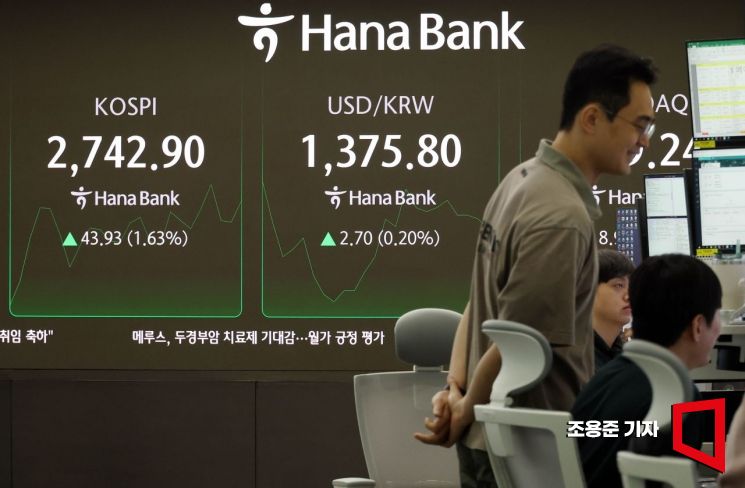 As Lee Jae-myung, who pledged to open the era of a 5000 stock price, was elected president, the domestic stock market rose nearly 2%. On the 4th, the status board in the dealing room of Hana Bank in Jung-gu, Seoul, displayed KOSPI, KRW/USD exchange rate, and KOSDAQ. On that day, the KOSPI index opened at 2,737.92, up 38.95 points (1.44%) from the previous trading day, and KOSDAQ opened at 749.13, up 8.84 points (1.19%). Photo by Jo Yongjun, 2025.6.4
Despite the depreciation of the US dollar in the first quarter of this year, the increase in the KRW/USD exchange rate was limited. This was due to heightened tensions between the US and China, which pushed up the USD/CNY exchange rate until April, and lingering political uncertainty until the early presidential election schedule was set.
Regarding this, Lee explained, "However, with the early presidential election schedule established in April, political uncertainty was resolved. In May, signs of easing US-China tensions led to a strengthening of the yuan, and the Korean won also began to align with other currencies against the dollar." He added, "In particular, at the beginning of May, the KRW/USD exchange rate re-entered the 1,300 won range, in tandem with a sharp drop in the Taiwan dollar exchange rate. As the US raised the possibility of demanding an appreciation of the Taiwan dollar, the Korean won?which has a similar economic structure?attracted hedge demand as a proxy currency."
Lee analyzed, "While a slowdown in exports is inevitable, domestic demand could be better than expected due to improvements in consumer and business sentiment." He continued, "The full-scale implementation of delayed economic stimulus policies, as well as additional interest rate cuts by the Bank of Korea, are also expected to fuel hopes for a recovery in domestic demand." He also explained, "There is a possibility that exchange rates could be discussed during trade negotiations with the US."
Lee stated, "Even if exchange rates are not directly discussed in negotiations with the US, if such discussions take place with other Asian countries, the Korean won is highly likely to be affected as well." However, he added, "If lingering trade-related uncertainties and intensifying trade conflicts undermine risk appetite, the rise in the exchange rate will be limited. Likewise, if domestic demand for investment in the US recovers, the rise in the exchange rate will also be limited."
Meanwhile, Lee maintained the view that the US dollar could weaken in the second half of the year. He said, "Trade-related uncertainties persist, and with supply chain restructuring accelerating under a second Trump administration, the preference for a weaker dollar remains valid." He added, "Stabilization of US Treasury yields is necessary to restore confidence in policy and the economy, so it is important to monitor whether related concerns are resolved during the budget process from late Q3 to early Q4."
© The Asia Business Daily(www.asiae.co.kr). All rights reserved.
![Clutching a Stolen Dior Bag, Saying "I Hate Being Poor but Real"... The Grotesque Con of a "Human Knockoff" [Slate]](https://cwcontent.asiae.co.kr/asiaresize/183/2026021902243444107_1771435474.jpg)
















