Random Calls Made to Citizens' Mobile Phones
Recorded Message Says "Stock Up on Emergency Food and First Aid Supplies"
Iran, which suffered a surprise attack by Israel, is making every effort to prevent public unrest caused by Israel's psychological warfare.
According to Iranian local media on the 15th (local time), since the Israeli airstrikes began in the early morning of the 13th, random calls from foreign numbers have been made to Iranian citizens' mobile phones. When answered, a recorded message in Persian reportedly played, saying, "In order to prepare for crisis moments like the current wartime situation, you must quickly stock up on emergency food such as powdered formula and first aid supplies."
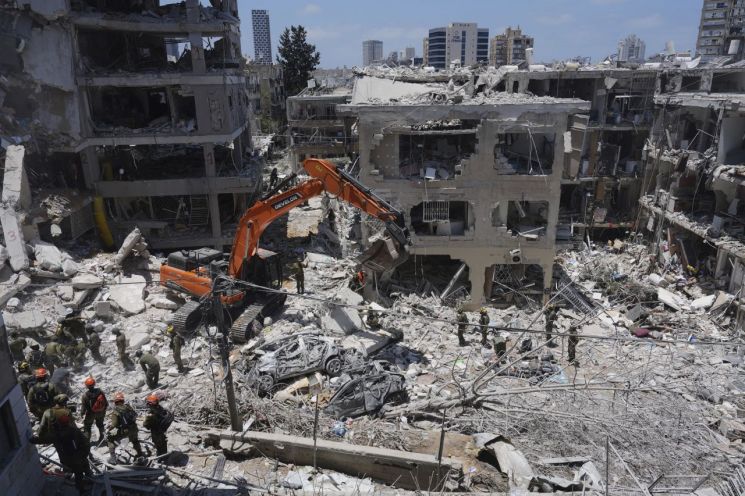 On the 15th (local time), Israeli soldiers are searching for survivors among the rubble of a residential building in the Bat Yam area destroyed by an Iranian missile attack. Photo by AP Yonhap News
An official from the Cyber Response Center of the Iranian police told the state-run IRNA news agency, "This is one of the psychological warfare tactics that the enemy (Israel) routinely employs during war," adding, "Many citizens received such calls and reported them." He went on to say, "The enemy conducts this psychological warfare to disrupt the peace of citizens and society and to drive them into despair," and urged, "Citizens should not spread fake news produced online or by hostile media."
Ahmad Reza Radan, Chief of the Iranian police, also warned, "Please pay attention only to the news from the state broadcaster regarding the (Israeli airstrikes)," and "Do not be deceived by fake news online." Iranian media are engaging in an information campaign by extensively reporting that the Iranian military's retaliatory airstrikes achieved significant results and neutralized Israel's air defense network.
On the 13th, Israel launched large-scale airstrikes across Iran, particularly targeting nuclear and missile-related facilities such as the Natanz nuclear facility and facilities in Isfahan, Tabriz, and Shiraz. As a result, dozens of people, including Iranian nuclear scientists and military commanders, were killed. In response, Iran launched retaliatory attacks against Israel, firing hundreds of drones and missiles at major Israeli cities such as Tel Aviv, Jerusalem, and Haifa.
Meanwhile, on the 15th, Iranian Foreign Minister Abbas Araghchi stated that Iran would also halt its response if Israel stopped its attacks. However, the Israeli military has hinted at the possibility of additional airstrikes, suggesting that the conflict between the two countries is likely to be prolonged. As a result, there are growing concerns that the international trade and energy markets will inevitably be affected.
© The Asia Business Daily(www.asiae.co.kr). All rights reserved.

















