Decomposes Within Days When Immersed in Water...
High-Performance Storage Function Included
Applicable in Various Fields Such as Biomedical Devices
A domestic research team has developed an electronic device that dissolves and disappears in water to address the issue of electronic waste disposal.
The Korea Institute of Science and Technology (KIST) announced on June 15 that a joint research team led by Senior Researcher Cho Sangho of the Extreme Physical Properties Materials Research Center and Senior Researcher Joo Yongho of the Functional Composite Materials Research Center has developed this material.
The results of this research were published on April 28 in the international journal "Angewandte Chemie International Edition."
While water-soluble electronic devices have been developed previously, they have had limitations such as lacking information storage capabilities or being vulnerable to repeated physical deformation.
However, the newly developed electronic material is a polymer that not only offers high-performance information storage but also completely decomposes within a few days when immersed in water.
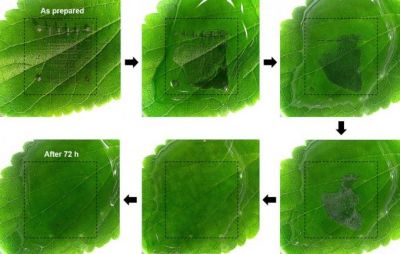 The image shows a small object on a green leaf dissolving and disappearing in water. Photo by Yonhap News
The research team designed a new molecular structure by combining a functional molecule capable of information storage, the organic compound TEMPO, with the biodegradable polymer polycaprolactone (PCL). Through this approach, they succeeded in enabling both electrical signal storage and natural decomposition within a single molecule.
By adjusting the thickness of the protective layer, it is possible to control when decomposition begins. Once the protective layer disappears, the device naturally decomposes in water without any residue after three days. The research team explained, "This achievement is the first case of integrating a physical self-destruction function into a high-performance organic memory device."
The memory device made from this material demonstrates an on/off current ratio?a key transistor performance indicator?of over one million, showing excellent signal distinction. It can also stably store data for at least 10,000 seconds. Furthermore, the device maintained its performance after more than 250 operations and over 3,000 bending cycles.
The research team believes that the developed material could be applied in various fields, such as biodegradable implantable medical devices that automatically dissolve in the body, disposable healthcare monitoring devices, and eco-friendly information storage devices.
The researchers stated, "We plan to further develop this into an 'intelligent self-destructing electronic device' by incorporating self-healing and photoresponsive functions, thereby accelerating the commercialization of next-generation bioelectronic and eco-friendly devices."
© The Asia Business Daily(www.asiae.co.kr). All rights reserved.
![Clutching a Stolen Dior Bag, Saying "I Hate Being Poor but Real"... The Grotesque Con of a "Human Knockoff" [Slate]](https://cwcontent.asiae.co.kr/asiaresize/183/2026021902243444107_1771435474.jpg)
















