From the 16th, service expands to Apgujeong and Sinsa
Three vehicles operate from 11 p.m. to 5 a.m.
4,200 accident-free rides recorded in eight months
Sae-byeok Donghaeng autonomous bus service also expanded
The Seoul Metropolitan Government is expanding the operating area of its "late-night autonomous taxis" to cover the entire Gangnam district. Over the past eight months of the pilot program, there were 4,200 rides, all of which were accident-free.
According to the Seoul Metropolitan Government on June 15, the "late-night autonomous taxi" pilot program, which was first launched in September last year in the areas of Yeoksam, Daechi, Dogok, and Samseong-dong, will extend its service area to Apgujeong, Sinsa, Nonhyeon, and Cheongdam-dong.
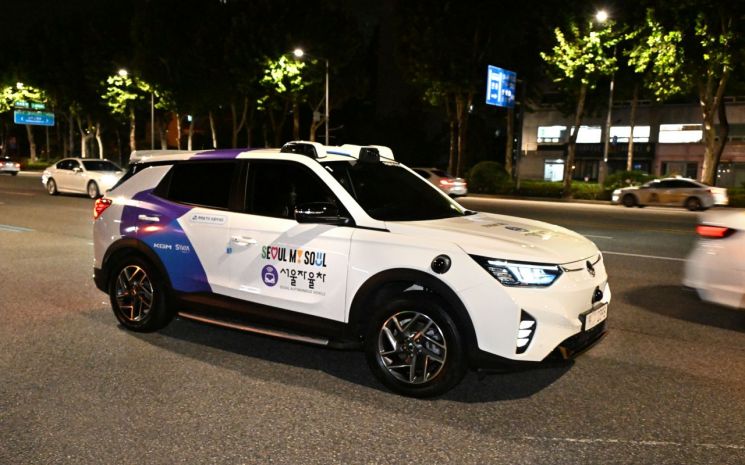
The "late-night autonomous taxi," which can be conveniently hailed through an app like a regular taxi, currently operates three vehicles from 11 p.m. to 5 a.m. on weekdays. Up to three passengers can ride at once, and fares are free during the pilot period. Users can select the taxi icon on the integrated mobility platform "KakaoT," set their departure and destination, and call a vehicle. If an autonomous taxi is available within the service area, the app will display "Seoul Autonomous Vehicle," and users can select this menu to book a ride.
Currently, the "late-night autonomous taxi" operates autonomously on roads with four or more lanes. On residential side streets and in school zones, a test driver who is always present in the vehicle switches to manual mode to ensure the safety of passengers and pedestrians. Since its launch on September 26 last year, the service has provided a total of 4,200 rides over eight months, averaging 24 rides per day. Notably, the pilot program recorded zero accidents in the Gangnam area, which is considered the most complex road environment in Korea. This has led to evaluations that the program has laid the groundwork for autonomous vehicles to become a safe and convenient means of transportation for citizens.
In addition to the Gangnam "late-night autonomous taxi," the Seoul Metropolitan Government also operates the "Sae-byeok Donghaeng Autonomous Bus," which runs a 50-kilometer round-trip route from Dobongsan Metropolitan Transfer Center to Yeongdeungpo Station starting at around 3:30 a.m. to support early-morning workers. The "Sae-byeok Donghaeng Autonomous Bus," which serves citizens such as sanitation workers and security guards who commute early or return home late, has become very popular, with about 10,000 users in just six months of operation.
During the second half of the year, the Seoul Metropolitan Government plans to add three more routes?Sanggye to Express Bus Terminal (shortened route 148), Geumcheon (Gasan) to Seoul Station (shortened route 504), and Eunpyeong to Yangjae Station (shortened route 741)?to further its philosophy of supporting transportation for vulnerable groups. At the end of June, starting with Dongjak-gu (Soongsil University to Chung-Ang University), the city is preparing to launch the "Local Companion Autonomous Bus" in three transportation-disadvantaged districts: Dongdaemun-gu (Janghanpyeong Station to Kyunghee Medical Center) and Seodaemun-gu (Gajwa Station to Seodaemun District Office) during the second half of the year. Yeo Jangkwon, Director of Transportation at the Seoul Metropolitan Government, stated, "The successful operation of advanced autonomous taxis in the complex Gangnam city center is a meaningful achievement for Korea's autonomous driving technology," and added, "We will continue our efforts to ensure that autonomous driving technology becomes a practical and safe means of transportation that enhances mobility for Seoul citizens."
© The Asia Business Daily(www.asiae.co.kr). All rights reserved.
![Clutching a Stolen Dior Bag, Saying "I Hate Being Poor but Real"... The Grotesque Con of a "Human Knockoff" [Slate]](https://cwcontent.asiae.co.kr/asiaresize/183/2026021902243444107_1771435474.jpg)
















