It was belatedly confirmed that invasive termites appeared in Seoul for two consecutive years, 2023 and 2024.
According to the academic community on the 14th, researchers from the National Institute of Ecology under the Ministry of Environment and the National Institute of Forest Science under the Korea Forest Service announced this fact in a paper published last month in the Journal of Environmental Science International.
The research team discovered about 100 invasive termites on April 24 last year in cardboard boxes stored at a logistics warehouse in Geumcheon-gu, Seoul.
The cardboard boxes, which the termites had used as food, were incinerated. These packaging materials had been imported from Singapore through Incheon Airport the previous day. None of the termites discovered were capable of reproduction, and there was no evidence of their spread to the surrounding area.
Genetic testing confirmed that these termites were Asian subterranean termites. The scientific name is Coptotermes Gestroi.
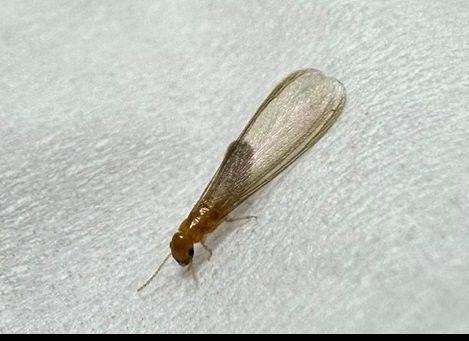 Termite belonging to the family Kalotermitidae, genus Cryptotermes, discovered in a residential area of Gangnam-gu, Seoul in 2023. Photo by Yonhap News
The Asian subterranean termite is known for its rapid colony growth, increasing by 60,000 individuals every four years, and is considered one of the most destructive termite species worldwide.
In Korea, there have been cases where this species was detected during quarantine inspections, but this is the first time it has been found during the distribution stage. This indicates a breach in the quarantine system.
In May 2023, invasive termites were also found in a residential area of Gangnam-gu, Seoul. Termites play a role in breaking down wood, returning carbon to nature, and maintaining soil moisture. While they do not harm humans, they can destroy wooden cultural heritage sites and buildings.
Both termite species found in Korea are tropical species, so the likelihood of them establishing themselves is low. However, experts explained that the situation is different for Coptotermes Formosanus, commonly known as the Formosan subterranean termite.
The Formosan subterranean termite is a temperate species, and there is a possibility that it could adapt to the Korean ecosystem, especially along the southern coast. It also reproduces rapidly, with colony sizes reaching several million individuals. For this reason, it is known to cause even greater damage than its relative, the Asian subterranean termite.
© The Asia Business Daily(www.asiae.co.kr). All rights reserved.

















