Korea Council for College Education Holds Vocational Education Policy Forum
"Vocational Education Should Be Led by the State as Part of Lifelong Learning
Legal Framework Needed to Redefine Its Status"
There has been a recommendation to emphasize the public role of 'vocational education' and to establish a legal foundation for it, in order to address complex challenges such as population decline due to low birth rates and aging, regional extinction, and industrial transformation.
On June 13, the Korea Council for College Education announced that it had held a vocational education policy forum on June 10 at the National Assembly Members' Office Building in Yeouido, Seoul, under the theme "Solving National Challenges: The Social Value and Role of Vocational Education." The forum was co-hosted by Kim Moonsoo, a member of the Democratic Party of Korea, and Kang Kyungsook, a member of the Innovation of the Fatherland Party. It was co-organized by the Korea Council for College Education, the Korean Society for Vocational Education, the Korean Society for Higher Vocational Education, and the Korean Society for Educational Law.
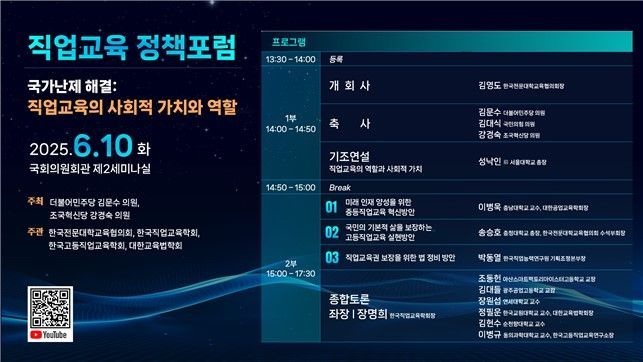
In his keynote speech, Sung Nak-in, former president of Seoul National University, stated, "Vocational education, as a part of lifelong education stipulated in Article 31 of the Constitution, should be actively promoted at the national level."
Sung pointed out that the institutional status of vocational education within the current legal system is unclear, stating, "It is necessary to reorganize the vocational education system and establish a separate legal foundation that clarifies the state's responsibility." He also added, "Vocational education should not be limited to technical training, but should be expanded as a strategic educational area for social integration and national sustainability."
The importance of securing a legal and financial framework for vocational education was also mentioned in the subsequent presentations.
Lee Byungwook, a professor at Chungnam National University and president of the Korean Society of Industrial Education, argued that vocational education should foster a new generation of 'artisans' in the context of technological change.
He said, "The goal of '100,000 new artisans' is not just a number, but refers to future-oriented skilled talents who possess digital competence, literacy, technical skills, and character in a balanced manner." He continued, "Current secondary vocational education faces structural constraints such as rigidity in the curriculum, limited authority of school principals, and lack of industry linkage. Therefore, in the medium to long term, it is necessary to design structural connections between secondary, higher, and industrial education, and to secure legal and financial systems."
Song Seungho, president of Chungcheong University and senior vice president of the Korea Council for College Education, also diagnosed that "it is necessary to establish laws, systems, and financial foundations specialized for vocational education." In particular, Song emphasized that "vocational education should serve not only as initial entry education for youth, but also as a foundation for transition education for middle-aged adults and for sustaining the lives of the elderly," highlighting the need to "establish a vocational education system that covers the entire life cycle."
Park Dongyeol, director of planning and coordination at the Korea Research Institute for Vocational Education and Training, also stated, "In order to respond to the second singularity phase caused by demographic changes, it is urgent to enact a Vocational Education Act, and through this, industry, education, and local communities should design governance together." He added, "When enacting the law, the status of vocational education institutions, the specification of the right to vocational education, learner rights, the connection between secondary and higher education, and financial items should all be included."
During the comprehensive discussion, various stakeholders?including secondary and higher vocational education institutions and university researchers?shared their views on the legalization and strengthening of the public nature of vocational education. Jang Wonseop, a professor at Yonsei University, said, "A new educational philosophy is needed that guarantees both the public nature and expertise of vocational education." Jeong Pilun, a professor at Korea National University of Education and president of the Korean Society for Educational Law, stated, "The reestablishment of the status of vocational education ultimately begins with institutional recognition through legalization." There was also an opinion that the issue cannot be solved by simple legislation, but that a national vocational education system connecting secondary, higher, industrial, and regional sectors must first be established.
Lee Byungkyu, a professor at Dong-Eui Institute of Technology and director of the Korea Institute for Higher Vocational Education, said, "Vocational education is education of connection and linkage, and it must be supported by a legal foundation and a policy implementation system that make this possible."
Kim Youngdo, president of the Korea Council for College Education and organizer of the forum, stated, "The council will play a pivotal role in ensuring that the tasks discussed do not remain mere declarations, but are carried forward through solidarity and action by the National Assembly, government, industry, and education sectors, by supporting legislation and expanding social consensus in the future."
© The Asia Business Daily(www.asiae.co.kr). All rights reserved.
![Clutching a Stolen Dior Bag, Saying "I Hate Being Poor but Real"... The Grotesque Con of a "Human Knockoff" [Slate]](https://cwcontent.asiae.co.kr/asiaresize/183/2026021902243444107_1771435474.jpg)
















