Key Role as Early Partner in New Administration
Cooperative Governance Expected for Stability
The newly elected floor leader of the Democratic Party of Korea, to be chosen on the afternoon of June 13, will serve as the first ruling party floor leader under the Lee Jaemyung administration. This person is expected to take the lead in maintaining a stable majority in the National Assembly and advancing a range of national reform initiatives. There are numerous pressing issues, including the handling of the supplementary budget and contentious legislative matters. While some predict that the party will accelerate its legislative drive, it is also anticipated that the ruling party will focus on dialogue and compromise for cooperative governance, given that its actions are closely tied to the president’s approval ratings.
The next floor leader of the Democratic Party will be elected based on a combined total of 20% from an online vote by party members, which began the previous day and continues until 3 p.m. today, and 80% from a vote by party lawmakers held at a general assembly on the same day. The results of the floor leader election are expected to be announced around 3:50 p.m. today.
Regardless of whether Kim Byunggi or Seo Younggyo is elected as floor leader, the focus will likely be on advancing reform agendas that President Lee Jaemyung has emphasized since his tenure as party leader, such as ending internal strife, dismantling vested interests, protecting the socially disadvantaged, and transitioning to the era of artificial intelligence (AI). In addition, the party is poised to address bills that the Yoon Sukyeol administration has opposed, including prosecutorial reform, the bill to suspend trials, amendments to the Commercial Act, the three broadcasting laws, the Yellow Envelope Act, and the Grain Management Act.
The Democratic Party currently holds 167 seats in the National Assembly, making it a major ruling party, and, together with allied parties, commands a stable majority of up to 190 seats. As long as the ruling party floor leader is determined, there is an environment in which major bills can be passed in plenary sessions.
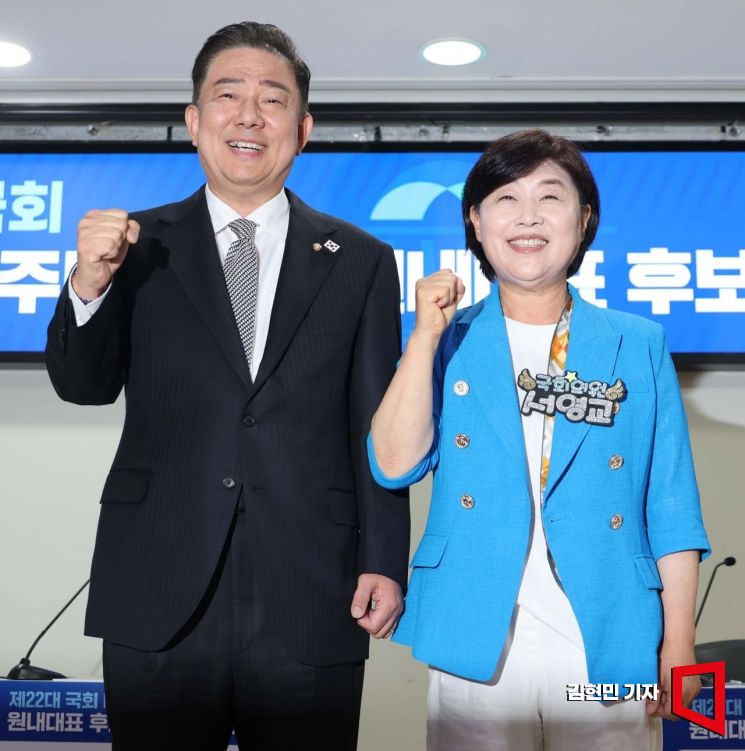 On the 10th, at the National Assembly Members' Office Building, Kim Byunggi (left) and Seo Younggyo, candidates for the 2nd term floor leader of the 22nd National Assembly from the Democratic Party of Korea, posed for the press cameras during a joint debate. 2025.6.10 Photo by Kim Hyunmin
However, the party’s political circumstances as the ruling party differ from those it faced when it was in opposition, and this serves as a variable. As the ruling party, it is fundamentally in a position of responsibility. If the National Assembly system fails to function properly, the ruling party will inevitably bear primary responsibility. This is why some predict that the party will lay the groundwork for cooperative governance by incorporating the voices of the opposition and various sectors of society.
When in opposition, the party sought to distinguish itself from the ruling party through differentiated bills and policies. However, now that it has become the governing party, persuasion and dialogue are necessary to ensure stable administration under the Lee Jaemyung government.
The decision not to address contentious issues such as the bill to suspend trials and amendments to the Commercial Act during Park Chandae’s tenure as floor leader, instead leaving them to the new leadership, is seen as an effort to adjust the party’s pace. In addition, issues such as the Yellow Envelope Act, the designation of mandatory holidays for large supermarkets, and increasing the number of Supreme Court justices are also under consideration, as stakeholders hold differing opinions on these matters.
Um Kyungyoung, director of the Zeitgeist Institute, commented, “In the past, the approval rating of the Lee Myungbak administration plummeted in an instant due to factors such as the overwhelming victory in the presidential election, the appointment of officials from Korea University, Somang Church, and the Yeongnam region, and the mad cow disease crisis. The end of internal strife should be pursued as a matter of principle, but in other areas, the party is likely to moderate its pace through cooperative governance.”
© The Asia Business Daily(www.asiae.co.kr). All rights reserved.
![Clutching a Stolen Dior Bag, Saying "I Hate Being Poor but Real"... The Grotesque Con of a "Human Knockoff" [Slate]](https://cwcontent.asiae.co.kr/asiaresize/183/2026021902243444107_1771435474.jpg)
















