Efforts to Reach Unanimous Agreement Between Residents and Administration
on the Operation Plan for the Nongseong 2-dong Public Multi-Purpose Complex
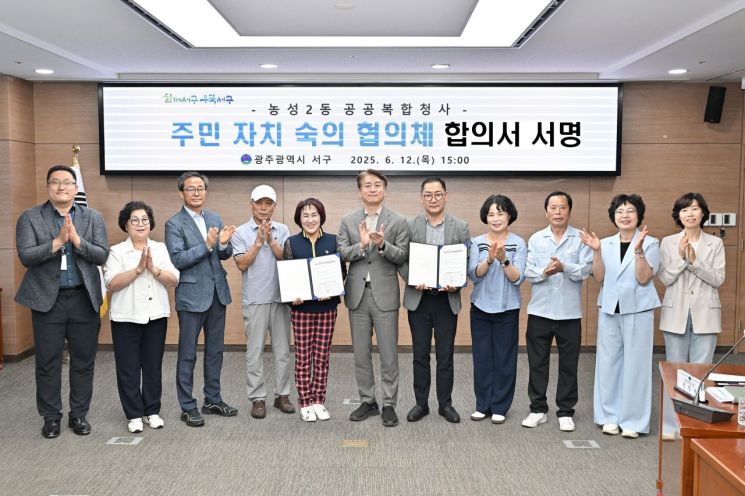 Seogu attracted attention by resolving a five-year-old conflict through "deliberative democracy." Photo by Seogu Office
Seogu District in Gwangju Metropolitan City has presented a model case of collaborative governance, with residents and the local government working together to resolve a regional issue that had been plagued by misunderstandings and conflict for over five years, using the method of "deliberative democracy."
In relation to the use of the public multi-purpose complex in Nongseong 2-dong, which is scheduled for completion at the end of this year, Seogu established a "Residents' Autonomous Deliberative Council" in April. Through this council, they addressed the root causes of misunderstandings and conflicts that had arisen since the early stages of the project, ultimately achieving unanimous agreement among all parties involved.
Through this deliberative process, Seogu was able to resolve an issue that had been misunderstood as a populist administrative move, by adhering to principles and standards. This is regarded as the first case in Seogu where a public solution was found together with residents through deliberation.
The conflict began in 2020 when the public multi-purpose complex project was launched in earnest. Seogu secured national funding and designed the complex to house several departments of the district office, such as the Traffic Administration Division and Traffic Guidance Division, as well as the Nongseong 2-dong Administrative Welfare Center, a community culture center, a small library, and a lifelong learning center. However, confusion during the explanation and promotion process led some residents to perceive the facility as an exclusive office for Nongseong 2-dong.
As a result, residents of Nongseong 2-dong continued to voice demands, including: clearly designating the name and management authority of the multi-purpose hall as "Nongseong 2-dong"; securing shared kitchen and storage space within the building; and either designating the residents' autonomous committee as the management authority for the nearby temporary parking lot or allocating management profits to them.
Over time, misunderstandings deepened. Despite Seogu proceeding with construction according to the original design and plans, accusations of "changing their stance" arose, leading to growing distrust toward the administration.
At a residents' meeting in April, Seogu District Mayor Kim Ikang proposed forming a Residents' Autonomous Deliberative Council to resolve the issue. The council was composed of five resident representatives and five directors and division heads from the Seogu District Office.
Over approximately three months, the council organized the main issues and engaged in deliberative procedures to coordinate their positions. At the final meeting on June 12, they reached a unanimous agreement. The final agreement specifies: the multi-purpose hall will be named "Nongseong 2-dong Multi-Purpose Hall" and managed by the head of Nongseong 2-dong; the shared kitchen will remain in its current location until a separate space is provided; and the temporary parking lot will be opened free of charge based on mutual agreement with residents, reflecting practical and balanced solutions.
Seogu evaluated this deliberative process as highly meaningful, noting that it not only resolved a simple civil complaint but also opened the way for democratic collaborative governance, where residents and the administration consult and make decisions on an equal footing.
© The Asia Business Daily(www.asiae.co.kr). All rights reserved.

















