Dollar Index Falls to 97.6
Hawkish Tariff Remarks and
Slowing Consumer and Producer Prices
Weak Dollar Amid Hopes for Rate Cuts
The value of the dollar, once synonymous with reserve currency status and a safe haven asset, has fallen to its lowest level in three years. This is seen as the result of a combination of factors: the Trump administration's tariff policies, slowing inflation, and concerns over fiscal soundness stemming from tax cuts and increased government spending. In addition, geopolitical risks originating from the Middle East and uncertainty surrounding the US-China trade agreement are also contributing factors, leading to forecasts that the 'Sell America' trend among foreign investors may accelerate.
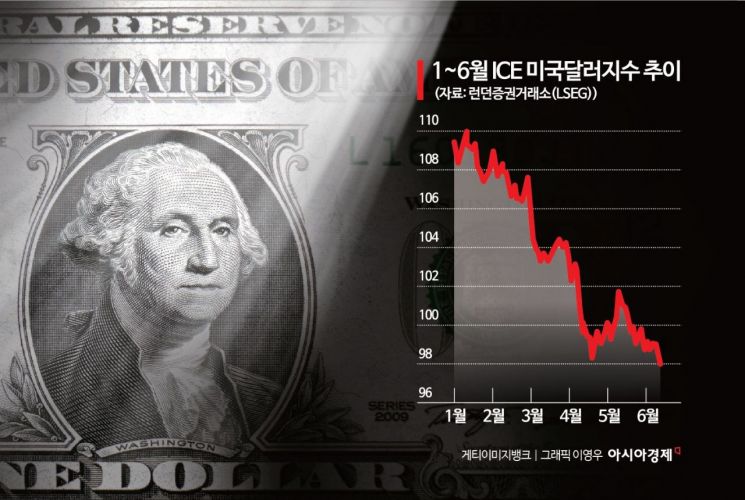
According to CNBC on the 12th (local time), the dollar index, which measures the value of the dollar against major currencies such as the euro and the pound, slipped to as low as 97.6 during trading, marking its lowest level in three years and three months. The dollar index has dropped by 10% compared to the end of last year, and the weakening trend of the dollar has become even more pronounced since the Trump administration took office in January this year. On the same day, the Bloomberg Dollar Spot Index (BBDXY), which tracks the value of the dollar against the currencies of ten countries including emerging markets, also fell 0.8% during trading, reaching its lowest level since April 2022.
The already weak dollar was further pressured by President Trump's remarks. On the 11th, President Trump stated, "Within one to two weeks, we will send letters specifying trade terms to all trading partners," and indicated that if US demands are not accepted after the mutual tariff suspension period ends on July 9, high tariffs may be imposed. The market immediately responded to his hardline stance?"Either accept the deal or walk away"?by selling dollars.
Furthermore, both the Consumer Price Index (CPI) for May and the Producer Price Index (PPI) came in weaker than market expectations, adding further downward pressure on the dollar. Despite Trump's tariff blitz, signs of inflation have not materialized, fueling speculation that the Federal Reserve (Fed) may cut interest rates further. If rates are cut, the interest yield on dollar assets such as US Treasury bonds decreases for investors. This acts as an incentive for funds to move to other currencies or countries offering relatively higher interest rates. Ultimately, reduced demand for US assets leads to reduced demand for the dollar, putting downward pressure on its value.
Helen Given, a foreign exchange trader at Monex, said, "The renewed tariff threats from Trump are heightening concerns about the US economy and fueling expectations for more accommodative monetary policy from the Fed," adding, "The dollar index could fall an additional 5-6% this year."
The issue is that the value of the dollar is falling even though US Treasury yields have recently been rising. Typically, rising interest rates strengthen the dollar, but since April this year, this correlation has broken down, resulting in the unusual phenomenon of a weak dollar amid rising rates.
Analysts attribute this to concerns over US fiscal instability. The Congressional Budget Office (CBO) projected that if President Trump's tax cut plan is actually implemented, US government debt will surge by $3.1 trillion over the next ten years. Credit rating agency Moody's downgraded the credit rating of US Treasuries by one notch from the highest level in May, reflecting such concerns.
As the dollar's weakening trend becomes more pronounced, foreign investors are selling US stocks and bonds and diversifying their funds into domestic or other regional assets. Fabiana Fedeli, Chief Investment Officer (CIO) at UK asset management firm M&G Investments, explained, "Institutional investors are reviewing portfolios that are overly concentrated in US assets and are attempting regional diversification."
Major currencies such as the yen, pound, and euro are showing relative strength against the dollar. On this day in the foreign exchange market, the dollar fell to the 143.10 yen range against the yen (per 1 dollar), deepening the strong yen and weak dollar phenomenon. The euro soared to its highest level against the dollar in about three years and eight months since October 2021. The British pound reached its highest level in three years.
The Guardian reported, "As foreign exchange traders sell dollars and buy yen and euros, these currencies have risen about 1% against the dollar. On the same day, the FTSE 100 Index hit a record high of 8,884 points," adding, "This is an indicator that investors are starting to shift their focus from US stocks to assets in other regions."
Some believe that the 'dollar exodus' of foreign capital is only temporary. Cliff Asness, founder of US hedge fund AQR Capital Management, argued, "If you believe the dollar will lose its reserve currency status, you must ask yourself which currency will take its place," adding, "Given the economic and fiscal instability in Europe and China, it is unlikely that large-scale capital outflows from the US will continue."
© The Asia Business Daily(www.asiae.co.kr). All rights reserved.

















