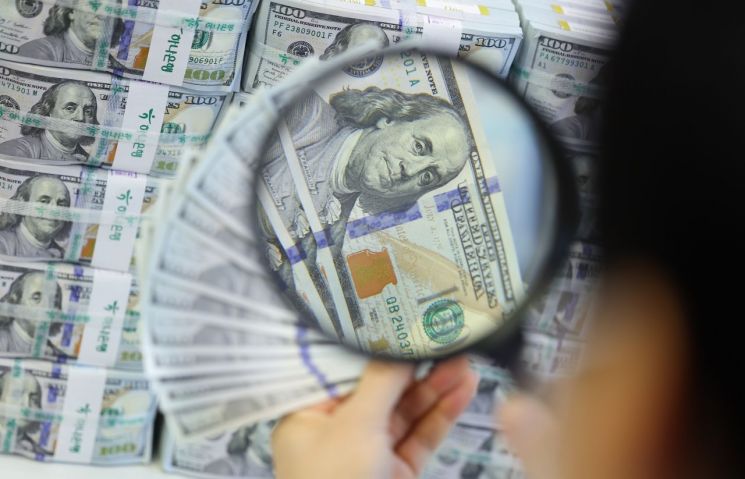
On June 13, IBK Investment & Securities analyzed the outlook for the USD/KRW exchange rate in the second half of the year, stating, "Currently, the exchange rate has diverged significantly from interest rates, which are the most direct explanatory factor for exchange rates. Therefore, the exchange rate in the second half is likely to remain at its current level or even rebound slightly."
Since May, the USD/KRW exchange rate has been falling rapidly, indicating a sharp appreciation of the Korean won. In early April, when the Trump reciprocal tariffs were announced, the exchange rate stood at around 1,470 won per dollar. However, after mid-May, when the U.S. intentions to pressure for a stronger won became apparent, the rate fell to the low 1,400 won range. Following the presidential election and the inauguration of a new government, the won continued to appreciate, with the rate dropping to around 1,350 won. Domestically, the recent strength of the won can be attributed to the resolution of the impeachment crisis, the establishment of a new government, the removal of uncertainty, and rising expectations for the new administration. Externally, the continued weakness of the U.S. dollar, along with the easing of concerns over Trump tariff pressures or the market's adaptation to these concerns, have contributed to the won's appreciation.
Currently, the market has high expectations for further appreciation of the won. Considering the recent strong performance of the stock market, aggressive stock purchases by foreign investors, expectations for the new government's economic policies, and U.S. pressure for a weaker won, some expect the exchange rate to fall to the low 1,300 won range or even lower.
Jung Yongtaek, an economist at IBK Investment & Securities, stated, "Both the USD/KRW exchange rate and the dollar index are unlikely to see significant further declines, and it is highly likely that the exchange rate will remain at its current level or even rebound slightly in the second half." He explained, "This is because, while exchange rate adjustments and alignment between different exchange rates have mostly concluded amid various uncertainties, the current exchange rate has diverged significantly from interest rates, which are the most direct explanatory factor for exchange rates."
During the pandemic, the most important factor explaining the continued rise of the U.S. dollar was the interest rate differential between the United States and other countries. However, this year, despite the fact that the gap between policy rates and market rates in the United States and major countries has either remained large or even widened, the value of the U.S. dollar has been adjusted downward considerably. This is because concerns about the U.S. economy and other risk factors have had a greater impact on the foreign exchange market.
Nevertheless, the most fundamental factor explaining exchange rates is interest rates. Also, considering that the Trump shock and various risk factors, which have previously acted unilaterally as factors for dollar weakness, are changing or that market participants are becoming accustomed to them, it is highly likely that the explanatory power of interest rates for exchange rates will gradually recover.
The same applies to the USD/KRW exchange rate. During the pandemic, the factor that best explained the USD/KRW exchange rate was the market's trend expectations for the Federal Reserve's monetary policy. Currently, the exchange rate has deviated significantly from these expectations. Jung noted, "Given that the Trump shock and other factors are not trend factors, attention to the direction of U.S. monetary policy is likely to rise again." He added, "I view the recent trend in the USD/KRW exchange rate as temporary, and in the second half of the year, the monetary policy and market interest rate differentials between the United States and Korea are more likely to act as factors for a weaker won rather than a stronger won."
© The Asia Business Daily(www.asiae.co.kr). All rights reserved.








![The Special Connection Between the Statue of Martyr Lee Jun in Jangchungdan Park and Mayor Oh Sehoon ③ [Current Affairs Show]](https://cwcontent.asiae.co.kr/asiaresize/319/2026012110001599450_1768957215.jpg)