Trump Hints at Raising Auto Tariffs Above 25%
"Says Higher Tariffs Will Lead Companies to Build U.S. Factories"
Criticizes Powell: "Inflation Has Fallen"... Urges Rate Cuts Again
Blames "Annual $60 Billion More in Bond Interest Payments"
U.S. President Donald Trump stated on June 12 (local time) that he could further raise tariffs on automobiles from the current 25% in order to expand domestic car production. There are growing concerns in South Korea, which is already suffering from the 25% tariff due to its high dependence on car exports to the U.S., that additional tariff hikes could further increase export losses.
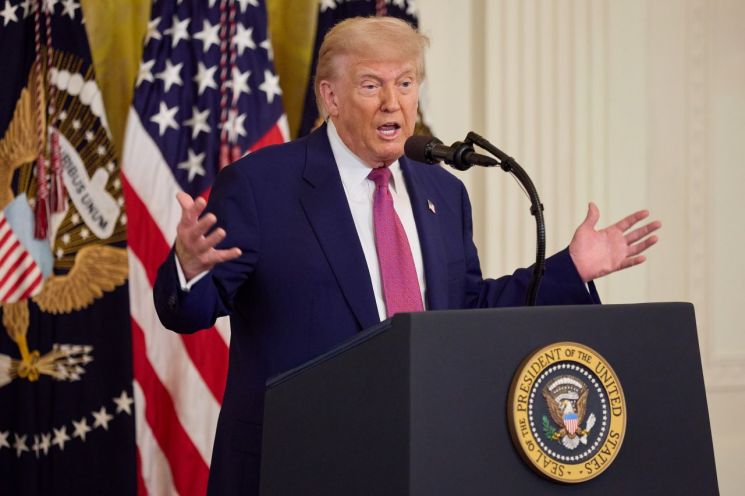
At a bill signing ceremony at the White House on the same day, where he repealed California's gasoline car regulations, President Trump said, "We could raise auto tariffs in the not-too-distant future," adding, "The higher the tariffs, the more likely companies are to build factories here (in the U.S.)."
Previously, after beginning his second term, President Trump imposed a 25% tariff on automobiles and major auto parts. Since April 3, a 25% tariff has been in effect on foreign-made cars, and since May 3, a 25% tariff has also applied to parts such as engines. However, tariffs on parts accounting for 15% of the price of cars assembled in the U.S. will be exempted for one year until April next year.
He argued that raising auto tariffs above the current 25% would protect the domestic auto industry. He also mentioned that General Motors (GM) plans to invest $4 billion in its U.S. plants over the next two years to avoid additional tariffs.
President Trump also criticized Jerome Powell, Chair of the U.S. Federal Reserve (Fed), calling him a "numbskull" and once again pressured for a rate cut. He reiterated that interest rates should be lowered, even for the sake of reducing government bond interest expenses.
He claimed that if rates were lowered by 2 percentage points, the White House could save $600 billion annually, saying, "But we can't make this person do it." He continued, "We are spending $600 billion every year," and added, "This $600 billion is being spent because of one fool who sits here and says, 'We don't see enough reason to lower rates.'"
He emphasized that he would agree to a Fed rate hike if inflation were rising, but the current situation is the opposite. On this day, the U.S. Department of Labor announced that the Producer Price Index (PPI) for May rose only 0.1% from the previous month, falling short of market expectations (0.2%).
President Trump said, "But (inflation) has gone down," adding, "Maybe we'll have to force something."
On June 6, President Trump announced that he would name Jerome Powell's successor, whose term ends in May 2026, "very soon." This appears to be a strategy to trigger a lame duck period for Powell by nominating the next Fed chair early, and it may have referred to such a move.
President Trump also mentioned that he had discussed electric vehicles and Tesla with Elon Musk, CEO of Tesla, who had openly clashed with him over tax cuts, saying, "I like Tesla."
Additionally, President Trump commented on the possibility of an Israeli attack on Iran, stating, "I don't want to say it's imminent, but the chances are very high." Regarding the ongoing nuclear negotiations between the U.S. and Iran, he said, "We are very close to a very good deal," and added, "I don't want them (Israel) to go in (attack Iran), because it could blow up the deal."
Regarding the stalled ceasefire negotiations in the Ukraine war, President Trump said he was "disappointed" with both Russia and Ukraine.
© The Asia Business Daily(www.asiae.co.kr). All rights reserved.

















