KDCA Holds 9th Healthy Society Forum
Policy Shift for Healthy Aging ... Launching "Frailty Prevention Initiative"
As South Korea enters a super-aged society, with people aged 65 and older accounting for more than 20% of the total population and the burden of medical expenses for the elderly rapidly increasing, the government is launching a frailty prevention program to promote healthy aging.
On June 11, the Korea Disease Control and Prevention Agency (KDCA) held the 9th Healthy Society Forum under the theme "The Need for Frailty Prevention for Healthy Aging in a Super-Aged Society and the Role of the KDCA," and announced its plans to implement a frailty prevention initiative.
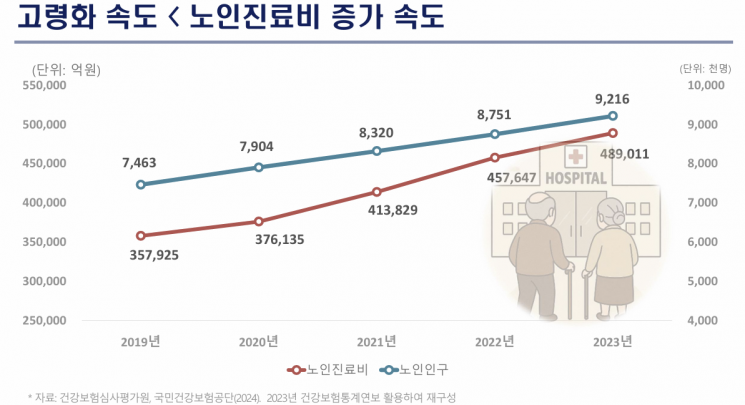
According to data reconstructed by the KDCA from the 2023 National Health Insurance Statistical Yearbook, the rise in medical expenses for the elderly in South Korea is outpacing the speed of population aging. While the population aged 65 and older increased by 23.5% from 7,463,000 in 2019 to 9,216,000 in 2023, medical expenses for the elderly surged by 36.6%, from 35.7925 trillion won to 48.9011 trillion won.
Park Kwangsook, head of the Frailty Planning Team at the KDCA, said, "Currently, elderly health policies are mainly focused on diseases such as dementia and chronic illnesses, as well as care for those conditions, but local governments lack sufficient budgets and capacity to implement such programs." Park added, "Going forward, elderly health policies will be shifted to a comprehensive health management system for healthy aging, and a national-level integrated strategy will be developed to improve the quality of life for seniors and reduce social costs."
The KDCA plans to develop a frailty prevention program model that enables seniors to maintain their own health functions and independence in daily life before they require care, and to conduct pilot projects in selected regions.
According to the 2023 Ministry of Health and Welfare Survey on the Status of the Elderly, 4.6% of seniors in South Korea are in a 'frail' state requiring care, while 32.2% are in a 'pre-frail' state.
Accordingly, the KDCA will divide target areas into urban, urban-rural mixed, and rural/fishing communities, and will select three local governments for the 2026-2027 frailty prevention pilot project, taking into account factors such as aging and population decline. In the selected local governments, the program will be implemented in 20 community units using senior centers and welfare facilities for the elderly. After the pilot project concludes in 2028, local governments will be supported to take the lead in operating the program.
The KDCA will also add frailty-related questions to the annual Community Health Survey to establish a monitoring system and assess the status of frailty in each region. The survey will ask, for example, whether respondents have felt fatigued in the past month, or if they have difficulty climbing 10 stairs or walking 300 meters alone without rest or assistance.
Ji Youngmi, Commissioner of the KDCA, stated, "We must implement policies to extend the healthy life expectancy of seniors and improve their quality of life in response to the super-aged society," and added, "We will continue to work with local communities to foster an environment that supports healthy aging."
© The Asia Business Daily(www.asiae.co.kr). All rights reserved.

















