1st Anniversary Press Conference Held
Emphasis on the Role of the Big Four and Corporate Audit Committees
"We Will Strive for the Passage of the Basic Accounting Act and the Local Autonomy Act"
On June 11, Choi Unyeol, chairman of the Korean Institute of Certified Public Accountants, addressed the issue of audit fee dumping in the accounting industry, describing it as "a step backward from accounting reform." He suggested solutions such as introducing special inspections by the Financial Supervisory Service and expanding the role of corporate audit committees.
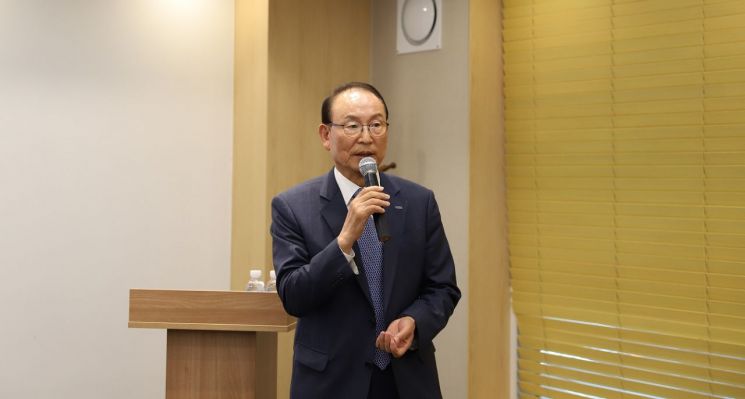 Choi Unyeol, chairman of the Korean Institute of Certified Public Accountants, is explaining the achievements and future key tasks at the '1st Anniversary Inauguration Press Conference' on the 11th. Korean Institute of Certified Public Accountants
At the 1st Anniversary Inauguration Press Conference held that day, Choi stated, "As the industry transitions from designated audits to freely contracted audits, the audit fees received by accounting firms have dropped, leading to many problems. While it would be desirable if audit fees were reduced through management efficiency, in reality, it is resulting in a decline in audit quality." He pointed out that the freely contracted audit fees of the Big Four accounting firms (Samil, Samjong, Anjin, Hanyoung) hit their lowest point in the past five years, indicating that the practice of underbidding has become widespread across the industry.
He noted, "If the Korean Institute of Certified Public Accountants tries to forcibly prevent this, it could raise fair trade issues." He added, "A possible solution would be for the Financial Supervisory Service to establish a system for conducting special inspections of accounting firms whose audit fees have become excessively low." He also said, "We plan to make direct and indirect efforts to encourage the Big Four and other accounting firms to recognize the problem and establish their own standards, or to enable corporate audit committees composed of external financial experts to play a role."
Choi predicted that the number of unassigned trainee accountants unable to find placements will increase this year. He said, "This year, the Big Four are expected to hire about 700 trainee accountants, and even when adding local firms and public institutions, the total will only reach 800 to 900. Given that the minimum number of new accountants to be selected in this year's exam is 1,200, about 300 will remain unplaced." He added, "We will communicate this to the government so it can be considered when determining the number of new hires."
Choi identified the amendment of the Local Autonomy Act as a key focus for the second half of this year. In March, the Seoul Metropolitan Council passed an ordinance amendment restoring 'accounting audits' as the method for reviewing settlement statements for Seoul's privately commissioned projects. However, attempts to revise ordinances in other metropolitan cities and provinces continue, aiming to change accounting audits to 'inspections.' Choi said the intention is to resolve these issues by amending the higher-level law.
Choi emphasized, "It is fundamentally wrong to have tax agents performing accounting audits. It is like asking a veterinarian to treat people." He continued, "Since both the Democratic Party and the People Power Party have submitted amendments to the Local Autonomy Act, I do not expect the passage to be difficult. We will do our utmost to ensure it passes the National Assembly within a year."
He also set the enactment of the Basic Accounting Act during the current administration's term as a goal. Currently, public institutions, public interest corporations, and private schools all operate under different legal grounds, making it difficult to establish consistent and systematic audit policies. Choi said the aim is to create fundamental principles that can be commonly applied to various organizations. He noted, "Since the enactment of the Basic Accounting Act was included in the Democratic Party's presidential campaign pledges, I expect it to gain momentum. Considering that legislation takes time, we aim to have it passed within two to three years."
Other key initiatives highlighted by Choi include ensuring predictable inspections of accounting firms by the Financial Supervisory Service, expanding support for accountants starting their own practices, and establishing a political academy.
© The Asia Business Daily(www.asiae.co.kr). All rights reserved.