North Gyeongsang's Mungyeong Ranks 5th Nationwide in Cumulative Growth This Year, 1st Among Non-Metropolitan Areas
Neighboring Yeongju Also 11th Nationwide... The Common Factor: "KTX"
New Construction Shortage... Mungyeong Sees 3 Years, Yeongju 4 Years of Zero Supply
"Other Drivers Needed for Long-Term Upward Trend"
Housing prices in Mungyeong and Yeongju, North Gyeongsang Province, are surging. The rate of increase has surpassed that of Seoul’s popular residential districts known as 'Mayongseong' (Mapo, Yongsan, Seongdong). This trend stands in stark contrast to the stagnation seen in other regional real estate markets. Analysts attribute the concentration of demand to the so-called 'KTX Belt,' which has gained attention due to improved rail transportation, especially in a situation where there is no new housing supply.
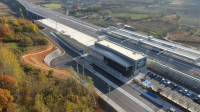 KTX Mungyeong Station exterior.
According to the Korea Real Estate Board on June 12, the cumulative apartment sale price growth rate in Mungyeong this year is 4.18%, ranking fifth among all cities, counties, and districts nationwide, and the highest among non-metropolitan areas. In terms of growth rate, Mungyeong follows Gwacheon in Gyeonggi Province (6.21%), Songpa in Seoul (6.14%), Gangnam (5.61%), and Seocho (5.17%). During the same period, Mapo recorded 2.95%, Yongsan 2.86%, and Seongdong 3.42%, all lower than Mungyeong. The neighboring city of Yeongju posted a 2.63% increase. Nationally, this places the 'Mungyeong-Yeongju' axis at 11th, highlighting the region’s pronounced upward trend. In contrast, the national average during the same period was -0.34%, indicating a decline.
Mungyeong and Yeongju Now Within 1.5 Hours of the Capital Area
The increase in Mungyeong’s housing prices over the past five months has already far exceeded last year’s annual growth rate of 3.79%. The rapid price rise has been driven by improvements in transportation infrastructure. In November of last year, the Jungbunaeryuk Line was extended to Mungyeong, dramatically improving access to the Seoul metropolitan area. It is now possible to reach Pangyo in Gyeonggi Province in about 1 hour and 30 minutes, cutting travel time by more than an hour compared to intercity buses. The KTX-Eum currently operates eight round trips per day.
In response, Mungyeong began construction of a station area mixed-use development project in March. The city aims to attract new residents and expand housing demand by creating an urban space that combines commercial, public, business, tourism, and industrial functions. Yeongju, adjacent to Mungyeong, also saw its transportation infrastructure improved last December with the completion of the double-tracking of the Jungang Line, enabling direct KTX service from Cheongnyangni to Yeongju to Busan.
Hwang Jae-du, head of the Mungyeong chapter of the Korea Association of Realtors, said, "Since the beginning of this year, there has been a noticeable increase in both investment from outside the region and local demand for upgrading homes." He added, "A customer from Daegu was surprised, asking if the price of Mungyeong’s 'Gukpyeong' (standard apartment size) had exceeded 420 million won." He also noted, "Given the limited supply compared to demand, prices continue to rise."
Supply Drought and Gap-Filling in Neighboring Areas... 'Gukpyeong' Sets New Record at 420 Million Won
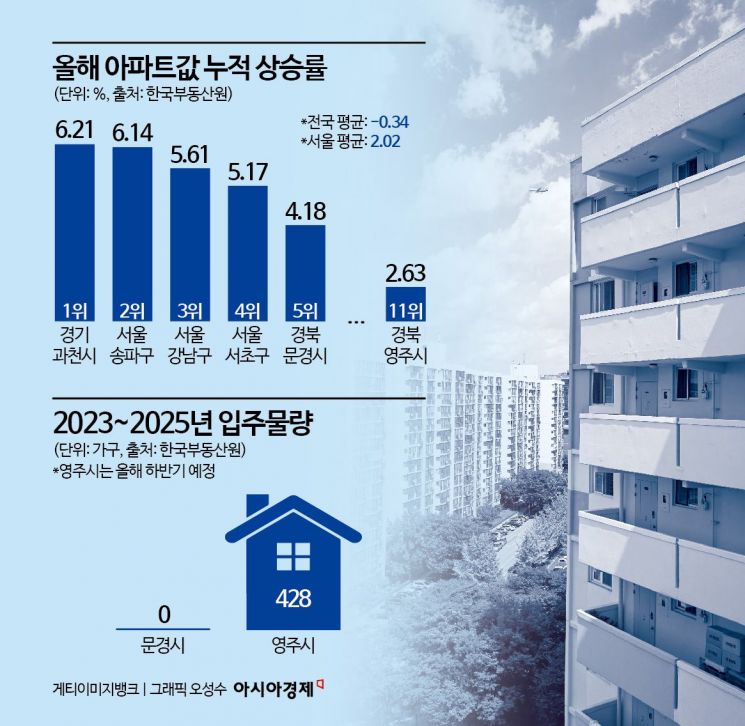
The shortage of supply has also been a key factor supporting the strength of Mungyeong’s housing prices. Mungyeong has seen no new housing supply for three consecutive years, from 2023 through this year. Due to the recent deterioration of project financing (PF) conditions in small provincial cities, there have been no new apartment launches for several years.
A clear trend has emerged in which existing apartments are 'closing the gap' with the prices of new developments in neighboring areas. In May, an 82-square-meter unit in 'Mungyeong Mojeon Koaru Noble 36,' completed in 2022, was sold for a record-high 420 million won. This is an increase of 81.89 million won compared to the previous record high of 338.11 million won (set in 2023).
Yeongju has also had no new housing supply for the past three years. However, the city is expected to alleviate its 'new construction drought' with the completion of 'Yeongju I-Park' (428 units) in the second half of this year and 'Yeongju Xi Signature' (763 units) next year. Pre-sale rights for these complexes are being traded at a premium of 20 to 30 million won, reflecting concentrated demand.
The market is divided over the unusual phenomenon of regional housing price growth outpacing that of the capital area. Some point to expanded transportation networks and development benefits as factors driving real demand, while others are skeptical about the long-term sustainability of this trend due to declining populations and a lack of jobs.
Park Won-gap, Chief Real Estate Expert at KB Real Estate, pointed out, "In small and medium-sized provincial cities, the overall transaction volume is low, so even a few high-priced deals can exaggerate the statistical growth rate." He added, "For the upward trend to continue in the mid- to long-term, attracting industries and improving living conditions must go hand in hand."
© The Asia Business Daily(www.asiae.co.kr). All rights reserved.

















