Konkuk University Department of Fashion Design Launches "Fashion Startup" Course
From Planning and Production to Marketing and Distribution
Hands-on Experience Mirroring the Real Startup Process
"Students are gaining experience not just in the classroom, but in real-world settings."
Students from the Department of Fashion Design at Konkuk University have achieved success in launching fashion brands through the "Fashion Startup" course. Those who succeeded in securing funding plan to produce and sell the final products of their brands. Through launching their brands, the students gained valuable entrepreneurial experience.
The Fashion Startup course, offered in the first semester at Konkuk University's Department of Fashion Design, is a hands-on project-based class designed to provide students with direct experience of the entire process of launching a brand, going beyond theory to cover planning, production, marketing, and distribution. Students experience every step of the actual startup process in a one-stop format, from initial idea planning and design development to sample production, marketing strategy formulation, and securing distribution channels.
In particular, when faced with a lack of funding to create their design products, students themselves sought out investors and approached production agencies to propose collaborations. This allowed them to develop practical business acumen and problem-solving skills as prospective entrepreneurs, rather than simply completing assignments.
Professor Han Taekyun, who supervised the course, said, "Fashion design is a practice-oriented field where you have to design and realize the product yourself. However, after COVID-19, there were fewer startup activities related to design within student clubs, so students lacked sufficient opportunities to experience these processes." He added, "That's why I planned this course to give students the chance to launch their own brands this semester."
This semester marks the first time that a startup-related course has been newly introduced as part of the regular curriculum in the Department of Fashion Design at Konkuk University. This change was driven by the growing need for practical, hands-on entrepreneurship education, as the pace of change in the fashion industry accelerates and launching a brand becomes one of the main career paths after graduation.
A total of 20 students participated in the course, forming seven teams, each of which established a unique concept and target market to plan its own brand. The students went beyond simple design to build brand identity by considering brand philosophy, product lineup, and market competitiveness, following a practical startup process.
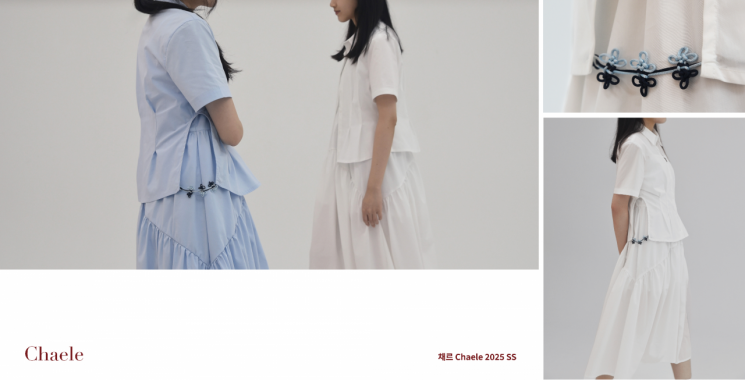
The brands created by the students showcased creativity and planning skills, each presenting distinctive products based on different themes. The work apron brand "Stitta" combined functional workwear with stylish design to propose fashion items that can be used in daily life, balancing practicality and style. "Chaele" drew inspiration from the traditional hanbok garment "dangui," reinterpreting it as a modern casual two-piece, aiming to harmonize tradition and trendiness. "Sorok" focused on consumer-oriented design by planning dresses with adjustable silhouettes to accommodate diverse body types.
Other brands stood out by combining functionality, eco-friendliness, and emotional storytelling. "Khafre" produced T-shirts using cooling functional materials to enhance sweat-wicking and comfort during summer. "Vaer" aimed to realize eco-friendly values with windbreakers made from recycled nylon. "WIMS" was inspired by the natural scenery of Jeju Island, incorporating unique colors and moods into swimwear design. "Nymph" brought the image of nymphs from Greek mythology to life as modern, stylish dresses, blending fantasy elements with fashion.
After completing brand planning and prototype production, each team registered their businesses and conducted crowdfunding through Wadiz and Tumblbug. Funding for these brands took place over about three weeks, from May 20 to June 11, 2025. As a result, six out of the seven brands achieved their funding goals and succeeded in crowdfunding. The one brand that did not meet its goal plans to reattempt with a new windbreaker product for the upcoming fall season.
The students regarded the crowdfunding process as a valuable experience, not just as a means of raising funds, but as an opportunity to communicate directly with consumers, gauge market response to their products, and seek ways to improve. In particular, feedback from actual buyers was seen as highly beneficial in objectively identifying areas for improvement in the brands.
The teams that succeeded in crowdfunding are now entering full-scale product manufacturing. Students are receiving hands-on training in all aspects of apparel production, learning specialized skills such as sewing, cutting, and pattern modification. They are also visiting manufacturing plants to gain firsthand knowledge of material selection, production scheduling, quality control, and other aspects of on-site operations.
The final products will be sold through online platforms. Each team will use a variety of digital distribution channels, such as social networking services (SNS) and e-commerce platforms, to connect directly with consumers according to the characteristics of their brands. The profits generated will go to the students, providing them with practical experience in economic concepts such as profit structure and cost calculation.
Professor Han, who founded the fashion brand "Seismic" based on his own entrepreneurial experience as an undergraduate at Konkuk University's Department of Fashion Design, is sharing his brand-startup know-how with the students. He expects that, through this, students will be able to realize their own brands as well. Professor Han said, "Going forward, we will continue to expand various hands-on, industry-linked programs so that university education is even more closely connected to the industry."
© The Asia Business Daily(www.asiae.co.kr). All rights reserved.

















