First High-Level Meeting in London After Truce
Expectations for Lifting Rare Earth and Semiconductor Export Controls
To Be Implemented Upon Approval by Trump and Xi Jinping
The United States and China have taken another step toward easing tensions by reaching an agreement on a framework to implement the 'Geneva Agreement' during their first high-level trade talks since the temporary truce in their tariff war. Attention is now focused on whether this agreement will ultimately lead to a final resolution, as both sides have used semiconductor and rare earth export controls as negotiating leverage since the truce.
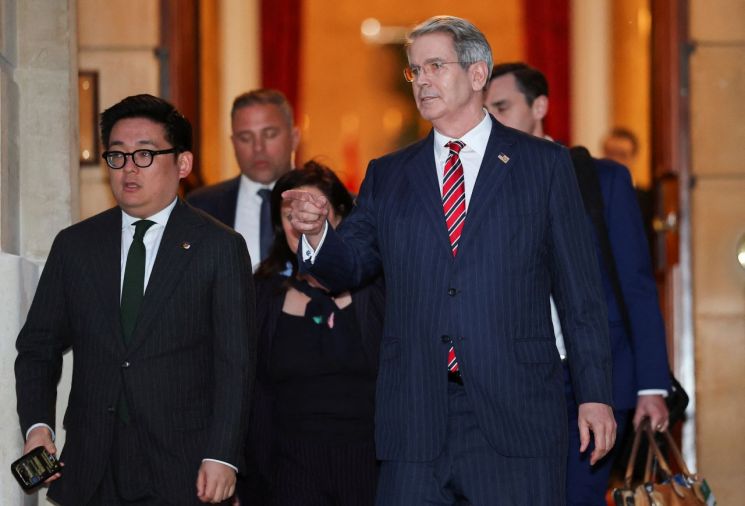
Howard Lutnick, U.S. Secretary of Commerce, said after two days of trade negotiations with China in London on the 10th (local time), "We have agreed with China on a framework to implement the Geneva Agreement," according to Bloomberg News. He added, "This framework adds specific details to the Geneva Agreement." He went on to say, "This measure will help address China's restrictions on rare earth exports," and, "If both leaders approve, we will implement it."
Li Chenggang, one of the Chinese representatives and China's Vice Minister and Chief Negotiator for International Trade at the Ministry of Commerce, also told reporters, "After two days of talks, the U.S. and Chinese delegations have reached a framework for the agreement derived from the leaders' phone call and the Geneva meeting on the 5th, and we will be reporting this to both leaders."
This London meeting was arranged to ease the heightened trade and technology tensions between the U.S. and China following the Geneva Agreement, and was prompted by a phone call between Chinese President Xi Jinping and U.S. President Donald Trump. Previously, at the first high-level trade talks held in Geneva, Switzerland on May 10-11, the U.S. and China agreed to lower their respective tariffs by 115 percentage points for 90 days, and China agreed to lift non-tariff measures.
However, the U.S.-China trade conflict, which had barely been patched up, reignited when China delayed exports of rare earths and other critical minerals. The U.S. expressed dissatisfaction, accusing China of continuing to control exports of rare earths and key minerals, and announced new regulations targeting China on the export of jet engine and semiconductor design technologies.
As tensions between the two countries persisted, concerns grew that the initial agreement could fall apart. The Wall Street Journal (WSJ) pointed out that the tariff truce reached in Geneva was being jeopardized by China's delays in rare earth exports, reporting that both countries were maintaining an unstable ceasefire.
The framework is expected to be implemented immediately once approved by both leaders. Secretary Lutnick explained, "The plan for this measure is to discuss and secure approval from President Trump, after which the Chinese side will also consult with President Xi for approval, and then the framework will be executed." He added, "When the supply of rare earths was cut off, the U.S. took various countermeasures," and, "If China approves export licenses, the U.S. will also lift export control measures in a 'balanced manner,' as President Trump mentioned." The "U.S. measures" he referred to are understood to mean export controls on advanced technologies and key components to China, including semiconductor design software, jet engine parts, and chemical and nuclear materials.
However, some point out that the two sides have only agreed on a 'principled framework' to ease controls on semiconductors and rare minerals, and that specific details are still being negotiated, making it uncertain whether this will lead to a substantive agreement.
China's state-run Xinhua News Agency reported that the two sides had reached an agreement "in principle," a term typically used in diplomacy or by Chinese state media when details have not yet been finalized.
The New York Times (NYT) noted on the same day that Xinhua described the negotiations as "professional, rational, in-depth, and candid." NYT interpreted the use of the word "candid" as an indication that there were considerable differences between the two sides, as the term is often used in such contexts.
There are also skeptical views about the sustainability of this framework agreement. Henrietta Treyz, Policy Director at economic policy analysis firm Veda Partners, said, "Two days of negotiations are better than none, but there have been many cases in the past where such lengthy talks have been repeated." She added, "It takes a lot of time to confirm language and coordinate meanings, but often ends with little progress and a maintenance of the status quo." She concluded, "This London meeting appears to be a typical example of that."
© The Asia Business Daily(www.asiae.co.kr). All rights reserved.

















