The effect of goods on encouraging donations is limited, and the majority of citizens do not recognize organizational identity from the images of goods, according to a recent survey.
On June 11, The Future Solution Lab announced the results of its "Donation Goods Awareness Survey," conducted last month through the survey platform 'TilianPro' with 1,014 adult men and women. According to the results, 50.6% of respondents said that their decision to donate was unrelated to the presence or absence of goods. Only 15.6% responded that they would donate more if goods were available. In contrast, 31.7% of respondents felt that campaigns centered on goods "blur the line between social value and commercialism," and 43.8% expressed concerns about "overheated competition."
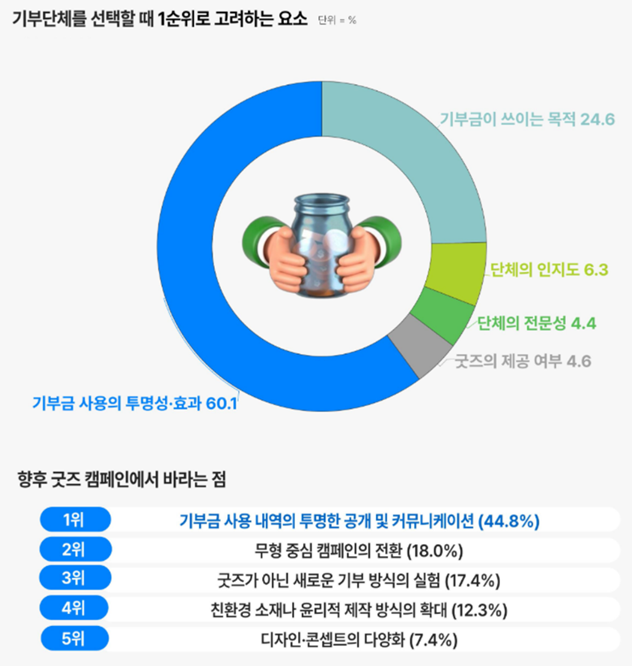
When asked about the most important factor in participating in donations or choosing an organization, 60.1% of citizens cited "transparency and effectiveness in the use of donations." For future campaigns, the highest priority was also "transparent disclosure and communication of donation usage details," at 44.8%.
The evaluation of goods images revealed limitations in conveying organizational identity. The Future Solution Lab presented promotional images for SNS goods from seven major NGOs (World Vision, Good Neighbors, UNICEF, ChildFund Korea, Save the Children, Miral Welfare Foundation, and Korea Food for the Hungry International) with the institution names concealed, and surveyed respondents' perceptions. Among the respondents, 43.4% said they "could not guess at all" which organization was represented, while 37.6% thought the images "looked like product advertisements." Additionally, 32.7% responded that "the design is attractive, but it is difficult to understand what activities are being promoted."
By age group, older respondents were less responsive to goods. The percentage of those who said their decision to donate was unrelated to goods was 35.5% among those in their 20s, 42.8% in their 30s, 47.7% in their 40s, 54.6% in their 50s, and 59.7% in their 60s.
Kim Kyungha, head of The Future Solution Lab, stated, "Goods can serve as an 'entry point' for donation participation, but it is difficult to build sustained trust without designing the post-donation experience and value." Kim added, "Rather than focusing on design competition, it is necessary to redesign how the authenticity and public value of campaign messages are communicated."
© The Asia Business Daily(www.asiae.co.kr). All rights reserved.

















