Government Aims to Approve Supplementary Budget at Cabinet Meeting by End of Month
Swift Passage Possible in National Assembly Led by Democratic Party
Supplementary Budget Size Under Review at 20 Trillion Won Standard
The government is set to approve a supplementary budget proposal at a Cabinet meeting chaired by President Lee Jae Myung as early as the end of this month.
According to the Presidential Office and the Ministry of Economy and Finance on June 11, the government is currently discussing the supplementary budget with the goal of passing it at a Cabinet meeting by the end of this month. Once the approximate size and details of the supplementary budget are finalized, the government will review the proposal for typographical errors and consistency between budget items, and then discuss it as a priority agenda at a vice-ministers' meeting. Afterward, if the supplementary budget bill is approved at the Cabinet meeting presided over by the President, a full-scale review by the National Assembly will begin.
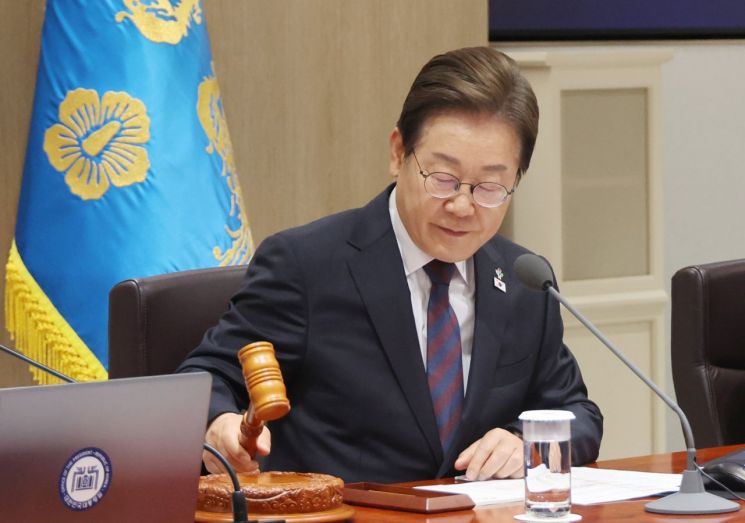 President Lee Jae Myung is striking the gavel to open the Cabinet meeting at the Presidential Office in Yongsan, Seoul on the 10th. Photo by Yonhap News
However, it appears unlikely that the supplementary budget will be passed within this month, as the ruling party has requested. While the Democratic Party of Korea is calling for the proposal to be processed during the June extraordinary session of the National Assembly, the government maintains that a minimum amount of time is required to pass the supplementary budget. An official from the Ministry of Economy and Finance explained, "It usually takes about two weeks just to check for any issues with the supplementary budget bill," and added, "No matter how quickly we move, it is too tight to complete both the Cabinet approval and the National Assembly review process within this month."
The full-scale execution of the supplementary budget is likely to begin as early as next month. If the ruling party, which holds a majority in the National Assembly, speeds up the review, the bill could pass the plenary session in just a few days. In 2020, under the Moon Jae In administration, the Democratic Party processed a record-high supplementary budget of 35.3 trillion won in just one to two hours per standing committee. The first supplementary budget bill of the Yoon Suk Yeol administration, totaling 13.8 trillion won and submitted on April 22, also passed the National Assembly plenary session in a record-fast nine days.
The total supplementary budget is expected to reach 20 trillion won. The ruling party proposed a 35 trillion won supplementary budget in February, but since the Yoon Suk Yeol administration already implemented an essential supplementary budget of 13.8 trillion won, it now sees the need for an additional supplementary budget of around 20 trillion won. Lee Hanju, Chairperson of the National Policy Planning Committee, also suggested a benchmark of 20 trillion won for the supplementary budget during a radio interview as head of the Democratic Research Institute on June 5.
While the supplementary budget could increase further during discussions, government officials involved in the process believe it will be difficult to add several trillion won more. A high-ranking official, speaking on condition of anonymity, explained, "When implementing a supplementary budget, it is important to identify areas where funds can be executed quickly," and added, "All the funds must be used within five months, and the larger the supplementary budget, the more difficult it becomes to execute."
Fiscal soundness is also a key issue. Last year, South Korea's national debt stood at 1,175.2 trillion won. The national debt-to-GDP ratio was 46.1%. With the managed fiscal deficit exceeding 60 trillion won in the first quarter, there is criticism that excessive spending could undermine fiscal health. The supplementary budget bill is expected to include measures for restoring livelihoods and stimulating the economy. The Presidential Office is reportedly discussing ways to supplement sluggish construction and consumer investment, as well as budgets to support small business owners and vulnerable groups. The nationwide livelihood recovery support payment, a core policy of President Lee, and the local currency budget are also under consideration. Budget items with little opposition from the opposition party, such as those for semiconductors and artificial intelligence (AI), are also likely to be included in the supplementary budget.
Jin Sungjoon, Policy Committee Chair of the Democratic Party, said on the 10th, "Active consideration should be given to loss compensation for small business owners who are struggling due to the civil unrest and the aircraft disaster," and added, "It is also essential to include a budget to support industrial crisis regions such as the petrochemical and steel industries."
© The Asia Business Daily(www.asiae.co.kr). All rights reserved.

















