Warning Issued and Safe Distance Secured in Case of Rear-End Collision Risk
Driving Control Technology Integrated with Sensors Such as Front Camera
An active control technology that enables a vehicle to autonomously escape dangerous situations by using sensors when another vehicle approaches from behind will soon be released to the market. This technology is expected to allow for defensive driving by predicting the movements of rear vehicles that are approaching quickly or are being driven inattentively, such as in cases of drowsy driving.
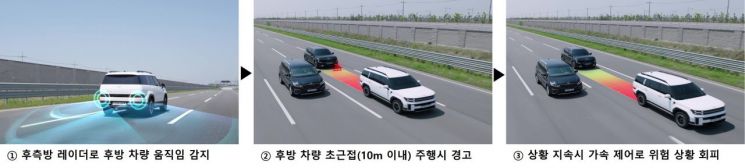
On June 11, Hyundai Mobis announced that it has developed a rear safety control technology that warns the driver and then autonomously secures a safe distance if a following vehicle is driving in dangerously close proximity.
This new technology integrates sensors such as rear-side radars and front cameras with driving control systems, and was awarded the grand prize at the 2022 'Hyundai Motor Group Idea Contest.' After about a year of dedicated development, the technology has now reached a level suitable for mass production.
This technology operates when the driver is using the Smart Cruise Control (SCC) function on the highway. If a rear vehicle is detected driving within approximately 10 meters, the sensors recognize this situation and first issue an audible warning, such as a "beep," or provide a visual alert on the cluster. If the situation does not change after a certain period, the vehicle autonomously increases its speed to secure a safe distance. At this time, the rear-side radars on both sides of the rear bumper detect the movement of the following vehicle, while the front camera recognizes the lane and the vehicle ahead to assist with safe acceleration.
Hyundai Mobis explained that it has enhanced its technological competitiveness to a level where the vehicle can autonomously adjust the distance from the vehicles in front and behind to avoid dangerous situations (autonomous control). Existing safety technologies applied by finished vehicle brands provide warnings in the event of a rear collision risk and adjust the tension of the seatbelt in preparation for impact during an accident.
Hyundai Mobis plans to further expand the scope of autonomous control. In addition to the current acceleration control function that allows the vehicle to autonomously increase speed, the company is also developing a function that automatically changes lanes to escape dangerous situations. Jung Soo-kyung, Head of the Electronics BU (Vice President) at Hyundai Mobis, stated, "We will actively protect the safety of mobility users by providing solutions that can smartly respond to dangerous situations caused not only by the vehicles in front but also by those approaching from behind during driving."
© The Asia Business Daily(www.asiae.co.kr). All rights reserved.

















