Cemtech Asia 2025 Held
Goals Set for Developing Low-Carbon Raw Material Substitution Technologies
The domestic cement industry has set a goal to reduce greenhouse gas emissions by approximately 12% by 2030 and by 53% by 2050, compared to 2018 levels.
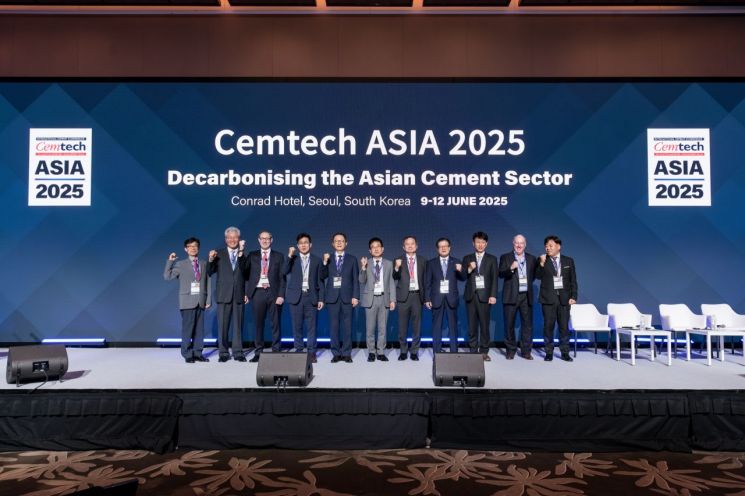 (From left) Jongseok Yoon, President of Korea Ceramic Technology Institute; Changgi Lee, Vice Chairman of Korea Cement Association; Thomas Armstrong, Editor-in-Chief (Chairman) of International Cement Review and General Manager of Semtech Asia; Wonjin Lee, CEO of Sampyo Cement; Seungryeol Lee, Director of Industrial Policy at Ministry of Trade, Industry and Energy; Geunsik Jeon, Chairman of Korea Cement Association; Inho Han, CEO of Sungshin Cement; Hyunjun Lee, CEO of Ssangyong C&E; Donghwan Bae, CEO of Sampyo Cement; Tony Hadley, CEO of THAA Ltd; Euicheol Kim, Director of Technology Development at Korea Cement Association. Provided by Korea Cement Association
The Korea Cement Association, whose members include major domestic cement companies, announced on June 10 that it had presented the "2050 Carbon Neutrality Strategy Plan for the Domestic Cement Industry" at "Cemtech Asia 2025." This event was hosted by Cemnet, a UK-based global cement industry specialist, and sponsored by the Korea Cement Association.
Euicheol Kim, Director of Technology Development at the Korea Cement Association, delivered the first keynote speech and analyzed that greenhouse gas emissions from the Korean cement industry have been decreasing since peaking in 2016, due to ongoing reduction efforts and investments.
Kim pointed out, "The emissions trading system has had a significant impact on emissions in the cement industry. During the first and second planning periods, emissions increased as production rose with the recovery of the construction market. At times when emissions allowance prices were high, most cement companies faced a shortage of allowances, resulting in considerable difficulties." He added, "These challenges have become a driving force for the industry to work even harder toward achieving carbon neutrality."
He summarized the efforts toward carbon neutrality in the Korean cement industry into three pillars: carbon-neutrality and ESG management based on a joint declaration; continuous facility investment for carbon neutrality; and research and development for the production of low-carbon products.
Kim stated, "In particular, R&D is expected to become the most important pillar. With government support, we are currently pursuing core carbon-neutral technologies for fuel switching and raw material conversion, together with the steel, petrochemical, and semiconductor industries."
For raw material conversion, the domestic cement industry plans to develop technologies to replace limestone with low-carbon materials (non-carbonate materials) in clinker production, aiming to increase the limestone substitution rate by more than 2% by 2030. In addition, to reduce clinker usage, the industry is developing blended cement manufacturing technologies that use new supplementary materials (such as limestone powder and calcined clay) in addition to the existing three types of supplementary materials.
For fuel switching, the industry announced plans to develop key technologies for the use of alternative resources, such as pre-treatment and pollutant control, to replace fossil fuels like bituminous coal with recycled resources (such as waste synthetic resin) and carbon-free fuels (such as biomass and hydrogen). The goal is to achieve a substitution rate of over 80% for recycled resources by 2030 and to develop technologies for the uniform supply of heat sources needed for biomass and hydrogen combustion. To this end, Kim emphasized that active R&D efforts and the revision and establishment of cement KS standards are essential for demonstration and commercialization following technology development.
Kim explained, "From the late 2010s to the present, the Korean cement industry has invested about KRW 1 trillion in fuel conversion facilities to utilize combustible waste, and as a result, has achieved the 2030 target fuel substitution rate of 36% ahead of schedule. The industry has also invested significant amounts in waste heat recovery power generation, which has contributed to lowering the greenhouse gas emission factor per unit of cement product."
© The Asia Business Daily(www.asiae.co.kr). All rights reserved.
![Clutching a Stolen Dior Bag, Saying "I Hate Being Poor but Real"... The Grotesque Con of a "Human Knockoff" [Slate]](https://cwcontent.asiae.co.kr/asiaresize/183/2026021902243444107_1771435474.jpg)
















