Tourist Passage Restrictions Begin in March at Hanok Village
Mixed Reactions from Residents and Merchants
"There are none. By 4:30 in the afternoon, there isn't a single person around."
Choi Jeongsook (62), who runs a convenience store near Bukchon Hanok Village in Gye-dong, Jongno-gu, Seoul, is having a difficult time. Since the implementation of the tourist passage restrictions in the Hanok Village in March, her sales have dropped by more than 10 million won. Choi said, "After the Constitutional Court impeachment was over, I tried to get my business going again, but now this is happening," adding, "In the summer, the sun is still up even at 7 PM, but these days, by 4:30 PM, all the tourists are gone and there is no one left." Lee Taegyu (46), who runs a souvenir shop at the entrance of the Hanok Village, also saw his monthly sales fall by 30 to 50 percent after the passage restrictions were put in place. Lee said, "If tour buses stop coming in July, the damage will only get worse, so I'm worried."
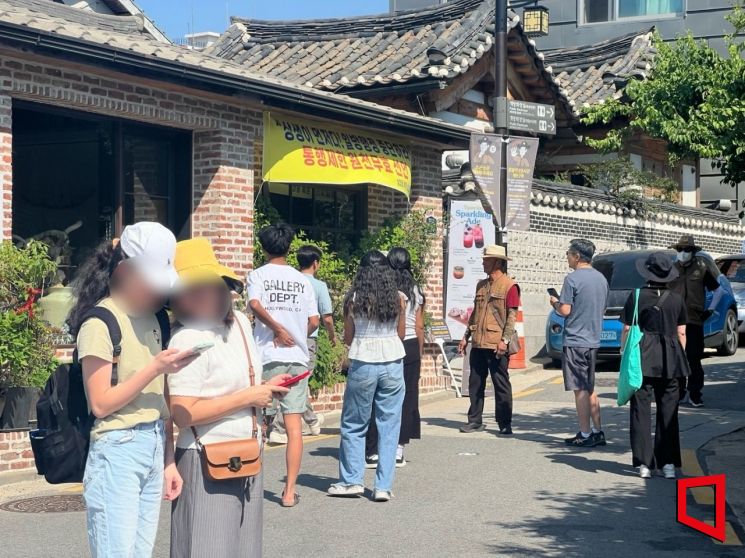 Tourists waiting to enter or turning back following the security guard's guidance restricting passage around 9:50 AM. Photo by Lee Eunseo.
Merchants in the Bukchon Hanok Village area, where tourist passage restrictions have been fully enforced to address overtourism, are growing increasingly anxious. From 5 PM to 10 AM the next day, tourists leave the area, so they are unable to benefit from the peak summer season at all.
On June 10, banners reading "Coexistence comes first! Stop unilateral administration" were seen at shops around Bukchon Hanok Village. As Bukchon 11-gil in the Hanok Village was designated a red zone and passage was restricted, merchants have been protesting because of the impact on nearby businesses. It was also common to see foreign tourists turning back after learning about the restrictions. Kim (65), the owner of a cafe across from the Hanok Village, said, "The passage restriction is technically only for the Hanok Village, but all the surrounding businesses are affected," adding, "People come here, then visit Insadong or Gye-dong, and shop while touring the village, but with the passage restrictions, won't the number of visitors keep dropping?"
Some have questioned the exception that allows residents, merchants, guests at accommodations, and shop customers to pass through. Not only is it difficult to clearly distinguish who qualifies, but it also creates a stiff atmosphere in the tourist area. Park (38), who is both a resident and merchant, said, "Blocking even basic passage to Samcheong-dong while allowing visitors to commercial spaces under the system is ambiguous," adding, "There are people who want to promote Korean culture through their businesses, so if you block all foreigners indiscriminately, aren't you preventing foreigners who are genuinely interested in Korean culture from visiting?"
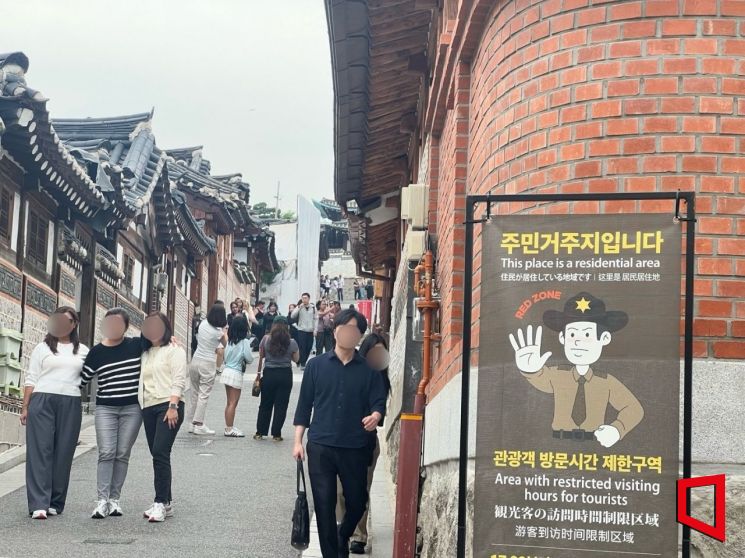 Foreign tourists lowering their voices and quietly sightseeing in Bukchon Hanok Village. Photo by Eunseo Lee
Some residents have responded positively, saying the neighborhood has become quieter. Kim (90), who has lived here for 52 years, said, "When I was trying to rest in the evening, the doorbell would ring five times, and when I went out, people would grab my pant leg asking to use the bathroom," adding, "Now there are no outsiders at night, and the neighborhood is quiet, so I feel at ease." Park Jeonghee (67) also said, "In a hanok, the room is right next to the wall, and people would take pictures by the wall from early morning so I couldn't sleep, and they would even shake the door handle, which startled me," adding, "I'm glad the passage restrictions are in place."
Although their perspectives differ, both merchants and residents share the hope for coexistence in the Hanok Village. Resident Lee Yeonseong (38) said, "I like that foreigners come and bring vitality to the neighborhood," adding, "I hope the unique character of the village, which is both a residential area and a tourist destination, can be preserved." The owner of a samgyetang restaurant, Lee (50), also said, "Rather than sacrificing one side for the other, I hope they consider flexibly adjusting the passage restriction hours for summer and winter, or introducing a city tax to provide welfare benefits to residents."
Kim Namjo, a professor in the Department of Tourism at Hanyang University, said, "To prevent the problem of overtourism from recurring, the priority must be given to local residents," adding, "It is necessary to continue informing foreigners about the passage restriction policy, and residents and merchants should work together to come up with solutions such as flexible restriction hours or a city tax for coexistence."
© The Asia Business Daily(www.asiae.co.kr). All rights reserved.


















