Despite the Decline, Prices Remain Twice as High as Last Year
Japanese Government to Release Additional "Half-Price Reserved Rice"
Agriculture Minister Koizumi: "We Will Do Whatever Is Necessary"
After repeatedly surging since November of last year, rice prices in Japan have declined for two consecutive weeks for the first time in half a year. On June 10, Yonhap News, citing an announcement from the Japanese Ministry of Agriculture, Forestry and Fisheries, reported that the average price of rice (based on 5 kg) sold at 1,000 supermarkets nationwide from May 26 to June 1 fell by 0.9% compared to the previous week, reaching 4,223 yen (approximately 40,000 won). Although rice prices have declined for two consecutive weeks, they remain nearly twice as high as the average price during the same period last year (2,136 yen). The Asahi Shimbun explained that the increase in the distribution volume of government-reserved rice, which is cheaper than market prices, appears to have contributed to the decline in rice prices.
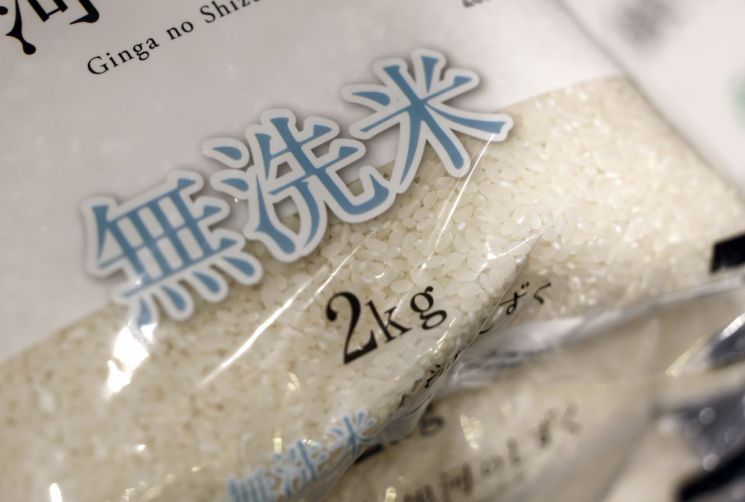 The Japanese Ministry of Agriculture, Forestry and Fisheries announced that the average price of rice (based on 5 kg) sold at 1,000 supermarkets nationwide from the 26th of last month to the 1st of this month dropped by 0.9% compared to the previous week, reaching 4,223 yen (approximately 40,000 won). Photo by EPA Yonhap News
The so-called "half-price reserved rice," which Agriculture Minister Shinjiro Koizumi released through private contracts directly with retailers instead of the traditional bidding method, began to be sold in stores on May 31, so this survey result barely reflects its impact. Accordingly, some analysts suggest that rice prices are likely to fall further next week.
In this context, the Nihon Keizai Shimbun (Nikkei) reported that the inter-company trading price for 60 kg of Koshihikari brown rice from Niigata Prefecture dropped by 8% from the previous week to about 45,250 yen (approximately 424,000 won) as of the previous day. The trading prices of some other well-known rice varieties from different regions also fell by more than 10%. However, Nikkei analyzed that the supply of half-price reserved rice tends to be concentrated in major urban areas, such as the Tokyo metropolitan area, Osaka Prefecture, and Hyogo Prefecture in the Kansai region. Nikkei stated, "Thirty large local government areas remain 'blank zones,'" and emphasized, "From the middle of this month, the nationwide expansion of reserved rice supply is necessary to eliminate regional price gaps."
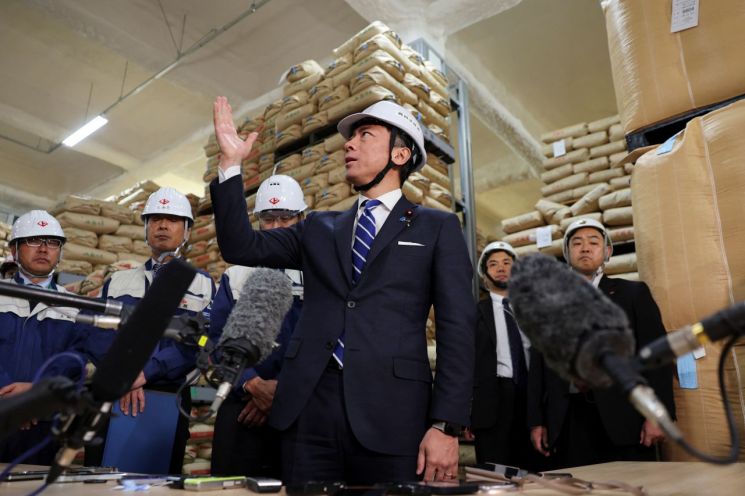 Since his inauguration on the 21st of last month, Agriculture Minister Koizumi, who declared that he would consider all options to control rice prices, announced on this day that an additional 100,000 tons of reserved rice from 2020 and 100,000 tons from 2021 would be released through private contracts. Reuters·Yonhap News
Meanwhile, since his inauguration on May 21, Agriculture Minister Koizumi has declared that he would consider all options to control rice prices, and on this day announced plans to additionally release 100,000 tons of reserved rice from 2020 and 100,000 tons from 2021 through private contracts. Minister Koizumi also stated the previous day that he is considering advancing the timing of importing up to 100,000 tons of staple rice from abroad, which Japan can import tariff-free. In addition, regarding concerns raised by some Liberal Democratic Party lawmakers about expanding rice imports, he emphasized, "I am not aware of any calls for caution," and stressed, "We will do whatever is necessary to prevent a sharp rise in prices."
© The Asia Business Daily(www.asiae.co.kr). All rights reserved.
![Clutching a Stolen Dior Bag, Saying "I Hate Being Poor but Real"... The Grotesque Con of a "Human Knockoff" [Slate]](https://cwcontent.asiae.co.kr/asiaresize/183/2026021902243444107_1771435474.jpg)

















