National Tax Service Launches Asset Tracing Investigations on 710 Habitual High-Value Tax Delinquents
Collected 2.8 Trillion Won Through Asset Tracing Investigations Last Year
A, the CEO of a home appliance wholesale corporation, was found to have received false tax invoices and was imposed with value-added tax amounting to several hundred million won, but failed to pay. In response, the National Tax Service conducted simultaneous searches of A's residence and the corporation's business premises. Through this operation, the National Tax Service discovered bundles of 100,000-won checks disguised as trash under newspaper on the taxpayer's home balcony, collecting a total of 500 million won.
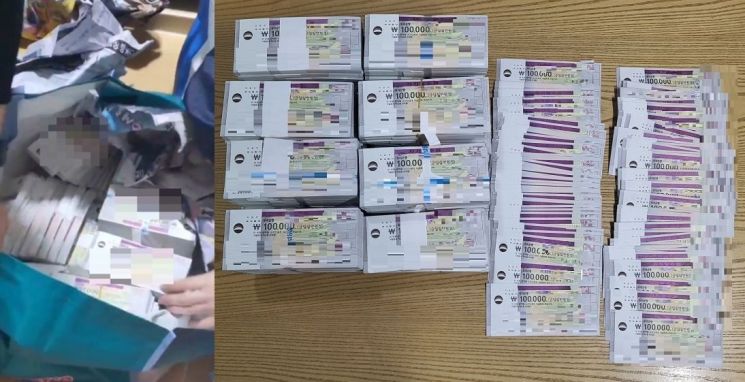 A bundle of checks worth 500 million won found through a search by the National Tax Service. (Photo by National Tax Service)
Tax delinquent B failed to pay capital gains tax on a commercial property in Nowon-gu, Seoul. The National Tax Service confirmed B's actual residence through CCTV at the registered address, then opened the front door of B's residence with police officers while B was absent to conduct a search. The National Tax Service found gold bars worth several hundred don and cash totaling 300 million won in a hiking backpack that B usually carried.
On June 10, the National Tax Service announced that it has selected 710 habitual high-value tax delinquents for property tracing investigations. The agency expects the total amount of their tax arrears to exceed 1 trillion won.
An Deoksu, Director of the Collection and Legal Affairs Bureau at the National Tax Service, stated, "The National Tax Service is strictly conducting property tracing investigations on habitual high-value tax delinquents who evade compulsory collection through sophisticated or irregular methods, or who deliberately conceal assets and fail to pay taxes despite having the ability to do so. This round of property tracing investigations targets 710 habitual high-value tax delinquents who have hidden assets or are living extravagantly while evading tax payments."
First, the National Tax Service is conducting property tracing investigations on 224 delinquents who are evading compulsory collection through sham divorces and donations to related religious organizations. These individuals have avoided compulsory collection by immediately filing for sham divorces upon receiving tax bills and dividing their assets. Others have donated assets to related religious organizations or transferred listed stocks to family members and relatives to avoid compulsory collection. For these tax delinquents, the National Tax Service is filing lawsuits to invalidate fraudulent transfers to recover assets diverted to evade compulsory collection, and is taking measures such as filing criminal complaints against delinquents and related parties when acts of evasion to avoid collection are identified.
Another 124 delinquents who concealed assets in borrowed-name accounts or bank safe deposit boxes are also subject to property tracing investigations. These individuals avoided paying taxes by diverting business income to family members and holding 10 commercial properties in borrowed names, or by receiving income, accounts receivable, and loans through borrowed-name accounts. Some delinquents opened VIP bank safe deposit boxes to hide cash, high-value checks, and gold bars. The National Tax Service is filing lawsuits to cancel title registrations for real estate held in borrowed names, tracing the use of borrowed-name accounts through financial inquiries, and sealing and seizing safe deposit boxes as part of its property tracing efforts.
Additionally, 362 delinquents who purchased luxury goods such as designer bags at department stores or luxury shops, or whose personal or non-income-earning family members' spending is excessive, as well as those living in high-end residences while falsely registering their address to conceal their actual residence and maintain an extravagant lifestyle, are included in the property tracing investigations. The National Tax Service is conducting intensive on-site collection activities, including inquiries, stakeouts, and searches of suspected asset concealment locations such as actual residences and business premises, using big data-based real residence analysis systems for these delinquents.

Last year, the National Tax Service intensified property tracing investigations and on-site collection activities such as inquiries and searches for delinquents who concealed assets using new methods, including high-value artwork, imported luxury car leases, and renunciation of inheritance shares. The agency conducted 2,064 on-site searches to find and seize hidden assets of delinquents and filed 1,084 civil lawsuits to recover diverted assets. In addition, 423 individuals who evaded or assisted in evading compulsory collection were subject to criminal penalties. As a result of last year's property tracing investigations on habitual high-value tax delinquents, the National Tax Service collected or secured claims totaling 2.8 trillion won.
Director An stated, "We will further strengthen our response to habitual high-value tax delinquents by expanding the operation of dedicated tracking teams at tax offices and by enhancing the accuracy of target selection through the advancement of tracking and analysis systems using artificial intelligence (AI) and big data. The National Tax Service will mobilize all compulsory collection measures, including property tracing investigations, public disclosure of names, and travel bans, to strongly respond to unfair practices that undermine fair taxation, thereby upholding tax justice."
© The Asia Business Daily(www.asiae.co.kr). All rights reserved.


















