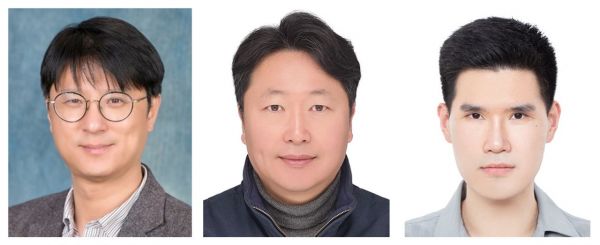
 (From left) Professor Jaeyoung Lee of GIST, Professor Gangmu Heo of Chungnam National University, and PhD candidate Seyun Park of GIST.
A team of Korean researchers has developed a "conductive hydrogel platform" that can treat extensive muscle injuries through a simple injection method, drawing attention as a next-generation regenerative medicine therapy.
On June 10, the Gwangju Institute of Science and Technology (GIST) announced that a joint research team led by Professor Jaeyoung Lee of the School of Materials Science and Engineering at GIST and Professor Gangmu Heo of the Department of Organic Materials Engineering at Chungnam National University has developed an injectable conductive hydrogel capable of effectively treating volumetric muscle loss (VML).
This research is significant because it goes beyond merely "physically supplementing" damaged tissue and serves as an active regenerative therapy platform that induces cellular activation and functional recovery within the body.
VML is a condition in which skeletal muscle tissue is extensively damaged due to causes such as traffic accidents, military injuries, surgical procedures, or intense physical activity. It is a refractory injury that is difficult to recover from naturally.
Until now, autologous tissue transplantation has been the primary treatment. However, the amount of tissue available for transplantation is limited, and secondary complications such as infection, pain, and scarring may occur at the donor site, making treatment challenging.
As an alternative to overcome these limitations, tissue regeneration technologies based on "hydrogels" have recently attracted attention. Hydrogels, which are based on natural and synthetic polymers, can mimic the structure and mechanical properties of biological tissues and offer high biocompatibility, making them a promising alternative to tissue transplantation. Research in this area is actively underway.
In particular, for electrically active tissues such as skeletal muscle, cardiac muscle, and nerves, conductive hydrogels utilizing conductive materials are especially noteworthy, as they can promote the electrical activity of cells and enhance tissue regeneration effects.
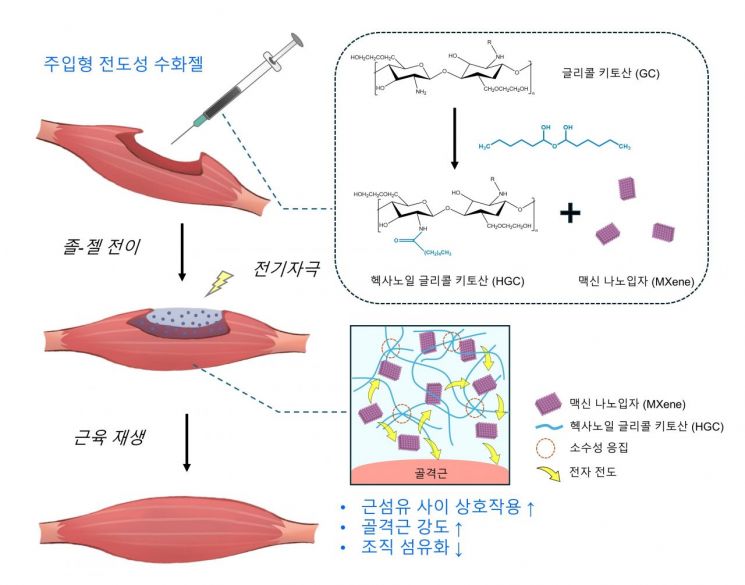
The research team developed a temperature-responsive hydrogel by introducing a hexanoyl structure, which has hydrophobic properties, into the natural polymer glycol chitosan. They then combined this with highly conductive "Maxin (MXene)" nanoparticles to create an injectable conductive hydrogel.
This hydrogel remains in a liquid state at room temperature but transitions to a gel state at body temperature (around 30°C), allowing for easy injection. It can be precisely positioned and fixed even in irregular muscle injury sites.
To verify the hydrogel's applicability in vivo, the team conducted injection experiments on laboratory mice with induced VML. When comparing the group treated with hydrogel alone to the group that also received electrical stimulation, they found that the hydrogel alone enabled muscle tissue regeneration and functional recovery. When electrical stimulation was combined, muscle contractile strength (85.4 ± 13.5% compared to normal skeletal muscle) and tissue regeneration effect (weight recovery of 86.6 ± 4.4%) were further significantly improved.
Professor Jaeyoung Lee of GIST stated, "The injectable conductive hydrogel we have developed can be applied not only to muscle tissue regeneration but also to the regeneration of various electrically active tissues such as the heart, peripheral nerves, and brain. It will become a new therapeutic paradigm that overcomes the limitations of conventional autologous transplantation methods."
© The Asia Business Daily(www.asiae.co.kr). All rights reserved.
![Clutching a Stolen Dior Bag, Saying "I Hate Being Poor but Real"... The Grotesque Con of a "Human Knockoff" [Slate]](https://cwcontent.asiae.co.kr/asiaresize/183/2026021902243444107_1771435474.jpg)

















