Carney Stresses Need to Rapidly Build Defense Capabilities
Canada, which has faced pressure from U.S. President Donald Trump to become the "51st state," has decided to significantly increase its defense budget in order to reduce its security dependence on the United States.
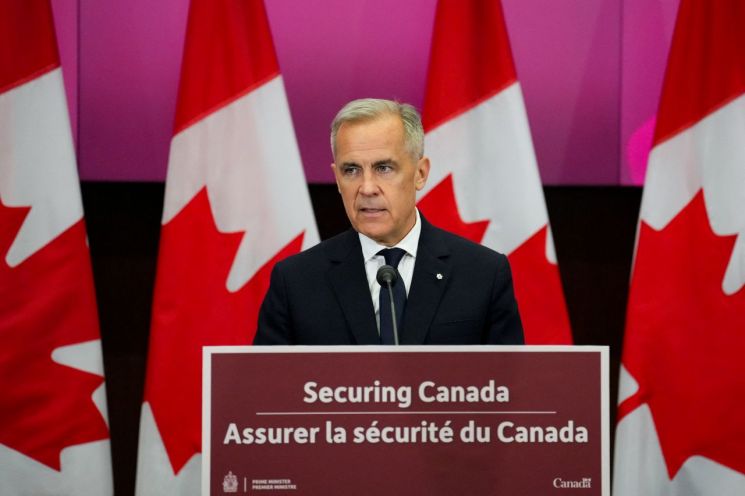
On June 9 (local time), Canadian Prime Minister Mark Carney announced in a defense and security strategy briefing that Canada plans to achieve its defense spending target of raising the defense budget to 2% of its gross domestic product (GDP) within the current fiscal year (April 2025 to March 2026). In his speech, Carney stressed, "In an increasingly dangerous and divided world, Canada must assert its sovereignty."
Carney emphasized that the increase in defense spending will not only strengthen the defense sector but also create opportunities for Canadian businesses across related supply chains, thereby making Canada stronger. He specifically pointed out that Canada has so far paid about three-quarters of its defense spending to the United States, mainly for arms purchases, and expressed the need to reduce this amount. Carney has previously outlined his intention to reduce Canada's defense dependence on the United States, instead building up Canada's own security capabilities and strengthening security cooperation with European allies.
The newly increased defense spending plan includes improvements to Canadian military salaries, acquisition of new aircraft, armored vehicles, and munitions, development of new drones and sensors for underwater and Arctic surveillance, and capacity building in artificial intelligence (AI), cyber, quantum, and space sectors. Through these investments, Canada aims to significantly enhance core capabilities such as over-the-horizon (OTH) radar in the Arctic, a joint counter-drone program, joint support ships, long-range precision strike capabilities, and munitions production.
The Canadian government explained that defense-related investments included in this fiscal year will exceed 9 billion Canadian dollars (approximately 8.9 trillion won).
As Canada seeks to bolster its defense capabilities, South Korea has also been working to build a defense and security partnership, holding a diplomatic and security (2+2) ministerial meeting with Canada in November last year to discuss cooperation in the defense industry. In March, South Korea's Defense Acquisition Program Administration announced that South Korean defense companies would participate as a "one team" in Canada's submarine acquisition project. Meanwhile, Canadian public broadcaster CBC last month highlighted South Korea's rapidly rising defense industry capabilities on the global stage, reflecting growing interest in South Korea's defense industry competitiveness not only within the Canadian defense sector but also in the media.
Canada's current defense spending as a share of GDP is about 1.4%, which falls far short of the North Atlantic Treaty Organization (NATO) guideline of 2% of GDP. With this announcement, Canada will achieve its defense spending target five years earlier than previously planned. The previous government, led by former Prime Minister Justin Trudeau, had pledged to reach the 2% of GDP defense spending target by 2032, while Carney promised during the last election to achieve this goal by 2030. Carney stated, "We will quickly procure new equipment and technology and build defense industry capabilities to meet the defense spending target promised to NATO this year," adding, "Canada will seize this opportunity with urgency and determination."
© The Asia Business Daily(www.asiae.co.kr). All rights reserved.

















