"Unilateral Decision Without Residents' Consent Is Unacceptable"
Mayor Park Gangsu: "We Will Mobilize All Means, Including Legal Action"
On the afternoon of June 9, Mapo District in Seoul held a press conference in front of the Mapo Resource Recovery Facility, strongly criticizing the "Mapo Resource Recovery Facility Joint Use Agreement" that the Seoul Metropolitan Government signed without including Mapo District.
Park Gangsu, mayor of Mapo District, stated, "We can never accept an agreement that was made without the consent of Mapo District and its residents," emphasizing that "the right to life and health of residents is an invaluable value that cannot be measured in monetary terms."
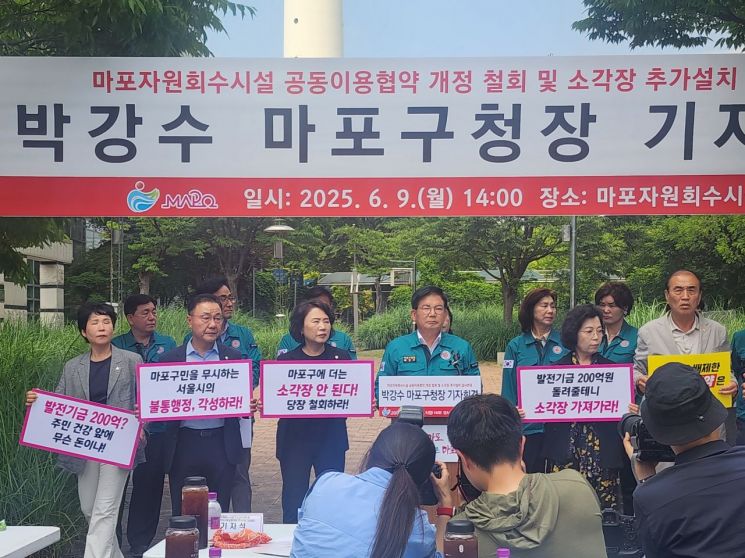 Park Gangsu, mayor of Mapo District, held a press conference on the 9th, opposing the additional installation of the Mapo Resource Recovery Facility (incinerator) and claiming the joint use agreement is invalid. Photo by Kim Minjin.
On this day, the district also firmly declared its position that it would never accept the "additional installation of a metropolitan resource recovery facility." The conflict began in August 2022, when the Seoul Metropolitan Government unilaterally announced its plan to select Sangam-dong in Mapo District as a candidate site for a new 1,000-ton metropolitan resource recovery facility.
Mapo District proposed various alternatives to the Seoul Metropolitan Government to reduce waste without the need for an additional incinerator, but the city ignored these suggestions. Mapo residents strongly opposed the city's unilateral decision and filed an administrative lawsuit to cancel the public notice designating the site for the metropolitan resource recovery facility. On January 10, the court ruled in favor of the Mapo residents.
However, the Seoul Metropolitan Government did not accept the ruling and immediately filed an appeal. In response, Mapo District submitted a petition with the signatures of over 38,000 residents to the Seoul High Court and the Seoul Metropolitan Government, demanding that the appeal be withdrawn.
After the joint use period of the existing incinerator expired, the Seoul Metropolitan Government unilaterally signed the agreement with four other districts that dispose of waste, excluding Mapo District, which is a key party to the agreement.
The agreement unilaterally extends the usage period from the original "20 years from the start of use" to "until the facility is closed." As effective alternatives, Mapo District proposed signing the agreement on a yearly basis, forming an operations committee with a majority of Mapo District officials and members of the Residents Support Council, withdrawing the appeal, and reducing waste in Seoul by 10% annually for the next five years. The Seoul Metropolitan Government rejected all of these proposals.
Mayor Park pointed out, "Although more than 20 years have passed since the closure of the Nanjido landfill, the history of tears in Mapo continues, only in a different form." He added, "The Seoul Metropolitan Government has ignored the 'principle of processing household waste at its place of origin' and has made Mapo District process 3.5 million tons of waste from four neighboring districts over the past 20 years." He further stated, "The Seoul Metropolitan Government lost the lawsuit due to procedural flaws after forcibly pushing ahead with the additional installation of a 1,000-ton incinerator without following legal procedures. Now, the city has once again ignored procedural legitimacy by changing the joint use agreement for the Mapo Resource Recovery Facility, excluding only Mapo District and the Mapo Residents Support Council. This is both shocking and deeply hurtful."
Mayor Park stressed, "The joint use agreement for the Mapo Resource Recovery Facility is not a light matter that can be decided through mere advisory consultations." He continued, "The entrusted waste processed by the four districts amounts to 329,900 tons per year, which places a significant environmental and health burden on Mapo residents."
He also criticized the changed agreement that excluded Mapo District, saying, "It is as if the perpetrators gathered and reached an agreement without the victim," and added, "To use a housing analogy, it is like a broker acting as the owner and signing a lease contract with tenants while excluding the real owner, which is an act that defies common sense."
Regarding the claim that the four participating districts paid around 20 billion KRW as financial compensation at the time of the initial incinerator installation, Mayor Park strongly objected, saying, "The right to life and health of residents is an invaluable value that cannot be measured economically. We will return the 20 billion KRW, so move the incinerator elsewhere."
Mapo District made it clear that the amended joint use agreement for the Mapo Resource Circulation Facility is invalid and announced plans to mobilize all possible means, including legal action, together with residents, to ensure that the opinions of Mapo residents are fully reflected through transparent and official renegotiations.
The district also reaffirmed its opposition to the additional installation of a new incinerator and its firm stance to respond strongly to the unreasonable administrative actions of the Seoul Metropolitan Government, which is trying to make Mapo a scapegoat.
Mayor Park emphasized, "Although the Seoul Metropolitan Government has stressed that 'Mapo residents are also citizens of Seoul,' all of its current decisions are forcing only Mapo residents to make sacrifices. There is nothing more important than the lives, health, and pursuit of happiness of Mapo residents." He warned, "We will stand our ground and fight to the end, responding strongly to the Seoul Metropolitan Government's uncommunicative administration."
© The Asia Business Daily(www.asiae.co.kr). All rights reserved.

















