Behind Peter Schreyer's Recruitment at Kia
Strengthening 'Design Management' Sparked by Schreyer's Appointment
Brand Strategy, Public Reputation, and Work Culture Transformed
Success of the K Series Boosts Employee Confidence
Kia Sweeps Global Design Awards, Emerges as a Design Powerhouse
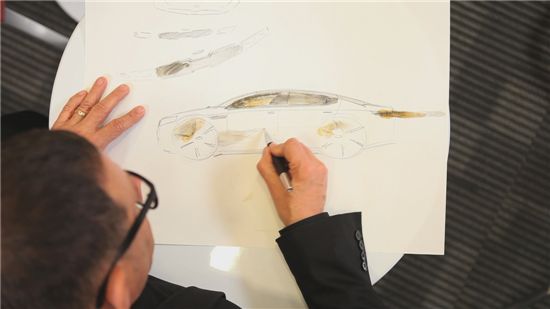 Car design sketch drawn by Peter Schreyer, former head of design management at Hyundai Motor Group. Provided by Kia.
In 2006, while driving on the German Autobahn, Peter Schreyer received an unexpected phone call. The caller, who introduced himself as Kia's CEO, asked if Schreyer would be interested in meeting to discuss a position as head of design at Kia. It was a very cautious approach, characteristic of Koreans. At the time, Schreyer knew little about Kia other than that it was a Korean car brand and that a former colleague had joined the company a year earlier. This call marked the beginning of what would become a nearly 20-year relationship with Kia. As soon as the call ended, Schreyer intuitively sensed that he was at the start of a major project. Like an arrow released from a bow, he began moving toward a new challenge in the latter half of his life.
That same year in Seoul, Jeong Euisun, then President of Kia (now Chairman of Hyundai Motor Group), was contacting the European branch almost daily. He was checking on the progress of the first major project he was leading since becoming CEO. The name of the new project he spearheaded was "Design Kia." Jeong wanted to imprint the Kia brand in the minds of people worldwide with a completely different image. It was virtually impossible for a latecomer Korean brand to catch up overnight with the engine technology that German, Japanese, and American brands had built up over decades. Instead, Jeong believed that Kia could compete in the creative field of design. Design was the fastest shortcut to attempt brand innovation in a short period. Recruiting a world-class designer to lead Korean designers was essential.
Even as the Kia team pushed the project forward, they were skeptical. Since Jeong Euisun, the heir apparent, was personally leading the initiative, they were making inquiries, but the chances of success seemed close to zero. On the other hand, hiring a second-rate figure would have drawn criticism from the very start of the project. Until the mid-2000s, Kia's position in Europe was quite unstable. No matter how much money was offered, global C-level executives were not interested in joining Kia, as they believed that working there would not benefit their careers at all.
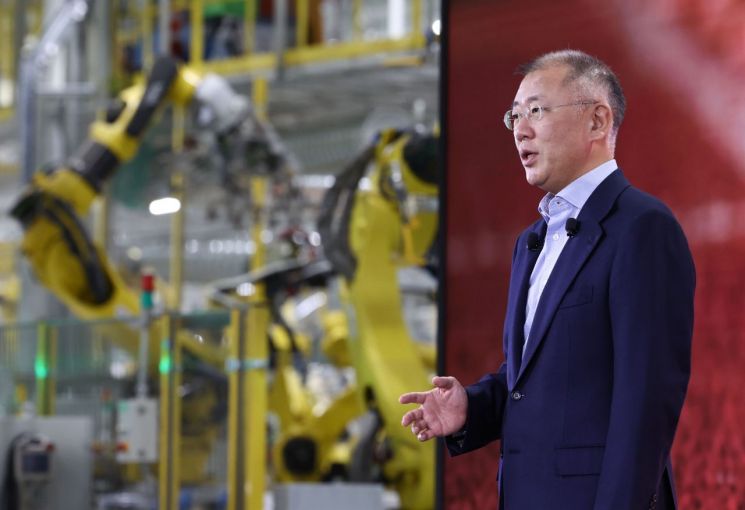 Hyun Jeeson, Chairman of Hyundai Motor Group, is delivering a New Year's address at the 2024 Hyundai Motor Group New Year's event held at Kia Autoland Gwangmyeong. Photo by Yonhap News
In May of that year, Jeong invited Peter Schreyer to Korea. Schreyer is regarded as one of the world's top three automotive designers. He led the design of global mega-hit models such as the Audi TT, Volkswagen New Beetle, and Golf. Kia offered Schreyer a salary of 1 million euros?more than the CEO at the time?and the position of Executive Vice President of Design. Jeong used every possible means to show Schreyer a vision that went beyond compensation. At the Namyang R&D Center, he showcased the passion of Korean designers and discussed the future they could build together. At their first meeting, he even invited Schreyer's family to his private residence for a meal, recognizing that Schreyer valued family bonds and close human relationships, and using this to persuade him. Later, in his autobiography, Schreyer recalled, "Kia was a brand like a blank canvas where anything could be drawn," and "From the first moment I met Jeong Euisun, I felt a strong attraction based on deep empathy that we could build a connection."
Schreyer’s recruitment brought three major changes to Kia: ▲The brand strategy shifted to a design-centric approach; ▲Schreyer’s success at Kia paved the way for recruiting top global C-level executives; and ▲A horizontal and creative working style began to spread throughout the company.
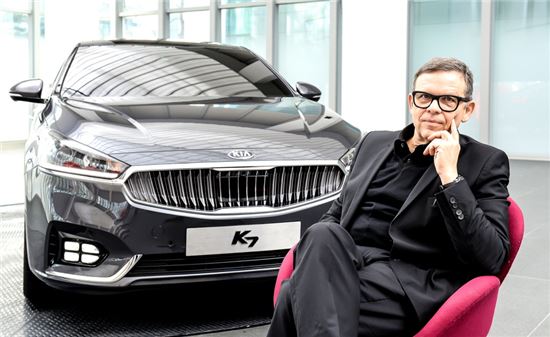 Peter Schreyer, former President of Design Management at Hyundai Motor Group. Photo by Kia
Kia's Turning Point: Design
After Schreyer joined, Kia's design underwent a dramatic transformation. The change was not simply an upgrade of products; it became a representative case showing how design can reveal a brand's identity and deliver a consistent message to consumers, beyond just making the exterior look better.
Previously, most Kia cars featured functional, unremarkable designs. While they appeared rounded and clean, they lacked character and left a rather ordinary impression. There was no consistency across the lineup, and it was hard to find the essence of automotive design?proportional aesthetics.
Let’s look at the design of Kia’s flagship models from the early 2000s. For example, the 1997 Kia Sephia 2 emphasized a more streamlined look compared to the boxy first generation. Although the use of curves on the front, sides, and rear was considered trendier, some said it resembled Japanese cars. The Spectra, which succeeded the Sephia, was praised for balancing design and functionality, but was still criticized for lacking character. The interiors used inexpensive materials, reinforcing the image of a value-for-money car. Overall, the main assessment of Kia’s design was that it imitated Japanese brands but lacked individuality and detail.

Schreyer aimed to give Kia’s design a unique identity and establish a clear brand character. His goal was for people to recognize a Kia at a glance, just by looking at its exterior. To achieve this, he introduced the "tiger nose" grille to the front of the car?the face of the vehicle. This wide grille, with its center indented vertically, became Kia’s signature. The core concept of the tiger nose design was first applied to the "Kee" concept car unveiled by Kia in 2007, and then rolled out across the lineup, from the K7 large sedan to the K5 midsize sedan, and even to the compact SUV Soul and the Morning city car.
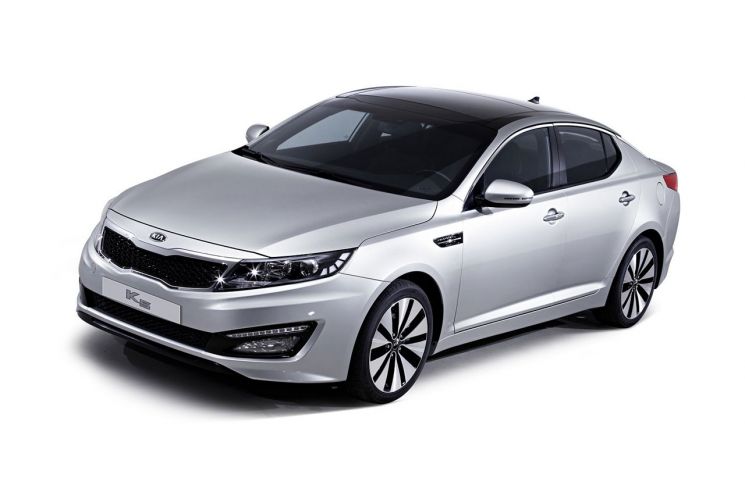
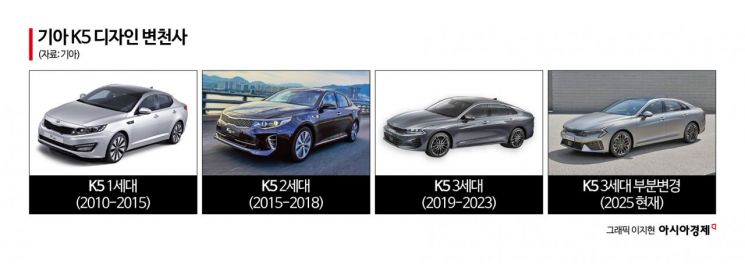
The model that benefited most from this design transformation was the midsize sedan K5. Before 2010, the domestic midsize sedan market was dominated by Hyundai's YF Sonata and Renault Samsung's SM5. The YF Sonata attempted a radical design shift compared to the previous NF generation, which some consumers disliked. In contrast, the competing SM5 barely changed its design, earning a reputation for being outdated. Kia created a model that struck a balance between these extremes. The K5 was conceived as a stylish sedan targeting young, middle-class consumers in their 30s and 40s. From the side, the coupe-like roofline flows smoothly from the roof to the rear, emphasizing a sleek silhouette. The long hood and short trunk proportions give it a dynamic feel. Chrome accents running from the front windshield pillar (A-pillar) to the rear window make the car look slimmer and longer than it actually is.
The K5 instantly captured the hearts of consumers in their 30s and 40s, selling 10,673 units in June 2010 alone?surpassing the competing YF Sonata (9,957 units) and SM5 (7,315 units). Of course, the K5’s new model effect lasted only two to three months, and on an annual basis, the Sonata still led in sales. However, this was the first time the industry realized that the "national car" Sonata’s dominance could be challenged. Internally at Kia, it was a turning point that lifted the sense of defeat lingering since the 1998 merger with Hyundai Motor Group, and instilled confidence among employees that "we can do it."
Kia Sweeps Global Design Awards, Emerges as a Design Powerhouse
After stepping down as head of design management at Hyundai Motor Group in 2021, Schreyer has since completed his advisory role. The design legacy he left at Kia is being carried on by successors such as Luc Donckerwolke, Chief Creative Officer (CCO) of Hyundai Motor Group, and Karim Habib, Vice President of Global Design at Kia. Kia continues to present emotionally resonant and distinctive designs based on its design philosophy, "Opposites United"?the creative fusion of contrasting concepts.
Automotive design is a field where personal preferences can vary widely. While there are no absolute standards, there are common elements that form a consensus around what makes "good automotive design." First, car design must possess functional completeness beyond mere beauty. Aerodynamics, visibility, and intuitive driver controls are all part of functional design. Second, a beautiful silhouette must be created through proportion and balance. Giorgetto Giugiaro, Schreyer’s idol and designer of the Hyundai Pony, once said, "The essence of automotive design lies in proportion," and emphasized the beauty of balance, warning against creating ugly cars in the name of uniqueness. Lastly, car design must express brand consistency and identity. Aesthetic beauty and creativity are fundamental elements.
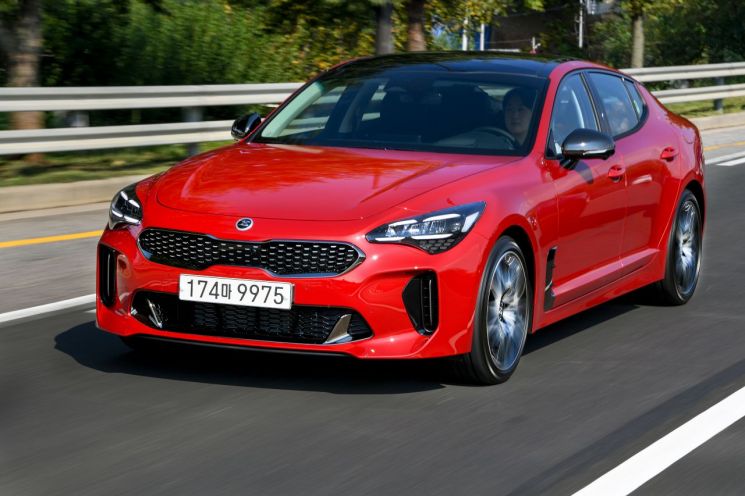
Kia is globally recognized as a brand that fulfills all three of these elements. The company has achieved remarkable success, winning the prestigious "Best of the Best" award four times at Germany’s Red Dot Award, one of the world’s top three design awards. The Stinger in 2018, EV6 in 2022, EV9 in 2024, and EV3 in 2025 all received this honor. This is a record unmatched not only by most global automakers but also by Hyundai. When the Stinger first won a design award, automotive media outlet Carscoops commented, "This award marks a special achievement for Kia," and "By presenting models that stand shoulder to shoulder with supercars like Ferrari and McLaren, Kia has become a brand that delivers the best design on the road."
Today, "Design Kia" faces new challenges. The task is not only to create designs that satisfy consumer preferences, aesthetic beauty, and functional practicality, but also to incorporate environmental sustainability. In major markets such as Europe, environmental regulations are tightening to reduce carbon emissions throughout the entire vehicle lifecycle?from production to use to disposal. As public concern for the environment grows, not only emissions reduction but also the eco-friendliness of interior materials has become a key purchasing factor. To address this, Kia is gradually reducing the use of natural leather in vehicle interiors and applying a variety of eco-friendly materials, such as bio-based leather containing corn or eucalyptus, and fabrics made from recycled PET bottles. Recently, Kia has even been planning a project to develop eco-friendly leather based on mycelium extracted from mushrooms and apply it to new vehicles.
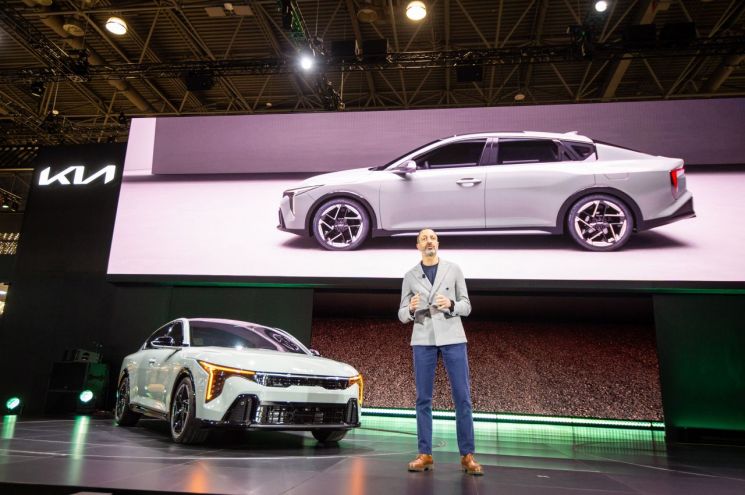 Karim Habib, Vice President of Global Design at Kia, is unveiling the K4 at the New York Auto Show. Photo by Kia
© The Asia Business Daily(www.asiae.co.kr). All rights reserved.



















