Introduction of Fifth-Generation District Heating and Cooling System in Seoul
Aiming for Seoul-Style Carbon Neutrality and Reduced Financial Burden for Residents
The introduction of a "fifth-generation district heating and cooling system" utilizing unused energy sources such as geothermal energy is set to be actively pursued in urban-type multi-family housing developments such as Moa Town in Seoul.
Moa Town is an urban regeneration model designed to quickly renovate low-rise residential areas, where large-scale redevelopment is difficult, by grouping them into blocks and focusing on resident-led projects. Since 2022, Seoul Mayor Oh Sehun has been promoting this initiative, and currently, 110 locations have been designated across Seoul.
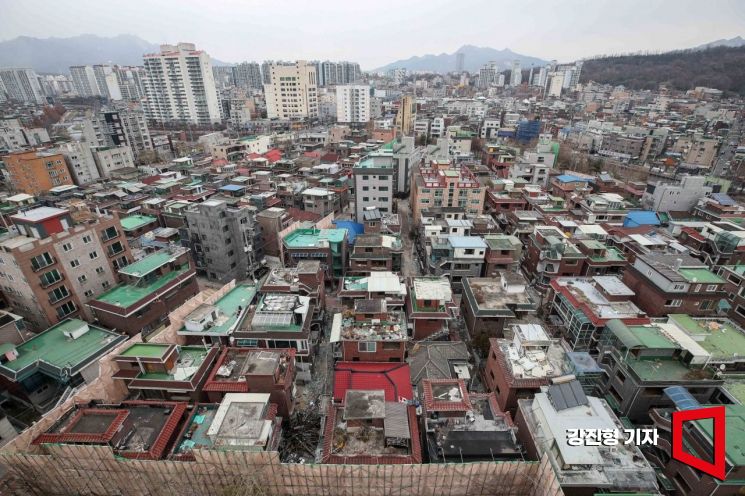 The planned site for Moa Town in Beondong Districts 1 to 5, Gangbuk-gu, scheduled for demolition. Photo by Kang Jinhyung
On June 9, Seoul Energy Corporation announced that, in response to carbon neutrality and the mandatory Zero Energy Building (ZEB) certification, it will promote the introduction of a "fifth-generation district heating and cooling system" in urban-type multi-family housing such as Moa Town, utilizing geothermal, water-source, and air-source energy.
Hwang Boyeon, President of Seoul Energy Corporation, stated, "The key is to expand Seoul's energy self-sufficiency base from solar power to include geothermal, water-source, air-source, and waste heat. By introducing these systems to urban-type multi-family housing such as Moa Town, we aim to minimize heat loss and greenhouse gas emissions, and take the lead in realizing carbon neutrality in Seoul."
The core of this system is to increase heating and cooling efficiency based on renewable heat sources, while simultaneously reducing building operating costs and alleviating energy expenses in ways that residents can directly feel.
From this month, the government has made ZEB (Zero Energy Building) certification mandatory for multi-family housing. To obtain the minimum (Grade 5) certification, an energy self-sufficiency rate of at least 20% is required, making the use of renewable and unused heat sources essential. As a result, increased construction costs, such as equipment installation, are leading to higher sales prices, thereby increasing the financial burden on residents.
As a solution, the corporation proposed the "fifth-generation district heating and cooling system." This system not only reduces heating and cooling costs, but also offers up to a 20% acquisition tax reduction when obtaining ZEB certification, which is expected to provide tangible financial relief for residents.
The fifth-generation district heating and cooling system is a high-efficiency method that directly utilizes various low-temperature heat sources such as geothermal and wastewater heat near the site, and integrates them into a single network to dramatically reduce heat loss and greenhouse gas emissions. Its operational efficiency is significantly higher than that of third-generation (fossil fuel-based) or fourth-generation (centralized renewable heat source) systems. In particular, geothermal energy can supply energy stably 24 hours a day, regardless of external weather conditions, making it suitable for urban-type multi-family housing, according to the corporation.
The corporation will launch a demonstration project to apply the potential of the fifth-generation system to an actual urban environment. This project, part of the Ministry of Trade, Industry and Energy's initiative to "develop and demonstrate efficiency improvement technology for distributed next-generation district heating and cooling systems," will establish the nation's first "fifth-generation district heating and cooling system" in the area around the Seoul Institute in Seocho-gu, utilizing a variety of heat sources and heat storage technologies, including geothermal, water-source, wastewater, and air-source energy.
 Seoul Mayor Oh Sehun is delivering a congratulatory speech at the "Beondong Moa Town Groundbreaking Invitation Day" held last December in the Moa Town area of Beondong, Gangbuk-gu, Seoul. Seoul Energy Corporation is promoting the introduction of a "5-unit district heating and cooling system" in urban-type multi-family housing such as Moa Town. Photo by Kang Jinhyung
The total project cost is 14.7 billion won (including 11 billion won in government support). The corporation, together with 14 industry-academic-research institutions?including the lead institution AptNeuroscience, Seoul Institute, Hanyang University, and the Korea Institute of Science and Technology (KIST)?will carry out technology development and demonstration. The demonstration sites include the Seoul Human Resources Development Center, Seoul Institute, and Seoul Data Center. In addition, the corporation plans to develop energy trading models and rate systems to maximize tangible benefits for residents.
Kang Sangwoo, a researcher at KIST, stated, "Europe has already banned the installation of individual boilers and is expanding fifth-generation district heating and cooling systems as part of its carbon neutrality policy. Applying this system to urban-type multi-family housing such as Moa Town will enable the use of renewable energy and high-efficiency heat pump technology, ensuring mid- to long-term economic viability."
*ZEB (Zero Energy Building): A building that minimizes energy consumption and produces its own energy through renewable sources, bringing its annual energy consumption close to zero.
© The Asia Business Daily(www.asiae.co.kr). All rights reserved.


















