In Harvard Belfer Center Index,
China Most Likely to Surpass US in Bio Sector
South Korea has entered the global top five in five major advanced technology sectors, driven by its technological competitiveness centered on semiconductors. In the bio sector, which is considered a future growth engine, South Korea was ranked 10th.
According to the Korea Biotechnology Association's Bioeconomy Research Center on June 9, the Belfer Center at Harvard Kennedy School released the "Core and Emerging Technology Index," in which South Korea ranked fifth overall, based on its strength in the semiconductor sector. The United States and China overwhelmingly occupied the first and second places in the five key technologies: artificial intelligence (AI), bio, semiconductors, space, and quantum.
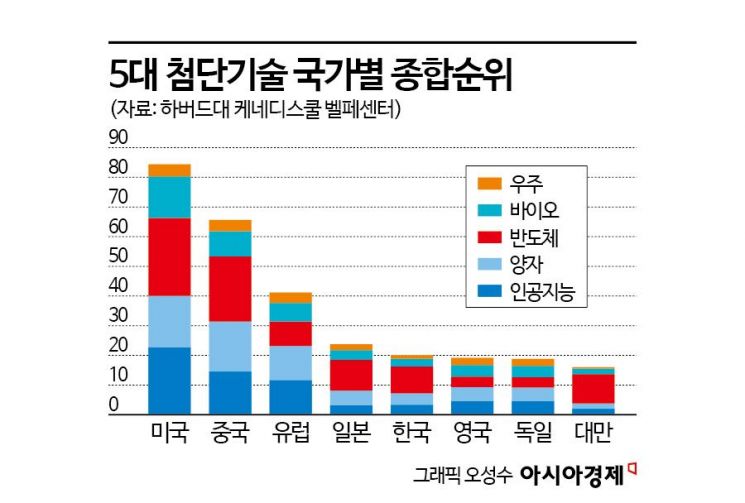
Looking at the rankings by technology, South Korea ranked fifth in semiconductors, ninth in artificial intelligence, tenth in bio, twelfth in quantum, and thirteenth in space. The United States received the highest scores in all five sectors, while China was assessed to be rapidly closing the gap with the United States in bio and quantum technologies.
This ranking is based on a quantitative technology assessment model built by analyzing thousands of public and commercial data points. The Belfer Center explained that the index is intended to help policymakers and strategists better understand the global competition for technological supremacy.
The report stated, "The United States has strong leadership across all technology sectors, but it is not an absolute hegemon. Strategic partnerships with Europe, Japan, and South Korea are important." In particular, the report projected that the United States could secure even greater competitiveness in bio, semiconductors, and quantum technologies through cooperation with these countries.
China was identified as the country most likely to surpass the United States first in the bio sector. Leveraging large-scale public investment and strengths in pharmaceutical production capacity, China has already achieved results close to those of the United States in areas such as pharmaceutical manufacturing and quantum communications. However, in semiconductors and advanced AI, China lags behind the United States due to its reliance on foreign equipment and the immaturity of its private capital markets.
South Korea designated AI, bio, semiconductors, quantum, and space as five of its twelve national strategic technologies in 2022. In 2023, the country enacted a special law for fostering national strategic technologies, and in 2024, it established a comprehensive inter-ministerial master plan. Accordingly, this year, a total research and development budget of 6.8 trillion won is scheduled to be allocated, with a particular focus on AI, semiconductors, bio, and quantum sectors.
The report highlighted that South Korea ranked fifth in advanced technology overall, despite being fourteenth in the world in terms of GDP. This achievement is attributed to a combination of world-class ICT infrastructure, fast internet speeds, government policies promoting digital transformation, and a population with a high level of technological literacy.
The report also recommended investment, STEM (science, technology, engineering, and mathematics) workforce development, regulatory easing, and expansion of international partnerships to foster South Korea's five major advanced technology sectors. The report noted, "South Korea has not yet converted large-scale public and private capital into a bio strength, but given the country's new interest in this field, it is a nation to watch," adding, "To foster South Korea's biotechnology sector, bio big data, regulatory harmonization and expanded R&D, and workforce development are needed."
© The Asia Business Daily(www.asiae.co.kr). All rights reserved.

















