Aiming to Solve Major Healthcare Challenges
Such as Developing a Treatment Platform for Pediatric Rare Diseases
The government will promote the development of a customized innovative treatment platform for pediatric rare disease patients and innovation in new drug technology development using quantum technology as new projects under the Korean Advanced Research Projects Agency for Health (ARPA-H) initiative.
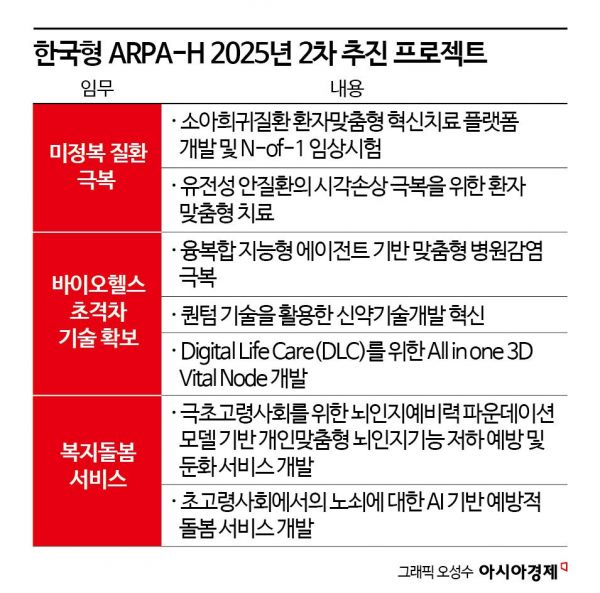
The Ministry of Health and Welfare and the K-Health Future Initiative Task Force of the Korea Health Industry Development Institute (Korean ARPA-H Task Force) announced on June 9 the launch of seven new projects for the second round of the 2025 Korean ARPA-H initiative and opened calls for research and development proposals.
The Korean ARPA-H initiative is a program designed to solve national health challenges, such as infectious disease pandemics and essential medical care crises, by supporting high-cost and high-difficulty research and development (R&D). A total of 1.1628 trillion won will be invested by 2032. Last year, the government planned a total of 10 research projects and selected 25 R&D tasks to launch the initiative. In May of this year, the first round of three new projects was announced.
The seven projects announced in this second round are designed to address three of the five key missions of the Korean ARPA-H initiative: overcoming intractable diseases, securing super-gap biohealth technologies, and solving challenges in welfare and care improvement.
First, under the mission to overcome intractable diseases, a project aims to develop a patient-customized innovative technology-based treatment platform to improve the survival rate and quality of life for pediatric rare disease patients. The ultimate goal is not only to design the treatment platform and conduct preclinical trials but also to carry out patient-customized N-of-1 clinical trials, which repeatedly alternate treatment and control interventions in a single patient to evaluate therapeutic effects.
In addition, to support the first-ever domestic clinical entry of gene therapy for hereditary eye diseases and to lay the foundation for commercialization, the government plans to select and support research teams that possess patient genetic information and diagnostic technology, and are capable of developing innovative technology-based treatment platforms and conducting clinical trials.
Projects will also be pursued to address challenges in the bio and medical fields by combining innovative technologies such as artificial intelligence (AI) and quantum computing. The project to discover innovative new drug candidates and enhance the potential for new drug development using quantum computing technology is an area currently attracting large-scale investment from multinational pharmaceutical companies.
The "All-in-One 3D Vital Node Development for Digital Life Care" project aims to develop devices capable of real-time measurement, collection, and analysis of biometric information. Without specifying target diseases, the call for proposals encourages research teams to freely suggest solutions, focusing on aging and chronic diseases.
Additionally, to improve the health and quality of life of the elderly population, a "multimodal foundation model specialized in brain cognitive function" will be established, and a personalized service for the prevention and mitigation of cognitive decline based on risk will also be developed.
The Ministry of Health and Welfare will accept research and development proposals for these projects until July 9, and plans to select R&D institutions to carry out the projects within July.
Jung Eunyoung, Director General of Health Industry Policy at the Ministry of Health and Welfare, stated, "If successful, the new projects for 2025 will enable us to overcome hereditary diseases, solve hospital-acquired infection problems, and develop technologies to slow frailty in a super-aged society, thereby addressing issues in health and welfare that are closely related to the public through science and technology." She added, "We will continue to support the development of technologies that the public can experience firsthand in the field by conducting demand surveys and other efforts."
© The Asia Business Daily(www.asiae.co.kr). All rights reserved.
!["The Woman Who Threw Herself into the Water Clutching a Stolen Dior Bag"...A Grotesque Success Story That Shakes the Korean Psyche [Slate]](https://cwcontent.asiae.co.kr/asiaresize/183/2026021902243444107_1771435474.jpg)
















