The 'Landscaping Stone Controversy' Deepens
Residents Form Vigilante Group to Monitor Secret Installations
Administrative Guidance Issued, but Conflict Remains Unresolved
Amid the ongoing 'landscaping stone controversy' at a newly built apartment complex in Imun-dong, Dongdaemun-gu, Seoul, it has been reported that residents have even formed a 'vigilante group' to monitor whether landscaping stones are being installed secretly.
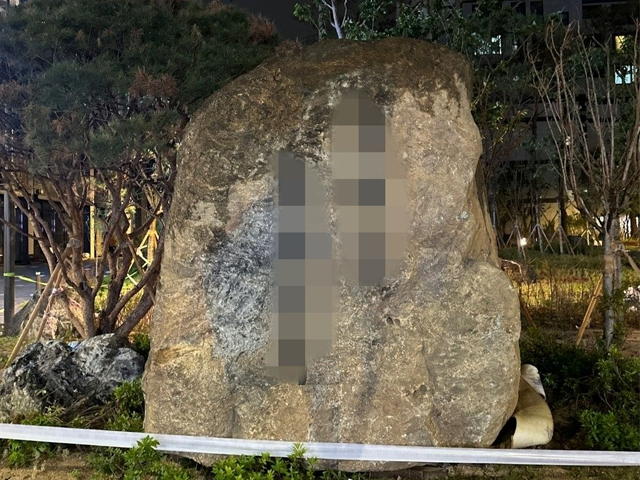 Landscaping stones installed in a newly built apartment in Imun-dong, Dongdaemun-gu, Seoul. Naver Cafe 'Real Estate Study'
On June 7, Yonhap News reported that on June 4, the head of the apartment association sent a text message to members emphasizing the necessity of installing landscaping stones. He stated, "The landscaping at the rear of the complex is weak and reinforcement work is needed," and added, "We want to leverage the advantage of being adjacent to a forest to become a representative complex in Gangbuk in the future. While opinions on landscaping stones may vary by age group, we plan to arrange them harmoniously with pine trees, rocks, and azaleas," expressing his commitment to the project.
As the redevelopment association maintained its stance on installing landscaping stones, it was reported that residents formed a 'vigilante group.' Around 30 residents opposed to the association's policy recently created a separate 'resident council' to respond. Some members organized an 'emergency contact team' to patrol both inside and outside the complex. Their role is to monitor whether the association installs landscaping stones without permission again and to report any violations to relevant authorities such as the district office. As the controversy grew, the Dongdaemun-gu district office issued administrative guidance to the association, advising them to refrain from installing landscaping stones without residents' consent. However, since this guidance is not legally binding, it is unlikely to resolve the conflict. Some have pointed out that this case is a clear example of the conflicts that frequently arise over association management at reconstruction and redevelopment complexes nationwide.
Previously, at the end of last month, the so-called 'landscaping stone controversy' erupted after three large landscaping stones engraved with the apartment's name were installed without residents' knowledge. After some residents commented that "it looks like an apartment from the 1980s," further installation was temporarily halted. However, at the association's delegates' meeting on May 28, a proposal to install 30 landscaping stones in the complex at a cost of 2 billion won was passed. The proposal is scheduled to be discussed again at the association's extraordinary general meeting on June 27, this time including tree planting and maintenance, with the total project cost rising to 3.4 billion won.
Conflicts between reconstruction and redevelopment associations and their members continue to occur nationwide. According to the Supreme Prosecutors' Office, in 2023, there were as many as 905 cases in which association executives were investigated and either prosecuted or not prosecuted for violations of the 'Act on the Maintenance and Improvement of Urban Areas and Dwelling Conditions for Residents.' Recently, a similar concern was raised in an online community for future residents of a reconstruction apartment in Jamsil, with some saying, "The same thing could happen to us."
Experts have suggested that the structure, which concentrates excessive authority in association executives, needs to be improved.
© The Asia Business Daily(www.asiae.co.kr). All rights reserved.

















