Tim Hortons Closes Store After Just One Year
Blue Bottle Records Its First Net Loss
Coffee brands that have achieved success in the global market are struggling one after another in Korea. Brands that have boasted strong fan bases in North America and Japan are now either downsizing their operations or even withdrawing from the Korean market, drawing attention to this trend.
 An outdoor advertisement announcing the opening schedule of Tim Hortons Sinnonhyeon Station branch located near Sinnonhyeon Station in Gangnam-gu, Seoul. Tim Hortons
According to industry sources on June 6, BKR, the operator of the Canadian coffee brand Tim Hortons (TH Tim Hortons), recently closed its Cheongna branch in Incheon. This store, which opened in April last year, decided to shut down after just one year, fueling speculation about a possible market exit.
The company stated, "We are looking for a more suitable location within the Incheon region so that we can deliver Tim Hortons' unique Canadian originality and distinctive sentiment to more consumers," adding, "We appreciate the support for the Incheon Cheongna branch so far and will strive to return with a new look as soon as possible."
The situation is no different for Blue Bottle, the American brand dubbed the 'Apple of the coffee world,' which attracted significant attention when it entered the Korean market. When its first store opened in Seongsu-dong, Seoul in 2019, Blue Bottle made headlines with lines stretching for hundreds of meters. The brand quickly expanded into major commercial districts, strengthening its presence. However, it is now gradually revealing its limitations due to the burden of fixed costs and stagnant demand.
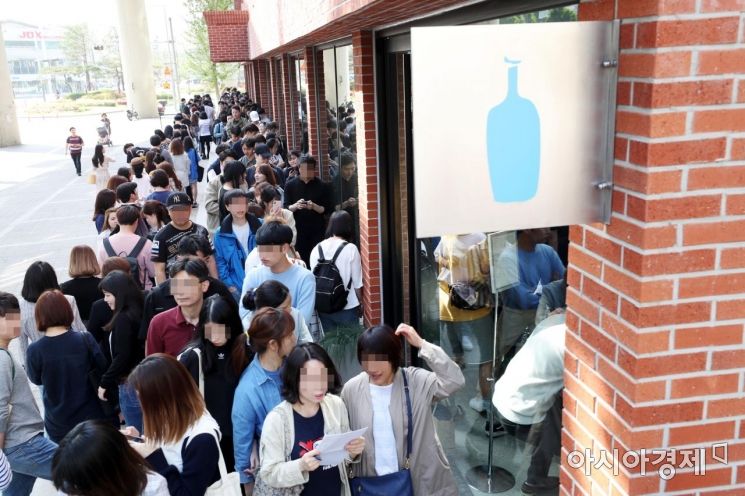 The Blue Bottle store bustling with customers when it first landed in Korea in 2019. Photo by Asia Economy DB
In fact, Blue Bottle Coffee Korea's sales in 2023 reached 31.1 billion won, a 17% increase compared to the previous year, but operating profit plummeted by 89% to just 200 million won. Net loss for the period was 1.1 billion won, marking the first net loss since entering the Korean market. Although sales increased, operating expenses outpaced revenue. According to a KBS report, considering that operating profit was 1.9 billion won in 2023, this represents a sharp decline. There are also concerns about a de facto capital erosion crisis, as it has been revealed that the company's cash and cash equivalents amounted to only 1.9 million won at the end of 2024.
An industry insider analyzed, "The Korean coffee market is extremely fast-changing in terms of trends, and with consumption spreading mainly through social media, the moment a brand is perceived as stagnant or outdated, it is quickly ignored by consumers." The insider added, "Foreign brands that adhere to global headquarters-driven management strategies have failed to respond flexibly to local needs, resulting in these outcomes."
The struggles of global coffee brands in the Korean market are not a recent phenomenon. Previously, the Japanese brand Doutor quietly withdrew, and the American brand Coffee Bean has also been reducing the number of stores in recent years and undergoing restructuring to survive.
A franchise industry expert pointed out, "Korean consumers consider not only the taste of coffee but also multi-layered factors such as store interior, brand story, and the value of sharing on social media when making their choices." The expert emphasized, "For global brands to succeed in Korea, they cannot simply rely on overseas sentiment or brand power. They need strategies optimized for the Korean market and agile local responses."
© The Asia Business Daily(www.asiae.co.kr). All rights reserved.


















