Most Cases Occur from April to November
Prevention Is Key... Wearing Long Clothing Is Essential
As the season ideal for outdoor activities arrives and more people go camping and on outings, cases of severe fever with thrombocytopenia syndrome (SFTS) transmitted by ticks are spreading nationwide, prompting calls for heightened caution.
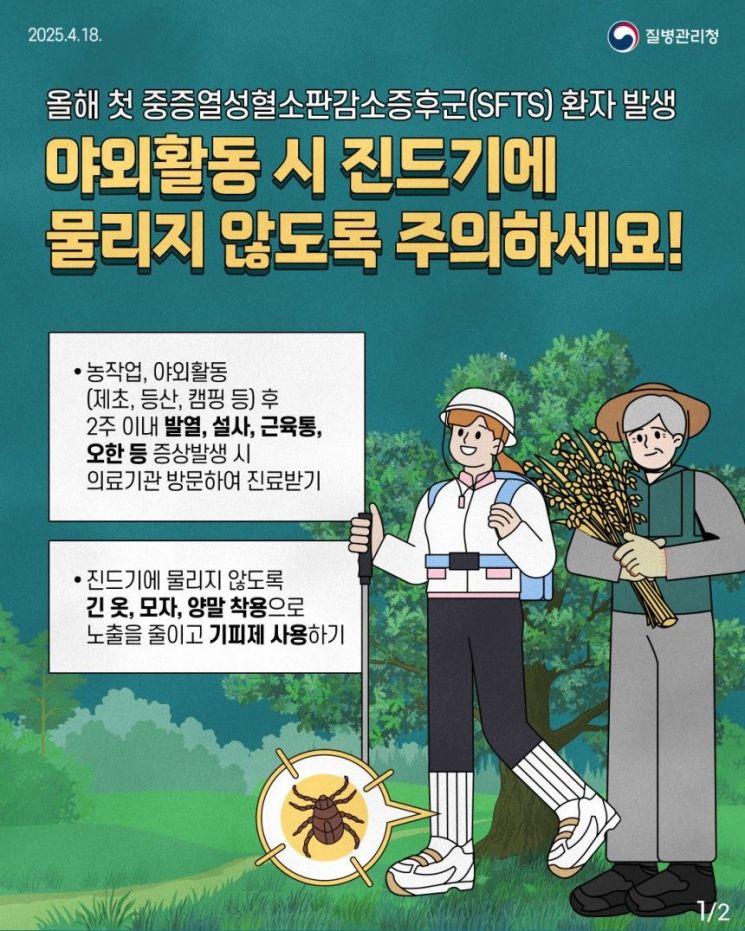 Cases of severe fever with thrombocytopenia syndrome (SFTS) infection transmitted by ticks are spreading nationwide. Korea Disease Control and Prevention Agency
According to the Korea Disease Control and Prevention Agency on June 6, the first domestic case of SFTS this year was reported in April, and since then, additional cases have continued to emerge across the country. As of June 4, the cumulative number of cases nationwide stands at 35. By region, there have been 5 cases each in Gyeonggi and Gyeongnam, 4 each in Gyeongbuk and Jeju, 3 in Ulsan, 2 each in Seoul, Gangwon, Chungnam, and Jeonbuk, and 1 each in Daejeon, Gwangju, Busan, Daegu, Chungbuk, and Jeonnam.
SFTS is an infectious disease contracted through bites from ticks carrying the SFTS virus. In Korea, the Haemaphysalis longicornis tick is the most prevalent and is known to be the primary vector of SFTS. Since the first reported domestic case in 2013, there have been a total of 2,065 cases up to last year, with 381 deaths, resulting in a fatality rate of 18.5%. Due to its high fatality rate, the tick that transmits SFTS is sometimes referred to as the "killer tick."
Because ticks are most active from spring through fall, SFTS cases also occur most frequently between April and November. Typically, 5 to 14 days after being bitten, symptoms such as high fever, nausea, vomiting, and diarrhea appear; in severe cases, the disease can progress to respiratory distress, decreased consciousness, and multiple organ failure. Currently, there is no vaccine or treatment for SFTS, making early detection and prevention the most important measures.
To prevent infection, it is recommended to wear long sleeves and long pants during outdoor activities and to avoid sitting or lying down on grass for extended periods. Using tick repellents is also advisable. After returning home, carefully check for attached ticks on the scalp, around the ears, under the arms, around the waist, and behind the knees. If a tick is suspected, seek medical attention immediately.
 Seoul citizens are enjoying an outing. This is a stock photo unrelated to the article content. Photo by Kim Hyunmin
Lim Soyoon, a professor of infectious diseases at Asan Medical Center in Seoul, emphasized, "SFTS has a mortality rate of about 20%, and it is even more dangerous because there is still no vaccine or treatment. After going outside, you should shower and check for ticks, and if you find one, do not forcibly remove it yourself but visit a hospital."
© The Asia Business Daily(www.asiae.co.kr). All rights reserved.
![Clutching a Stolen Dior Bag, Saying "I Hate Being Poor but Real"... The Grotesque Con of a "Human Knockoff" [Slate]](https://cwcontent.asiae.co.kr/asiaresize/183/2026021902243444107_1771435474.jpg)

















