Published in "Science"
Professors Kim Geunsu of Yonsei University and Yang Beomjeong of Seoul National University
Foundational Technology to Enhance the Precision of Quantum Computers and Sensors
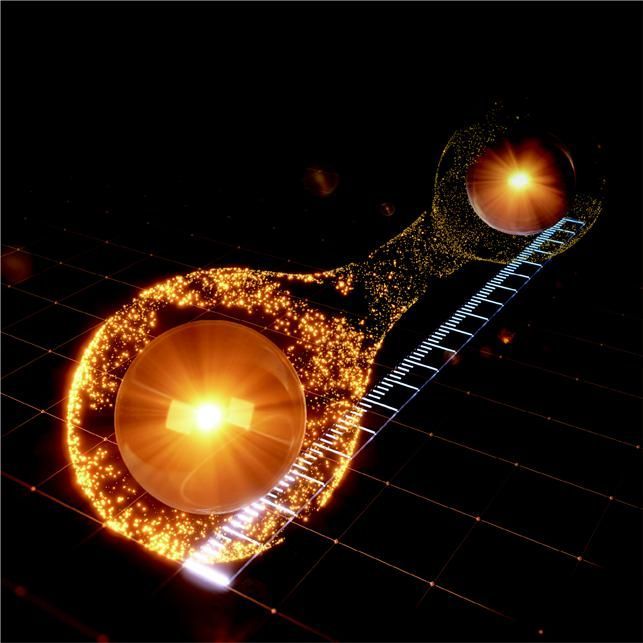 Schematic of quantum distance measurement. The two yellow spheres represent electrons, and the white scale below symbolizes a ruler indicating distance measurement. Although the quantum distance, which signifies the similarity between electrons, is a concept slightly different from the actual distance, this illustration intuitively depicts "quantum distance measurement." Image provided by Professor Kim Geunsu of Yonsei University.
A team of Korean researchers has succeeded in directly measuring the "quantum distance" of electrons within a solid material. This is a distance that can be quantified and measured at a scale one millionth the thickness of a human hair, smaller than an atom. This achievement is regarded as a foundational technology that could significantly enhance the precision of next-generation quantum technologies, such as quantum computing and quantum sensing.
On June 6, the Ministry of Science and ICT announced that a research team led by Professor Kim Geunsu of Yonsei University and a team led by Professor Yang Beomjeong of Seoul National University have jointly succeeded in completely measuring the quantum distance of electrons in a solid. The results of their research were published in the June 5th (local time) edition of the world-renowned journal "Science."
Quantum distance is a physical quantity that represents the "similarity" between particles. If two particles are completely identical, the value is 0; if they are completely different, it approaches 1. It serves as a precise means to track state changes among ultra-microscopic particles such as electrons and atoms, and is essential information for analyzing the accuracy of quantum operations and the properties of materials.
Until now, this value has only been theoretically estimated or measured approximately. However, in this study, the researchers targeted a special material called black phosphorus and succeeded in directly measuring the phase difference to extract the quantum distance as a numerical value. In particular, the academic community is paying attention to the fact that this result is the culmination of more than a decade of close collaboration between experiment and theory.
Professor Yang’s team theoretically demonstrated that the quantum distance between electrons in black phosphorus is determined by the phase difference, while Professor Kim’s team directly measured this phase difference using an "angle-resolved photoemission spectroscopy (ARPES)" experiment with a synchrotron accelerator. Through this, they overcame the limitations of previous indirect measurements and succeeded in fully quantifying the "quantum distance."
Professor Kim Geunsu stated, "Just as precise surveying is essential in construction, accurate quantum distance measurement must come first for quantum technologies to operate without error," adding, "This research outcome can serve as a fundamental tool across a wide range of quantum technologies, including quantum computing and quantum sensing."
This research was supported by the Leader Research and Leading Research Center programs of the Ministry of Science and ICT. The main authors are Professor Kim Geunsu (Yonsei University), Professor Yang Beomjeong (Seoul National University), and researchers Kim Seonje, Jeong Yuna, and Yu-Ting Qian.
Professor Yang commented, "This achievement could serve as a cornerstone for research in quantum geometry," and added, "We aim to expand our research to materials with diverse symmetry structures and electronic properties, with the goal of leading the world in quantum geometry research."
© The Asia Business Daily(www.asiae.co.kr). All rights reserved.

















