Trump's Repeated Tariff Policy Reversals Deepen
Surge in Content Mocking "TACO"
Greater Caution Needed in Timing Negotiations with the US
Recently, a new buzzword called "TACO" has been making waves on Wall Street in the United States. This term does not refer to the Mexican food, but is being used to criticize President Donald Trump's erratic tariff policies. President Trump strongly rebuked a reporter who used this term during a press conference, calling it "rude." Meanwhile, social networking services (SNS) are being flooded with videos mocking President Trump.
The Wall Street neologism "TACO" is an acronym derived from the phrase "Trump Always Chickens Out." In Korean, it translates to "coward Trump always backs down." The reason this term became popular on Wall Street is President Trump's inconsistent tariff policies.
President Trump has faced criticism for lacking consistency in his tariff policy, such as raising tariffs on China up to 145% and then suddenly lowering them to 30% after announcing a deal. In fact, it has been tallied that President Trump has announced, withdrawn, and reversed massive import tariffs more than 50 times so far.
Initially, Wall Street investors experienced sharp stock price drops every time new import tariffs were announced. The fear was especially high among large export companies, due to concerns that exports could shrink in the future. However, as the pattern of reversals repeated after a few days, the market has become less reactive to tariff policy announcements. As the perception spreads that President Trump will eventually reverse any announced tariff policy, investors now believe they do not need to panic and that stock prices will recover if they simply wait a little.
President Trump insists that his tariff policy is not something to be mocked as "TACO." He actively explains that the US economy is improving thanks to his efforts. He emphasizes that these are negotiations for the sake of the country, not actions taken out of fear, and that his policies are attracting significant investment to the US. However, the market is not accepting his explanations at all.
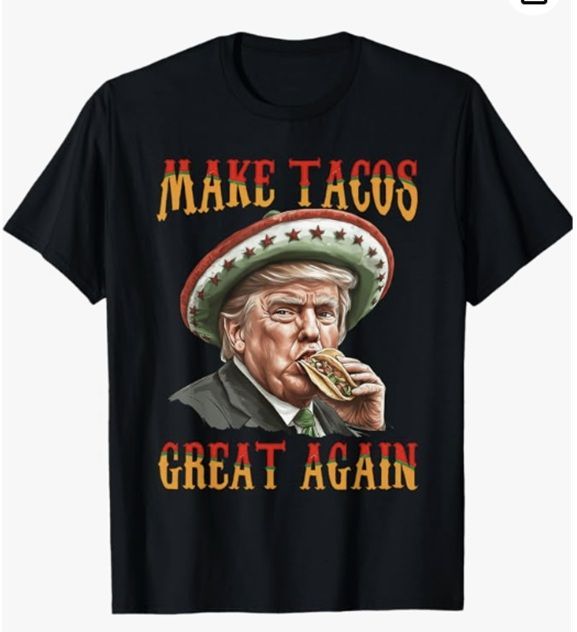 A so-called TACO T-shirt satirizing President Donald Trump's tariff policy, sold on a US online shopping mall. Amazon homepage
Meanwhile, the term has already become a widespread subject of ridicule on US social media. Countless pieces of content are being posted daily, including photos of President Trump dressed as a chicken, photos of him eating tacos, and photoshopped images of President Trump's face on taco dishes. There are even T-shirts being sold in large numbers with the word "TACO" printed over President Trump's picture. Products that parody his campaign slogan "Make America Great Again" by changing it to "Make TACO Great Again" are also being sold in large quantities on online shopping malls such as Amazon.
This phenomenon is being analyzed as the result of significant pent-up frustration among Americans over the Trump administration's unilateral tariff policies. As the tariff wars have driven up prices and caused hardship for ordinary people, this backlash appears to be a reaction to those difficulties.
Meanwhile, the US Court of International Trade has moved to restrain the Trump administration's reciprocal tariff policies, calling them excessive. On May 28, the Court of International Trade ruled that the exclusive authority to impose tariffs belongs to Congress, not the administration, and ordered the withdrawal of President Trump's reciprocal tariff orders implemented under the International Emergency Economic Powers Act, citing procedural issues because they require congressional approval.
The Trump administration immediately appealed, and the Federal Court of Appeals decided to suspend the effect of the Court of International Trade's ruling. While the reciprocal tariff policy will remain in place until the outcome of the second trial, the final decision is expected to be made by the US Supreme Court. Currently, six of the nine Supreme Court justices are conservative, most of whom were appointed by President Trump. Therefore, there is speculation that the outcome may favor President Trump. However, given the widespread impact of the policy itself, the final ruling remains unpredictable.
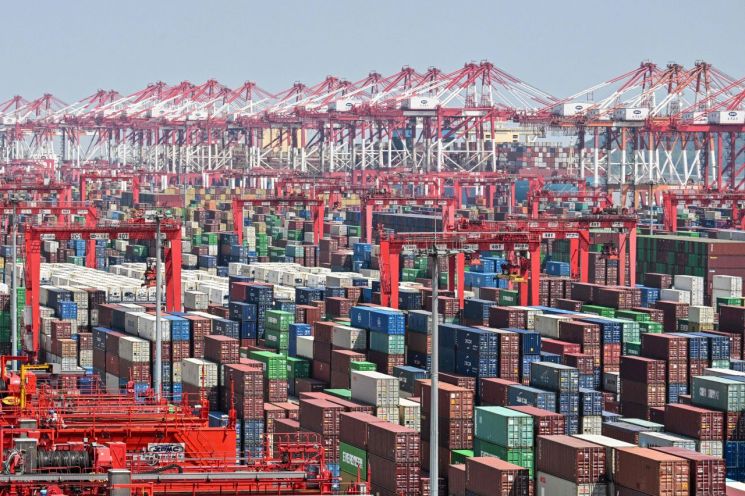
President Trump is pressuring the courts on his own SNS, Truth Social, arguing that if the court rules against the tariffs, other countries will gain an advantage, which would mean economic ruin for the United States. There are predictions that even if the reciprocal tariff policy is struck down in court, the Trump administration will not give up. Kevin Hassett, Chairman of the White House Council of Economic Advisers, also stated in a recent media interview that even if the courts block the reciprocal tariff measures, alternative options can be found.
Experts are concerned that if domestic political pressure over President Trump's tariff policy intensifies, he may respond by escalating external confrontations to turn the domestic political situation to his advantage. In fact, there are warnings that the tariff dispute between the US and China could reignite, and there was a recent announcement to raise import steel tariffs from 25% to 50%.
The most important factor in trade policy is stability, and analysts warn that continued uncertainty could destabilize the US economy itself. If the government continues to reverse its policies like the boy who cried wolf, the market will lose trust in those policies. As a result, there are concerns that the Trump administration's efforts to expand US investment and promote reshoring through reciprocal tariff policies could be undermined.
From the perspective of other countries, if the US government continues to reverse its policies and increase uncertainty, countries such as China, Europe, and others may band together and take a passive, time-buying approach in negotiations with the US. For countries like South Korea that are preparing for negotiations, experts point out that it is now more important than ever to carefully review the timing and strategy for negotiations with the US.
© The Asia Business Daily(www.asiae.co.kr). All rights reserved.


















