Court: "History of Flight and Risk of Escape"
Bail Decision Still Pending
Former Daejoo Group Chairman Jaeho Hur (83), who was forcibly repatriated after staying overseas for 10 years, had his request for release from detention dismissed by the court.
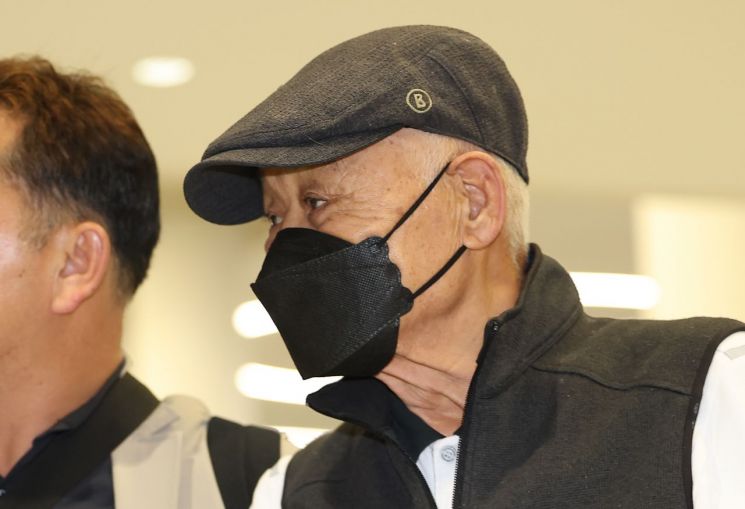 Former Daejoo Group Chairman Jaeho Hur, who was staying in New Zealand, was repatriated to South Korea through Terminal 2 of Incheon International Airport on the 27th of last month. Photo by Yonhap News
On June 5, the 11th Criminal Division of the Gwangju District Court (presiding judge: Kim Songhyun) announced that it had dismissed Hur's request for release from detention. The court stated, "The defendant has a history of fleeing, and there is credible concern that he may attempt to flee again," thereby recognizing the necessity of his detention.
In July 2019, Hur was indicted without detention on charges of tax evasion under the Act on the Aggravated Punishment of Specific Crimes, for failing to pay more than 500 million won in capital gains tax during the sale of stocks under borrowed names between May and November 2007. However, he never appeared in court and left for New Zealand in August 2015, living as a fugitive for nearly 10 years.
The prosecution believes that Hur left the country in July 2014 while under investigation following a complaint by the Seoul Regional Tax Office, and then fled to New Zealand immediately after a suspension of investigation for lack of witnesses was issued. Hur was repatriated to South Korea through Incheon International Airport at around 8 p.m. on the 27th of last month and was incarcerated at Gwangju Prison early the next morning.
On the day of his repatriation, Hur's legal team filed a request for release from detention, and on the day of his incarceration, also filed for bail. During the hearings for both the release from detention and bail, Hur's side appealed for leniency, stating, "It was in effect a voluntary return, and we will faithfully participate in the trial." The decision on bail has not yet been made.
Hur previously faced public criticism after being sentenced to a fine of 25.4 billion won for tax evasion amounting to approximately 50 billion won, and failing to pay, received a so-called "emperor labor" sentence, where each day of labor was calculated as paying off 500 million won of the fine.
© The Asia Business Daily(www.asiae.co.kr). All rights reserved.

















